
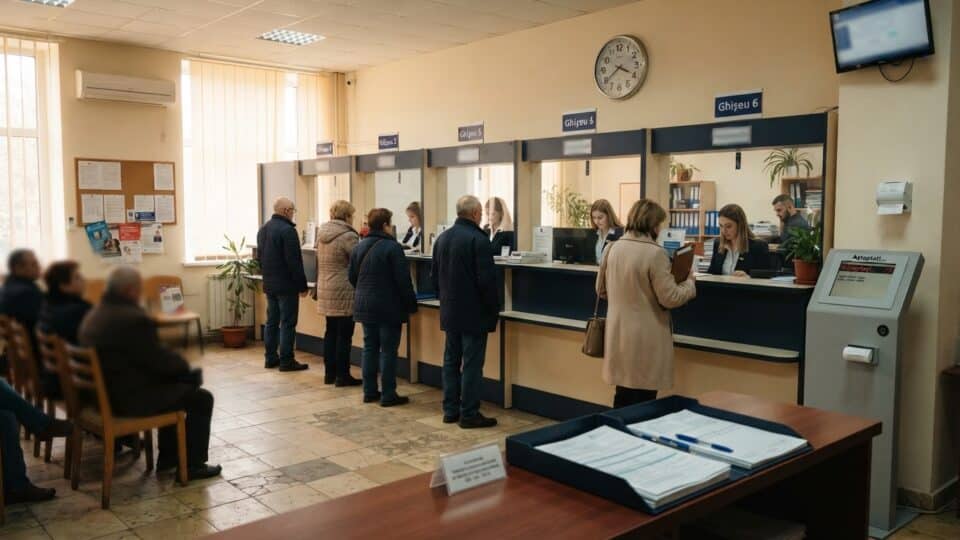
Time lost at public counters is not just the minutes spent in a queue. A single application can add hours of preparation, travel, repeated documents and costs that do not appear on the receipt. We have set out a transparent calculation method, three hypothetical scenarios and a guide to the digital services available in Romania in 2026. We also explain what Law No. 9/2023, Ghișeul.ro, ROeID and ROePAS have changed—without suggesting that every institution can complete every procedure entirely online.
Why a visit to a public counter costs more than the fee on the receipt
People see a fee of 20 or 50 lei on a receipt, but often overlook the expenses that made the payment possible: travel, waiting, time off work, printing documents and returning to provide additional information. If an application is free, that indirect cost does not disappear. Rather than counting only the people in a queue, it is worth measuring the entire journey of an application, from the first form to the final outcome.
There is no single price for “an hour lost”, and not everyone loses income by waiting. For an employee, the time may mean absence from work or making up hours; for a parent, rearranging childcare; for a pensioner, the effort of travelling. The distinction between money actually spent and the value of time should remain visible, rather than being turned into an artificial statistic.
Time lost at public counters: five stages that go uncounted
An administrative service often begins with finding out how the procedure works: the required documents, form, opening hours, appointment, fee and proof of payment. This is followed by preparing the file, travelling, waiting and speaking with staff at the counter. Sometimes the application remains under review, and the applicant must follow its status and return to collect the result. If a document is missing, the process starts again.
For a meaningful measurement, time each stage separately. Do not confuse an administrative processing period of several days with the hours during which the applicant is actively occupied; both matter, but in different ways. A portal that allows an application to be submitted online but requires the applicant to collect the response in person solves only part of the problem.
What official 2026 data say about Romania
The European Commission’s 2026 country report gives Romania a score of 63 out of 100 for the availability of digital public services for citizens in the reference year 2025, compared with 82 out of 100 across the EU. The indicator measures the availability of online public services, not how many minutes each citizen spends in a queue.
The report also says that 71% of respondents believe the administration repeatedly asks them for the same personal data. The share of e-government users reported for 2025 was 25% in Romania, against an EU average of 76%, according to the indicators cited by the Commission. The figures point to a problem of digital access and interaction, but do not allow an automatic calculation of the total amount of money Romanians lose at public counters.
How to measure the real cost of an application without inventing a salary figure
Use two separate calculations. Direct cost covers transport, parking, paid copies or materials, and any additional documented expenses. Time spent is the total number of minutes used for preparation, travel, waiting, interaction and checking the status. For an economic analysis, you may voluntarily assign a value to an hour, but must make clear that this is an assumption, not a recorded loss of earnings.
The simplified formula is: illustrative economic cost = direct expenses + (active minutes ÷ 60 × hypothetical hourly value). The statutory fee for the public service can be shown separately, as it exists in both the online and in-person versions; otherwise, the price of the service would be confused with the cost of bureaucracy. Do not apply this formula to the entire population without a representative study.
Three concrete scenarios: 76 lei, 143 lei or 182 lei
We have constructed three entirely hypothetical examples. In the first, a person in a city spends 125 minutes, pays 24 lei for transport and copies, and uses a demonstrative value of 25 lei per hour. The calculated economic cost is 76.08 lei. In the second, a longer journey and waiting time total 210 minutes, with 55 lei in direct expenses and the same hourly value: 142.50 lei.
In the third scenario, two trips and additional preparation take 240 minutes; if direct expenses are 42 lei and the hypothetical value of time is 35 lei per hour, the total becomes 182 lei. These figures are not average fees, average salaries, official costs or experiences measured in the field. They show how an individual case can be calculated transparently, without assigning every citizen the same circumstances.
| Demonstrative scenario | Total time | Direct expenses | Value of time (assumption) | Illustrative economic cost |
|---|---|---|---|---|
| One urban trip | 125 minutes | 24 lei | 25 lei/hour | 76.08 lei |
| Longer journey | 210 minutes | 55 lei | 25 lei/hour | 142.50 lei |
| Two visits | 240 minutes | 42 lei | 35 lei/hour | 182 lei |
Why actual payments must be separated from the value of time
If you paid 18 lei for transport, that money actually left your budget. If you spent 90 minutes at a public counter, it does not necessarily mean you lost the equivalent of an hour and a half of salary: you may have made up the time, travelled in your free time or been paid during approved leave. Even so, the time could have been used for other activities.
In a public analysis, always show demonstrable expenses, duration and estimated economic valuation in separate columns. For a family, it is also worth recording the cost of a second adult who accompanied the person, or paid childcare, where that cost was actually incurred. Do not double-count the same cost by putting both transport and time spent in traffic into two identical economic categories.
The file folder: what the law prohibits and what should not be confused
Law No. 9/2023, which amended Government Emergency Ordinance No. 41/2016, extended simplification obligations in public administration. Under the conditions and for the entities covered by the law, institutions may not require citizens to bring folders, file folders with metal fasteners (dosare cu șină) or other stationery supplies in order to receive a public service. There are also rules on accepting a copy of an identity card in electronic format and removing certain requirements for notarised copies.
The Harghita County Prefect’s Institution summarises the obligations and prohibitions that took effect on 4 July 2023. But the ban on the file folder does not mean that every application must be approved without supporting documents, or that all special procedures have disappeared. Ask for the precise legal basis of an unclear requirement rather than automatically assuming the entire procedure is unlawful.
Why the state should not send you to obtain a document issued by the state
Another important rule in the amended version of Government Emergency Ordinance No. 41/2016 concerns requests for copies of approvals or documents issued by other authorities and institutions within the scope of the measure. Under the conditions set by law, the institution handling the application must obtain the necessary documents or extracts directly, electronically, on the beneficiary’s express consent where the rule requires it.
The principle is straightforward: a document already held in an authority’s records should not have to be carried by a citizen between two buildings. In practice, applicability depends on the document, the institution, the legal basis and the specific procedure. Do not email sensitive personal information to an unverified address merely because someone says “that is how it is done”.
What you can do before leaving home
Check the exact name of the service on the institution’s website and whether an official fully online procedure exists. Look for an up-to-date form, the list of documents, the fee, the possibility of an appointment, the official email address and how the result can be obtained. If the information conflicts, ask for written clarification, stating the name of the procedure and the category into which you fall.
Do not upload photographs of your identity card, personal numerical code (CNP) or medical documents to forms found in advertisements or messages from unknown senders. Go directly to the institution’s official domain and check the connection’s security and the data-processing policy. If you cannot find a digital option, ask whether the relevant procedure accepts applications by email or post.
Ghișeul.ro: online payment does not always complete the entire application
Ghișeul.ro allows the online payment of certain taxes, charges and fines, in relation to the institutions and liabilities available in the system. The Authority for the Digitalisation of Romania describes the platform as a tool for consulting and paying liabilities online, partly or in full depending on the context.
This is a real saving of time if the purpose of the trip was only to pay a sum. But paying a fee does not always amount to filing an application, having documents checked and receiving an official document. Before considering a procedure complete, check whether registration, approval or collection of a document is still required.
ROeID, ROePAS and SPV: different services, not one universal portal
ROeID provides digital identification for access to certain compatible services; it does not automatically turn every public counter into an electronic service. ROePAS was launched by the Authority for the Digitalisation of Romania (ADR) in beta on 12 March 2026 to centralise and integrate procedures, including those migrated from the former PCUe portal. Institutions are continuing to validate and gradually publish services, so availability must be checked for each application.
Spațiul Privat Virtual (SPV) is the National Agency for Fiscal Administration’s service for various tax communications and documents, not a portal for all local administrations. Sources: the ADR announcement launching ROePAS and the ADR catalogue. Search for the service by institution and procedure, not only by the platform’s name.
Why a downloadable PDF does not mean full digitalisation
A PDF form placed online may eliminate one trip to collect a paper copy, but if it must be printed, signed, scanned, sent and then submitted in the original, citizens are still completing manual stages. An end-to-end solution enables suitable identification, completion of required details, submission and registration of the application, attachment of documents, status tracking, and remote receipt of the result where the law permits.
The quality of digitalisation is not measured only by the number of web pages or available forms. What matters to users is how many trips disappear and whether officials reuse existing data under lawful conditions. A service can be digital at the entry point and entirely manual inside, which users notice when they cannot view its status or receive repeated requests.
Online appointments help, but do not solve a complicated procedure
Appointments in set time slots can reduce crowding and make the day more predictable. Yet if a person must come three times for documents the institution already holds, the appointment simply moves the problem into a calendar rather than eliminating it. Displaying a time is not enough if the procedure, documents and communications have not been simplified.
One useful measure would be to publish the median waiting time by service, the proportion of applications resolved at the first attempt and the frequency of return visits. These indicators must be calculated from real data, not added retrospectively to look good in a report.
Rural residents may pay more for the same piece of paper
For anyone living far from an administrative centre, travel may be the dominant part of the cost. Infrequent public transport, changing between modes of transport or needing an accompanying person can turn a ten-minute interaction at a counter into a partly lost day. Internet access does not solve the problem if a procedure unnecessarily requires physical attendance.
At the same time, digitalisation that assumes an up-to-date smartphone, a paid electronic signature or high digital literacy risks excluding precisely the people it should help. Institutions need assisted channels and accessible procedures, not a system that replaces the queue at the door with an unexplained error message on a screen.
For people with disabilities, access matters as much as speed
A building may have a ramp, but the absence of an accessible route, a counter at the right height or alternative means of communication can make the service effectively inaccessible. An online portal must work with assistive technologies and provide understandable error messages. Otherwise, the mere existence of an app does not mean equal access.
Administrations should test services with real users who have different needs: older people, people with visual impairments, users with weak internet connections and people who need plain language. A successful digital project is less about spectacular design than about being able to complete an application without informal help.
How to check that an application has actually been registered
Record the date of submission and keep the registration number or electronic confirmation, if the institution provides one. A sent email does not always prove that an application was accepted through the channel specified for that procedure. If the portal displays a case number and status, save the confirmation somewhere secure.
If a response is delayed, first ask what statutory deadline applies to the specific procedure. Not all administrative applications are petitions subject to the same deadline, while permits, benefits and tax procedures may be governed by different rules. State your request clearly and avoid repeatedly sending the same personal documents to unknown addresses.
A message template to avoid an unnecessary trip
You can send a short question from your email address to the contact published on the institution’s official website: “Hello. I would like to apply for [name of service] and ask you to let me know whether the procedure can be initiated and completed online, which documents are mandatory, the legal basis for physical attendance, whether an appointment is available and how the result will be delivered. Thank you.”
This is not a universal formal application and does not replace the institution’s mandatory form, but it may prevent trips made on the basis of outdated instructions. If you receive conflicting verbal information, politely ask for the procedure and legal basis to be specified through an official communication channel. Do not include sensitive personal data unless it is necessary to identify the request and the channel is appropriate.
What to do when you are again asked for a document issued by another institution
Start by asking whether the document is genuinely mandatory for the requested service and whether the institution can obtain it directly. Politely refer to the simplification rules in Government Emergency Ordinance No. 41/2016, as amended by Law No. 9/2023, and request a written response on the basis for the requirement. The procedure must be assessed in context, because some documents and circumstances are subject to special rules.
If the interaction reaches an impasse, you can use the petition or complaint mechanism offered by the competent institution. Keep evidence of requests and responses, while avoiding posting photographs containing CNPs, addresses or other personal data on social media. A documented complaint can also help identify a recurring procedural problem.
What municipalities and institutions should measure each month
To establish whether bureaucracy is declining, institutions could publish five indicators: waiting time before an application is taken up; time needed to complete the form; the percentage of applications accepted on the first attempt; the average number of trips before the result; and the share of applications completed fully online. The data should be presented by service and period, rather than only as an annual total that conceals differences.
An institution may have 90% of payments made online and still have a very low proportion of applications managed entirely digitally. That is why payment, submission, verification and issuing the document must be tracked separately. If indicators change after a new system is introduced, a comparison period measured using the same method is also needed.
A reproducible editorial test for 15 administrative procedures
For a future local analysis, a measurement project could select 15 distinct procedures using public criteria: type of application, institution, whether an appointment is available, online availability and the need for physical attendance. The process would be documented using official information, then real experiences collected only with the consent of the people involved. The number 15 is a methodological proposal, not an InfoBuz study already carried out.
Each record could include the date, time, distance, active minutes, documented payments, the outcome and the reason for any return visit. Do not publish personal data or identity documents. For fair comparisons, separate services requiring mandatory identity checks, those requiring on-site inspections and those that could be resolved fully online.
What a genuinely simple procedure would change in practice
Consider an application that currently requires two trips: the first to submit it and the second to collect the response. A modernised version would allow remote identification, completion with lawfully obtained data, uploading of necessary documents, confirmation of registration, status tracking and electronic issuance of the result where the law permits. The time saved would equal the minutes actually eliminated, not the total duration of the administrative process.
To demonstrate improvement, compare applications of the same type before and after digitalisation, across the same categories of beneficiaries. Check whether the number of trips has fallen and whether support remains available for people unable to use the portal. If the online process introduces more forms than the in-person one, modernisation has not fully achieved its purpose.
| Stage | Predominantly physical process | Fully digital process, where the law permits |
|---|---|---|
| Information | Telephone, noticeboard, public counter | Clear procedure and conditions on the website |
| Identification | In-person attendance | Online authentication appropriate to the service |
| Documents | Copies, trips, additional information | Online form, lawful data retrieval |
| Submission | Registry office, queue ticket | Confirmation and registration number |
| Tracking | Telephone call or repeat visit | Status verifiable in the account |
| Result | Collection in person | Electronic document, where lawful |
Time lost at public counters and trust in institutions
A predictable service does not necessarily mean that every application is approved. It means the rules are known, proof of submission is clear, required documents do not change arbitrarily and the response can be tracked. Uncertainty and repeated return visits create the perception that citizens must know someone to finish a procedure, even where the real cause is poor organisation.
In its 2026 country report, the European Commission recommends simplifying and integrating administrative procedures and improving the user experience. A serious reform must reduce both the duration of interactions and uncertainty. An effective portal alone cannot compensate for contradictory rules or poor coordination between institutions.
Checklist for your next application to a public institution
Before travelling: identify the service and competent institution; check the official website, documents and fee; look for online submission, appointments and remote delivery; ask for clarification if the rules are unclear. When submitting: keep proof of the application and the registration number; check whether documents have been accepted and how you will receive the response. After submitting: follow the deadline applicable to the procedure and archive communications.
For your own budget, note direct expenses and active minutes. If you want to estimate the cost of time, record the chosen hourly value separately. This provides a useful record without confusing the statutory fee, cash spending and opportunity cost.
Frequently asked questions about time lost at public counters
Is it illegal to require a file folder with metal fasteners? For the entities and procedures covered by Law No. 9/2023, the requirement is prohibited; check whether it applies to your particular case. Can I send any document by email? Not automatically; official channels and the conditions of each procedure must be used. If I pay through Ghișeul.ro, have I completed the procedure? Only if the relevant service is limited to that payment or the institution confirms completion.
Does ROeID replace going to a public counter? It can facilitate authentication in compatible services, but does not turn all procedures into remote services. Can I calculate how much money Romania loses in queues each year? Not responsibly without representative data and a verifiable methodology. How can I avoid an unnecessary trip? Check the official website, ask about submission and collection, and save confirmations.
Useful reading from the InfoBuz archive
For a perspective on time lost across several everyday activities, see Time Has Become the New Luxury. For a broader measurement of the administrative burden, see the analysis Romania Loses Time, Not Just Money. For the state of online public-service provision, read The Public Services Catalogue and the Limits of Digitalisation.
This article adds to the previous pieces by offering a method for assessing an individual application and practical steps to avoid unnecessary visits. The numerical examples are demonstrative; we do not claim to have conducted a survey of citizens or measured conditions at public counters.
Sources, data and editorial methodology
Official sources: European Commission, Romania 2026 Country Report, Annex 7 and the Public service delivery section; European Commission, Digital Decade 2026; Harghita Prefect’s Institution—explanation of Law No. 9/2023; and the text of Law No. 9/2023.
Sources for digital services: ADR—operated platforms, ADR—launch of ROePAS beta, 12 March 2026, and ANAF—Spațiul Privat Virtual. Editorial review: 22 November 2026. The tables containing minutes and lei are editorially constructed examples, not statistics on real queues in Romania; hourly values do not represent official salaries. The percentages from the report are cited with their reference year and without extrapolation to the entire population.


Discuția cititorilor
Ai o opinie sau o întrebare despre acest articol? Spune-ne ce crezi.
Fii primul care deschide discuția.
Te rugăm să păstrezi un limbaj civilizat și să discuți la subiect. Comentariile spam sunt filtrate automat.