
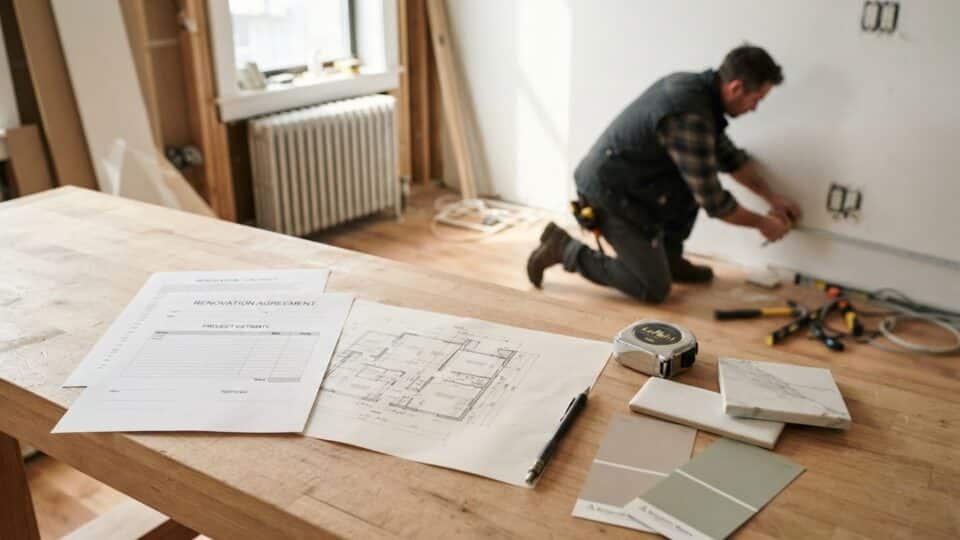
Renovation contract: before paying a deposit for an apartment or house, you need to know exactly what work you are buying, who will perform it, what materials will be installed and what you can check before the final payment. A vague offer can generate unforeseen costs, delays and conflicts. This InfoBuz guide explains cost estimates, staged payments, permits, acceptance, warranties and consumer rights, with sample clauses and documents for Romania.
Renovation contract: why a WhatsApp offer is not enough
A message saying “we will renovate the apartment for 35,000 lei” can be a starting point, but it does not say who buys the materials, which work is included in the price, what happens if a damaged pipe is found, or when the final instalment is due. Problems often arise between the initial offer and what each side believed had been promised.
A written contract, with a cost estimate and suitable annexes, turns expectations into verifiable obligations. It does not guarantee flawless work, but it can clarify evidence, payments and how defects will be remedied. For work involving the building structure, specialised installations or permits, a simple contract does not replace technical documentation or authorised personnel.
What type of contract is used for an apartment renovation?
Depending on the nature of the work and the parties’ relationship, a contract under which someone undertakes work for a price may fall under the Civil Code rules on a contract for works (antrepriză). Article 1851 describes a contractor who performs work or a service at their own risk for the client in return for a price. Where a consumer hires a company, consumer-protection rules also apply insofar as they are applicable.
Not every repair lasting a few hours needs a contract running to dozens of pages to be valid. A written form is especially useful, however, when payment is made in advance, expensive materials are involved or the work will take more than a few days. The Civil Code chapter on contracts for works provides the general framework; the specific clauses must be tailored to the job.
Checking the company and the person signing
Before paying, ask for the trader’s full name, Romanian tax identification number (CUI), registered office, contact details and the name of the representative authorised to sign. Check that the company or authorised sole trader (PFA) exists and that the person before you is acting on its behalf. You can use public information from the National Trade Register Office; an official finding certificate or other documents can clarify the authorised activities.
Do not confuse a social-media profile with a verified legal identity. If a tradesperson proposes a contract in a company’s name but asks for the deposit to be transferred to another person’s account, request documented explanations before agreeing. For specialist work, separately check the professional authorisations required; registration with the trade register alone does not prove technical competence.
What a renovation contract should contain in practical terms
A useful template identifies the parties and the property; gives an exact description of the work; includes measurement and cost-estimate annexes; states the price and VAT treatment; sets a timetable; allocates responsibility for materials; establishes rules for changes, acceptance, applicable warranties, termination and communications. Each side should also designate a contact person.
This is a recommended contractual checklist, not a claim that every item is required by law in the same form for every repair. Anything outside the contract scope should be identified. Furniture, light fittings, waste removal, material transport and fees for documentation may or may not be included, for example.
Detailed cost estimate: the document that controls the budget
Rather than relying on one lump sum, request an itemised cost estimate: demolition and rubble removal, substrate preparation, installations, finishes, fitting work and cleaning. For each item, state the unit of measurement (m², linear metre, point, piece), estimated quantity, unit price, value, who supplies the materials and the acceptance criterion. The estimate should have a version identifier and be attached to the contract.
An estimate should not be padded with details that cannot be checked, but neither should it be reduced to “full renovation: 50,000 lei”. For painting, distinguish the actual working area from the apartment’s floor area; for tiling, distinguish tiles, adhesive, substrate preparation and labour. Where materials have not yet been selected, specify an allowance or an approval mechanism rather than claiming their price is guaranteed.
Example renovation cost estimate: 50,000 lei, a hypothetical amount
Imagine an apartment renovation with a total contract price of 50,000 lei, including applicable taxes, solely as an exercise. The items are grouped by stages to show the relationship between completed work and payments, not to estimate the actual cost of a renovation in Romania in 2026.
The real price depends on the locality, floor area, installations, substrate condition, chosen materials, workers’ qualifications and taxes due. Do not use the figures in the table as a market quotation or price standard. In a real offer, these groups should be broken down into quantities and unit prices, with the relevant annexes.
| Work group | Hypothetical value | Document for checking |
|---|---|---|
| Preparation, protection, demolition and removal | 6,000 lei | Measurements and proof of removal |
| Substrate repairs and preparatory work | 8,500 lei | Photos and interim record |
| Included installations and technical checks | 13,500 lei | Reports and relevant documentation |
| Wall and floor finishes | 16,000 lei | Room-by-room inspection and installed products |
| Final fitting, cleaning and handover | 6,000 lei | Checklist and acceptance |
| Total | 50,000 lei | Example only, not a quotation |
Fixed price, unit price or daily labour: they are not the same
A firm lump-sum price reduces uncertainty for well-defined work, but can lead to disputes where documentation is incomplete. A contract using unit prices allows measured quantities to be adjusted, provided that the measuring method and approval process are clear. Hourly or daily pay may make sense for limited interventions, but requires time records and a cap or a justified estimate.
Avoid wording such as “calculated at the end” without a method, documents and limits. If the parties choose a contingency for unforeseen circumstances, it should remain a budget cap controlled by the client, not an advance which the team can spend automatically. Every change should be approved under the contract mechanism.
Renovation deposit: how much to pay before work starts
There is no magic percentage that is compulsory for every renovation. A deposit may be justified to reserve the team or purchase materials identified in the cost estimate, but the amount and timing must be negotiated and written down. As a prudent rule, avoid paying in full before work has been completed and can be checked. If materials account for most of the deposit, request purchase documents and agree where they will be stored and who owns them.
Bank payment into the professional’s account and tax documents are generally easier to trace than money handed over informally. If cash is used, comply with the limits and tax documentation applicable to the specific situation. A photograph of banknotes or a message saying “I received the money” does not provide the same evidence as a document identifying the payment, contract and recipient.
Staged payment model for a 50,000 lei contract
One negotiating example is: 10% deposit on signing; 25% after the space has been prepared and the initial work verified; 30% after included installations have been tested and documented; 25% after finishes and fitting work have been accepted; and 10% after acceptance and remediation of agreed observations. The total is 100%; these percentages are not imposed by law, but illustrate linking payment to results.
In the hypothetical example, the instalments are 5,000 lei, 12,500 lei, 15,000 lei, 12,500 lei and 5,000 lei. Such a schedule may be unsuitable if very expensive customised materials are bought at the outset; in that case, adapt the payments, guarantees and evidence. Do not pay for a stage merely because its calendar date has passed if contractually payment depends on that stage being accepted.
| Payment point | Proposed percentage | Amount for 50,000 lei |
|---|---|---|
| On signing, under the agreed conditions | 10% | 5,000 lei |
| After the first verified stage | 25% | 12,500 lei |
| After installations and stage documentation | 30% | 15,000 lei |
| After verified finishes | 25% | 12,500 lei |
| After acceptance and agreed remedial work | 10% | 5,000 lei |
| Total | 100% | 50,000 lei |
Who buys the materials and what happens with substitutions?
The contract should say whether materials are supplied by the client, contractor or both. Specify the brand, model or essential technical characteristics for adhesives, waterproofing, cables, electrical fittings, pipes, ceramic tiles and paint, while allowing for any accepted substitutions. Decide who bears transport, storage, damage and recorded shortages.
A clause saying “similar materials will be used” without criteria can conceal a significant quality difference. Require a change to be justified and approved in writing before installation, including its impact on price, performance and warranty. Invoices and technical sheets help identify installed materials, but do not by themselves prove that they were applied correctly.
Deadlines, stages and delays: a realistic schedule
Record the start date, estimated duration, sequence of work and final handover date. For a renovation involving installations and finishes, the schedule should allow for drying times, interim checks and material-delivery periods. A promise such as “we will definitely finish in 12 days whatever we find” may be unrealistic for an apartment with hidden problems.
The contract may state how a justified delay is documented, who notifies it, what evidence is sent and when a revised schedule is approved. That prevents a deadline change from being set unilaterally through a vague message sent a day before handover. Additional work should not automatically be used to justify every delay to the original stages.
Additional work: the contract-addendum rule
One of the most important clauses should say that additional work changing the price or deadline is performed only after the solution is described, its cost estimated and written approval obtained. If, for example, removing tiles reveals a degraded substrate, the contractor documents the situation with photographs, measurements and a proposed remedy. The client may request an alternative and explicitly approve the new amount.
For emergencies endangering people or property, the contract should define the procedure for stopping work and making the site safe, without assuming every cost is automatically accepted. A proper addendum identifies removed, added or changed items, the revised total value and timetable. Avoid wording such as “the contractor may carry out any necessary work at a cost”.
Concealed work: why a photo before finishing matters
Pipes and cables that will be covered, bathroom waterproofing or floor-substrate preparation are difficult to check once finishes are applied. Set contract checkpoints before covering: dated photographs, interim reports and, where relevant, measurements, tests and documentation prepared by responsible professionals.
A phone photo does not replace a technical report or regulated checks where they are mandatory. An orderly archive can nevertheless help identify routes and resolve a dispute. The client may request copies of relevant documents, but should not personally carry out dangerous tests on live electrical installations, gas systems or structural elements.
Work quality: define what “well finished” means
Phrases such as “premium-quality work” do not say whether walls will be perfectly straight, which waterproofing system will be used or what exact paint shade will be applied. Ask for samples, product identification and checking criteria suited to the work. For floors, the relevant issues include the material type, permissible flatness under the selected system, joints, substrate and installation method.
Do not invent arbitrary technical tolerances in the contract, such as “zero-millimetre deviation”; they must refer to the design, applicable standards and the manufacturer’s instructions. A photo of the desired finish may be attached as an aesthetic reference, but does not replace a specification where the work requires technical parameters.
Responsibility for electrical, gas and structural work
A team able to install wall tiles is not automatically qualified to alter an electrical panel, gas installation or structural wall. Before such work, establish who designs it, who holds the authorisation required by sectoral rules, and which checks and documents are handed over. Certain electrical and gas work is subject to authorisation or certification requirements and specific procedures; check operators in ANRE records, according to the activity category.
Do not accept phrases such as “we will do it without paperwork, because no one can see it”. Improper work can create risks of electrocution, fire, gas leaks or structural damage. The contract must distinguish finishing work from work requiring a designer, expert, authorised installer, site supervisor or other responsible persons, depending on the work.
Which renovations can be done without a permit, and what to check first
Article 11 of Law No. 50/1991 allows, under certain conditions, work without a permit such as painting and other interior finishes, floor repairs, joinery and certain installation repairs, where applicable requirements are met. The exemptions are limited: interventions altering the load-bearing structure, architectural appearance or affecting certain protected buildings may require different procedures.
Do not infer that removing a wall, enclosing a balcony, altering a façade or changing a service connection is permitted without checks merely because the job is called a “renovation”. For apartments, also check the regime governing common parts and any consents required. Consult the local authority and a competent professional before work with technical or legal implications. Source: Law 50/1991, Article 11.
Protecting the home, neighbours and waste removal
Specify who covers furniture, how the building’s lift and stairs are protected, permitted working hours and who repairs any damage to common areas. Photograph the initial condition of sensitive areas without unjustifiably exposing other people’s homes or data. Include regular cleaning and the route by which materials are moved through the building.
Rubble removal should be clearly included in the estimate or assumed separately, stating who orders the service and where waste goes. For the risks of improvised disposal, see InfoBuz’s guide to the legal waste route after an apartment renovation. A bag left at the household-waste point does not become lawful merely because the team promised it would “handle it”.
Renovation acceptance: why you should not sign in a rush
Under Article 1862 of the Civil Code, the client must inspect the work after notification of completion and, if it complies with the contract, accept it within a reasonable period. Failing to state the result without sound reasons may have legal consequences, while acceptance without reservations may limit reliance on apparent defects. A prompt, documented response is therefore important.
Use a handover/contractual acceptance report for ordinary renovation work. Record the rooms checked, tests carried out, lists of observable non-conformities, remedy deadlines, and materials and documents handed over. Do not confuse this contractual check with the regulated acceptance of construction work subject to specific procedures; work falling under the construction regime may require separate documents and commissions.
Work warranty versus liability for hidden defects
The contract may set a commercial warranty period for specific work and a notification and remedy procedure. Separately, the Civil Code governs the contractor’s obligations regarding defects in the work and agreed qualities; Article 1863 provides the general framework. Specific rights and time limits depend on the nature of the work and applicable rules, not simply on the words “2-year warranty” on an invoice.
There is no single statutory warranty period that mechanically applies to every paint job, installation or structural intervention. For construction works and regulated participants, Law No. 10/1995 includes special rules on hidden defects arising within ten years of acceptance and on certain defects in the load-bearing structure throughout the building’s existence. These provisions should not be presented as an automatic ten-year warranty for every minor finish.
Delays, penalties and compensation: what is reasonable to negotiate
A delay clause should distinguish fault by the contractor, delivery delays attributable to the person who ordered deliveries, and justified stoppages caused by technical discoveries or force majeure. The parties may negotiate penalties and other remedies within the law, but they must be clearly drafted, proportionate and compatible with each party’s rights. Do not assume that a penalty stated in an offer automatically applies in every situation.
For damage, the contract may provide for notification of the incident, photographs of the loss, access to civil-liability insurance if it exists, and a mechanism for assessment and repair. A penalty does not justify accepting unsafe work. If risks to people arise, stop using the affected area and call a specialist.
Ending the engagement if the team abandons the site
If work stops without justification, begin with a written notice describing the contract, the actual stage reached, unperformed obligations and the period requested for a response or remedy, in accordance with the contract and law. Inventory materials, photograph completed work and retain messages and payment evidence. Do not arbitrarily pay another contractor from sums claimed from the first team without documenting the situation.
Termination, rescission, recovery of the deposit or compensation depend on the contract and legal basis. For large amounts, structural work or a serious dispute, consult a lawyer and, if necessary, a technical expert. There is no universal rule that says, “if they are three days late, you can instantly recover all your money.”
The 14-day withdrawal right: when it applies and when it does not
Some contracts between a consumer and a professional concluded at a distance or off business premises may fall under withdrawal-right rules in Emergency Ordinance No. 34/2014. The regime depends, however, on how the contract was concluded, the service provided, the start of performance and any exceptions. The law excludes, among other things, contracts for constructing new buildings and substantially transforming existing buildings.
Therefore, do not promise an automatic 14-day withdrawal right for every renovation contract. Where performance began at the consumer’s express request, specific consequences may arise concerning payment for the service provided. The reader should check the particular contract and applicable legal framework, rather than rely on a message saying “I can cancel without a reason at any time”.
If the work does not meet the contract: follow the document trail
First identify the non-conformity precisely: the room, estimate item, photographs, date and agreed technical or aesthetic criterion. Send the provider a clear notice requesting remedial work and giving a period appropriate to the problem. Retain proof that it was sent and any reply. For an important technical defect, seek a specialist’s assessment before allowing it to be covered or altered.
Where the relationship is between a consumer and a professional, you may consult the ANPC portal for a complaint or alternative dispute resolution, depending on jurisdiction. ANPC does not replace a court or technical expert for every type of claim. In an arrangement between two private individuals outside a professional activity, ANPC jurisdiction may not apply; civil remedies may be relevant.
Seven guidance clauses for a renovation contract
Clause 1 — scope: “The Contractor shall perform only the work described in Annex 1 – Cost Estimate, version [date], at [address], in accordance with the attached materials and specifications.” Clause 2 — price: “The total price, including applicable taxes, is [amount] lei, with labour and materials listed separately in Annex 1.” Clause 3 — payments: “Instalments shall be paid after the stages have been confirmed and the payment documents listed in Annex 2 have been provided.”
Clause 4 — changes: “Additional work changing the price or deadline must be approved in writing before it is carried out, in a document describing its cost and effect on the timetable.” Clause 5 — inspection: “Work that is to be covered shall be notified for inspection before the next stage, in accordance with the checkpoints.” Clause 6 — acceptance: “Handover shall be recorded in a report with any reservations and remedy deadlines.” Clause 7 — remedial work: “Reported deficiencies shall be addressed under the agreed warranty and applicable legal rights.”
Handover report template at the end of a renovation
A guidance handover form can begin: “On [day/month/year], the client [name] and contractor [name] inspect at [place] the work under contract No. [number].” A table follows with the stage or room, inspection outcome, identified deficiency and remedy deadline. Attach photographs, evidence of checks, and the list of materials or documents handed over.
It may end: “The work is [accepted / accepted with recorded reservations / not accepted for the reasons listed], without prejudice to rights arising under law in respect of defects not apparent at this inspection, where applicable.” Both parties sign; if one refuses, record the refusal and send the observations in writing. This is an editorial document template, not a substitute for statutory acceptance of work requiring a regulated procedure.
| Space / work | Inspection outcome | Observations and deadline |
|---|---|---|
| Bathroom — waterproofing and finish | Accepted / with reservations / not accepted | Example: replace silicone sealant by date … |
| Kitchen — installations and fitting | Accepted / with reservations / not accepted | Example: testing and inspection documents |
| Bedroom — walls and flooring | Accepted / with reservations / not accepted | Example: documented touch-ups |
| Common areas and cleaning | Accepted / with reservations / not accepted | Example: remedy marks in the stairwell |
When a leak appears after renovation: a practical case
Imagine that damp appears on an adjacent wall two weeks after a bathroom renovation. The first step is to stop using the affected installation if there is a risk, document the signs and contact the contractor. Do not immediately break open all finishes without taking photographs and preserving evidence, except where intervention is needed to limit damage or ensure safety.
The source of the leak should then be checked by a competent person: waterproofing, connection, pipe, condensation or an earlier problem. Not every stain is automatically the team’s fault, but nor should the response “it will dry on its own” be accepted without a diagnosis. For moisture and cold-spot risks, see InfoBuz’s guide to condensation and mould after refurbishment.
Common mistakes that can turn a renovation into a dispute
Classic mistakes include paying a deposit without identifying the company, accepting an offer without quantities, buying materials without checking specifications, selecting installation work without competent personnel and signing acceptance before testing visible finishes. Another mistake is discussing every change only verbally, without later confirmation.
Conversely, the client can create problems by changing solutions daily, failing to provide agreed access, or requesting work for which there is no design or approval. A balanced contract sets obligations for both sides and a communication procedure. It should not turn every minor disagreement into litigation.
Checklist before signing and before the final payment
Before signing: the company’s identity and representative; work list; quantities and materials; total price and taxes; timetable; deposit; subcontractors and competence; permits where needed; procedure for additional work; damage; acceptance; warranties; contact method. If an important item is missing, ask for it to be added in writing.
Before the final payment: actual progress against the estimate; photographs of concealed work; relevant tests and checks; visible finishes; cleaning and waste; handed-over documents; a list of reservations with deadlines; signatures or communications on acceptance; the invoice or tax document. Do not unilaterally withhold money contrary to the contract without checking the legal conditions and, if the dispute is serious, taking legal advice.
Frequently asked questions about renovation contracts
Can I work on the basis of an invoice alone? An invoice is useful evidence, but usually does not by itself describe obligations, deadlines and quality in detail. Is a 30% deposit compulsory? There is no universal rule for every renovation; the amount is negotiated. Can I refuse additional work? The contract should set the approval mechanism and emergency situations; generally, do not accept unclear additional costs.
Is there a ten-year statutory warranty for every paint job? No: the special hidden-defect regime in Law 10/1995 should not automatically be extended to every finish. Do I have a 14-day withdrawal right? It depends on the type of contract, how it was concluded and legal exceptions. Can I go to ANPC about a private tradesperson? Its jurisdiction depends on whether that person is a professional and on the nature of the relationship.
Other useful guides before renovation
A good contract is only the first step. To prepare the worksite and prevent deterioration, read 25 preventive home checks. To control costs after interventions, follow energy losses in the home and remedial solutions. For furniture work, compare bespoke and modular furniture, including the impact of future repairs.
These articles are complementary and do not replace design, supervision or legal advice where these are required.
Official sources, legal checking and editorial methodology
Main sources: Civil Code – contracts for works (Article 1851 onwards), including Article 1862 and Article 1863; Law No. 50/1991, Article 11; Law No. 10/1995 on construction quality; Emergency Ordinance No. 34/2014; ANPC and its ADR service.
This is a general consumer guide, reviewed on 22 November 2026. The estimate examples, payment percentages, clauses and forms are illustrative, not official legal templates, and do not replace advice from a lawyer or technical expert for a specific contract. Whether a rule applies depends on the work category, property regime, parties’ status and legislative changes in force on the contracting date.




Discuția cititorilor
Ai o opinie sau o întrebare despre acest articol? Spune-ne ce crezi.
Fii primul care deschide discuția.
Te rugăm să păstrezi un limbaj civilizat și să discuți la subiect. Comentariile spam sunt filtrate automat.