
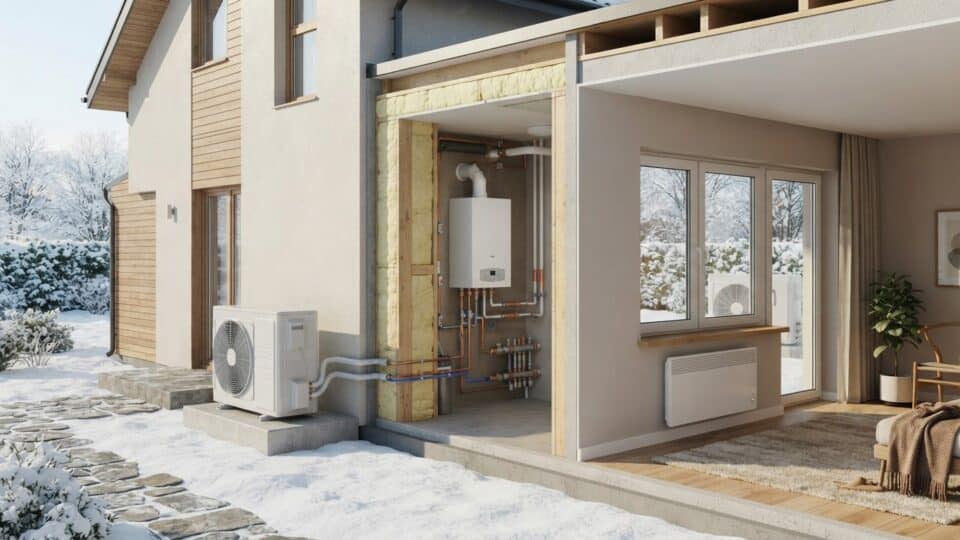
The cost of heating a home can differ greatly from the price shown on an energy bill. Gas, heat pumps and direct electric heating cannot be compared properly without accounting for efficiency, heat demand, installation costs and actual tariffs. This guide explains the formulas and provides an illustrative calculation, without promising unrealistic savings.

Home heating costs: what actually needs to be compared
When comparing gas, a heat pump and electric heating, the most important figure is not the price of a kilowatt-hour bought, but the cost of useful heat delivered to the rooms. A device that uses little energy but has low seasonal efficiency can still produce unexpected bills.
A proper calculation includes a building’s actual heat demand, seasonal efficiency, the effective energy price, taxes and fixed charges, installation, maintenance and service life. There is no universal winner: the result differs between a small flat, an older uninsulated house and a new home.
First, how much heat does the building lose?
Floor area alone does not determine energy use. Two 120-square-metre homes can have very different bills if one has good insulation, airtight windows and controlled ventilation, while the other loses substantial heat through its roof, walls or air leakage.
A room-by-room heat-loss calculation helps size the system. Without one, a heat pump may be oversized and a boiler may operate inefficiently. An energy audit and fixing major sources of heat loss can deliver savings regardless of the equipment installed.
Gas boilers: benefits and limitations
A modern condensing gas boiler can work well with a radiator system and provides a familiar source of heating and hot water. The upfront investment may be lower than for some heat pumps, particularly where the gas connection and distribution system are already in place.
The cost nevertheless depends on the gas tariff, real-world operating efficiency, system losses and maintenance. Technical inspections, ventilation requirements and flue-gas discharge must be handled by authorised professionals. Any regulated or capped price in force at the time of use should be checked separately.
Heat pumps: where their efficiency comes from
A heat pump transfers thermal energy from air, ground or water into the home. Unlike a resistance heater, it does not simply turn each kilowatt-hour of electricity into one kilowatt-hour of heat: it can deliver several times more heat than the electricity it uses.
The International Energy Agency describes a typical coefficient of performance of around four under certain conditions, but results vary widely with temperature and the installation. Source: IEA – How a heat pump works. A catalogue figure is not automatically the seasonal average for a particular home.
COP versus SCOP: the crucial difference
COP measures performance under specific test conditions, at a stated outdoor temperature and delivery temperature. SCOP is an estimate of seasonal performance under standardised conditions. For assessing an annual bill, the seasonal indicator and auxiliary consumption are more useful than a maximum COP used in advertising.
A system that requires water at very high temperatures may be less efficient than one with underfloor heating or radiators properly sized for lower temperatures. Ask the system designer to estimate performance for the local climate and actual temperature regime.
Direct electric heating: simple, but not always cheap
Electric resistance radiators, convectors and infrared heaters often have straightforward installation and allow individual room control. At the point of use, electricity is converted almost entirely into heat, but this does not mean heat is multiplied as it is with heat pumps.
In occasionally occupied spaces, the low initial investment can justify this option. For primary heating in a large house, variable costs can become high, especially where the electricity tariff is high. The comparison should be made per unit of useful heat, taking account of the pattern of use.
Calculation example: 12,000 kWh of heat a year
For illustrative purposes only, assume a home needs 12,000 kWh of useful heat over a season. With gas at 0.35 lei/kWh and seasonal efficiency of 93%, the energy cost would be approximately 4,516 lei. With a heat pump at a SCOP of 3 and electricity at 1 leu/kWh, the energy cost would be about 4,000 lei. Direct electric heating, at the same tariff, would cost approximately 12,000 lei.
These are mathematical assumptions, not current Romanian tariffs. They do not include domestic hot water, subscriptions, inspections, additional losses, installation fees or possible metering differences. Before making any decision, replace the prices and efficiencies with the figures in your contracts and system design.
A useful formula for your own calculation
For gas, estimate the cost of thermal energy by dividing the gas price per kWh by the system’s seasonal efficiency. For a heat pump, divide the electricity price per kWh by a realistic SCOP. For direct electric heating, the price of useful energy is close to that of the electricity consumed, without assuming additional heat production.
For the annual cost, multiply the result by the heat-energy requirement. Then add fixed costs and the annualised estimate of the investment. If solar photovoltaic panels are installed, use the likely amount of self-consumption during heating hours, not total annual generation.
Flow temperature and existing radiators
A heat pump generally works more efficiently when the distribution system can operate at low temperatures. Radiators sized for a boiler with a very high flow temperature may need adjustment, larger surface areas or other measures. This does not mean that all houses with radiators are incompatible with heat pumps.
A qualified installer should estimate the requirement for every room and the heating curve. In some cases, insulating the house and replacing a few radiators may be enough. In others, the changes may be extensive and should be included in the investment.
What happens in severe cold?
At very low outdoor temperatures, some air-to-water heat pumps may perform less well and may use defrost cycles or auxiliary heating. Such equipment is nevertheless used in cold regions, and efficiency depends on the model and the design.
The IEA notes that heat pumps can also work in less well-insulated buildings, although insulation reduces demand and equipment size: IEA – Does a heat pump work in a house with poor insulation?. Do not compare performance at mild temperatures alone.
Upfront investment and payback
Compare the full turnkey cost, not just the price of the equipment. For a heat pump, this may include distribution work, a tank, controls, electrical supply and adapting heat emitters. For gas, the connection, flue, inspections and maintenance may matter. Some homes already have this infrastructure; others do not.
Annual savings of a few hundred lei do not automatically justify an investment difference of tens of thousands. Estimate payback scenarios without assuming energy prices will remain fixed. Include the possibility of repairs and the value of the additional comfort provided by cooling, if the system allows it.
Solar panels and a heat pump
The combination can reduce energy bought from the grid if the heat pump runs during periods of solar generation, or if suitable storage and control systems are in place. In the cold season, photovoltaic output usually differs from summer output and may not cover the heating peak.
Do not calculate savings by automatically assuming that all electricity generated annually is used by the heat pump. Separate simultaneous self-consumption, battery energy, energy exported to the grid and energy bought. Net-metering rules and prosumer tariffs should be checked at the time of the assessment.
Hybrid systems and zone heating
Some households choose a combination of a heat pump and an existing heat source to optimise comfort and costs in extreme temperatures. Different systems can heat separate zones, such as an occasionally used room with an individual appliance.
A well-designed hybrid installation can provide flexibility, but it increases complexity, maintenance costs and the need for correct settings. It is not necessarily cheaper; compare the total cost of each option. Controls should take account of tariffs, temperatures and source efficiency.
Insulation is often the first investment
Insulating the attic, sealing uncontrolled air leaks and adjusting the heating system can reduce consumption before equipment is replaced. The order of work matters: if heat losses are reduced first, it may be possible to choose a smaller, potentially more economical heat generator.
Works should be planned so that they do not compromise ventilation and moisture management. A home sealed improperly can develop indoor-air-quality problems. Consult energy-efficiency specialists when carrying out an extensive renovation.
Safety, noise and permits
Gas equipment requires installation and inspection under the applicable legal and technical conditions. Air-to-water heat pumps have outdoor units, and their placement can affect noise perceived by neighbours. Electrical solutions must be sized for the capacity of the installation and its protective devices.
Before buying, check the available electrical load, installation requirements, warranty, service access and any local restrictions. Do not improvise electrical connections, flue-gas discharge or electrical protection measures.
Choosing the right system in four steps
First, measure or estimate the annual demand and heat-loss load at the design temperature. Next, seek comparable quotations that include all equipment and installation. Third, model costs using your actual tariffs and three price scenarios. Finally, assess maintenance and comfort over the period of use.
For an informed decision, explicitly request the estimated seasonal efficiency or SCOP under the conditions in your home, not only the maximum specification. Check the design, the installer’s accreditation and the equipment’s technical references. A premium unit installed incorrectly can perform worse than a more modest one installed properly.
Frequently asked questions
Is a heat pump always cheaper? No. It depends on the relationship between energy prices, SCOP, the home’s climate conditions and the investment. Is electric heating 100% efficient? At the point of use, electricity is converted almost entirely into heat, but that does not guarantee the lowest cost. Is underfloor heating mandatory? No, although lower flow temperatures can improve efficiency.
Is gas worthwhile if the network is already connected? It can be competitive in some scenarios, but it must be calculated. Can I heat only some rooms? Yes, with suitable zoning solutions, while taking care over comfort and moisture.
Recommended further reading
For more detail, also read How to compare investment in solar panels, batteries and heat pumps, a complementary guide published on InfoBuz.ro.
For more detail, also read The right order for energy renovation in an older house, a complementary guide published on InfoBuz.ro.
Sources and methodology
The general technical information draws on the European Commission – Heat Pumps, IEA – The Future of Heat Pumps and IEA – comparison of residential costs. More guides are available at InfoBuz.ro.
The calculations in this article are illustrative scenarios and do not constitute quotations, regulated tariffs or guaranteed savings. Editorial review: 22 November 2026. Choosing a technical solution requires a design tailored to the home.




Discuția cititorilor
Ai o opinie sau o întrebare despre acest articol? Spune-ne ce crezi.
Fii primul care deschide discuția.
Te rugăm să păstrezi un limbaj civilizat și să discuți la subiect. Comentariile spam sunt filtrate automat.