
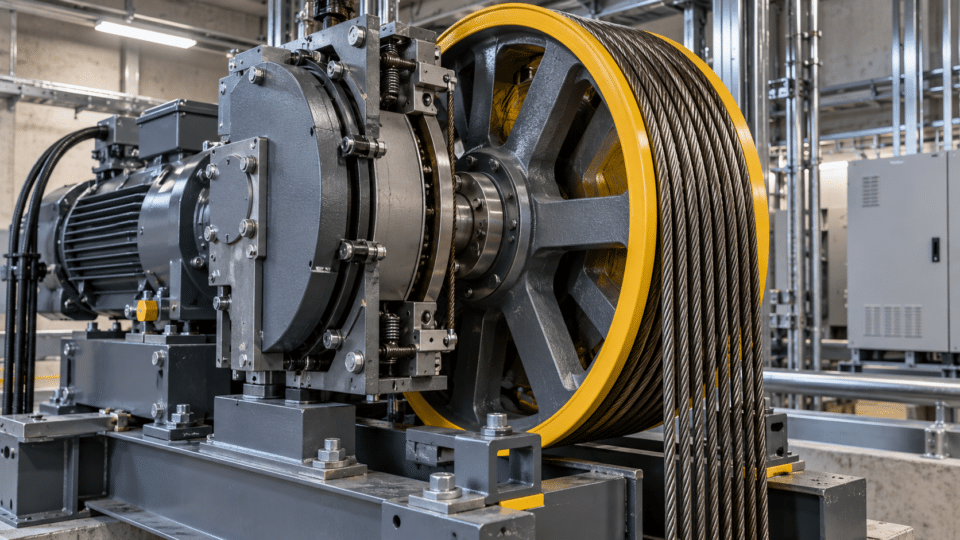
Elevator safety relies on several systems working together: supporting the car, controlling its movement, brakes, speed monitoring, door locking and means of communication. In a traction elevator, a power cut does not mean the motor must constantly hold the car “in the air”: the brake is designed to engage when its power supply is interrupted. Otis explains the mechanisms and their distinct roles.
A stop between floors can be unpleasant and may require technicians to attend, but its cause cannot be diagnosed from inside the car by its sounds or by what a passenger feels. Understanding the equipment can help people react calmly and ask the building manager the right questions. An elevator’s actual condition is established through technical inspections and documentation, not by the appearance of the mirror, the year the car was refurbished or an impression that it runs smoothly.
First, what type of elevator do you use?
In a traction elevator, the car is suspended by ropes or belts that pass over a traction sheave and connect to a counterweight system. The motor controls movement, while the counterweight reduces the imbalance the motor must overcome. In a hydraulic elevator, movement is produced by a cylinder-and-pressurised-fluid system. Schindler outlines the differences between these families of systems.
In the same context, see also Repair or buy new? The real cost of household appliances and the right to repair in Europe, which provides further relevant information.
The term “machine-room-less”, abbreviated MRL, describes where the equipment is located. It does not mean that the elevator has no machine, brakes or components requiring maintenance. Configurations vary, and the design of a fast office elevator cannot automatically be applied to a slow accessibility platform or a hydraulic installation. Each has its own intended use and documentation.
This leads to a first rule for interpreting technical information: an explanation is useful when it identifies the installation to which it applies. Most of the mechanisms described below are found in electric traction elevators. For a particular apartment building, the model and configuration must be identified from the documentation by competent personnel.
In hydraulic systems, the fluid circuit and cylinder change the way support and descent are controlled. The European directive includes devices fitted to hydraulic circuits to prevent falling among its safety components. Protection should therefore not be assessed simply by looking for ropes and counterweights in a diagram. The list of components in Annex III shows why two installations may pursue the same objective through different technical solutions. The distinction matters particularly when comparing online explanations with the elevator in a specific building.
Elevator safety: suspension, braking and speed monitoring
Suspension ropes or belts transmit the load, while guide rails keep the car moving along its designed path. The machine brake has a different role: it stops or holds the mechanism in a controlled position. In the system described by Otis, springs apply the brake and electrical power is used to release it. This logic explains why a loss of power can result in a stop rather than a free descent. The manufacturer’s description of the components is available here.
It is important to separate these functions. Calling the entire assembly “the motor” overlooks the fact that movement, support and stopping are different technical tasks. Likewise, a counterweight helps with balancing but does not replace brakes. Elevator safety is built by combining safeguards and checking how they interact.
The speed governor, also known as an overspeed governor, monitors for speed exceeding the level set for intervention. In common mechanical configurations, it has its own rope and can actuate the car’s safety gear. These devices act on the guide rails, separately from the function of the ropes supporting the car. The terminology and role of the governor rope are also defined in ISCIR’s technical regulation for elevators.
Safety gear is not a parachute. The name refers to a mechanical stopping device. Nor are the buffers at the bottom of the shaft “cushions” that would make any fall acceptable: they have a designed function, within the limits of the installation. Their presence does not justify ignoring a fault or using equipment that has been taken out of service.
| Component or function | What it monitors or does | What it should not be confused with |
|---|---|---|
| Suspension and guide rails | Supporting the car and guiding its travel | They are not the entire braking system. |
| Machine brake | Stopping and controlled holding | It is not the same device as the safety gear. |
| Speed governor | Detecting a speed that requires intervention | It is not the floor display in the car. |
| Safety gear | Mechanical stopping through action on the guide rails | It should not be tested through passenger experiments. |
| Door locking | Separating people from the travel zone | It is not the same as the sensor that reopens a door. |
| Alarm and communications | Sending a request for help | They do not by themselves guarantee power to the motor. |
The table is a functional summary based on Otis’s explanation, ISCIR terminology and European elevator requirements. It does not establish the exact equipment fitted to every installation.
Doors protect the point where two spaces meet
When entering or leaving, a passenger moves between the fixed landing and the moving car. That is why both the car’s position and the condition of the doors matter. European requirements provide safeguards against landing doors opening when the car is not in the corresponding zone, and against uncontrolled movement. There are precise technical conditions for certain levelling movements; these do not amount to permission for users to force doors open. Annex I to Directive 2014/33/EU sets out the essential requirements.
Optical sensors or sensitive edges that detect an obstacle have another function: reducing the risk of trapping when doors close. Their configuration varies among models and modernisation projects. Schindler’s guide for owners explains several solutions. The presence of a sensor is not a reason to test the door with a hand, foot or object. To keep a door open, use the control intended for that purpose, where available.
A useful report to the building manager describes the observation: “the car stopped at a different level from the landing” or “the door struck the object while closing”. A diagnosis such as “sensor X is burnt out” may misdirect the response if it has not been confirmed. Precise observation and technical verification are separate steps.
Elevator safety during a power cut
In a traction elevator, loss of power can stop the drive and apply the brake. Some installations have automatic evacuation devices or backup power, but their presence and operation must be checked for the particular model. A light that remains on or a working intercom does not show that the motor has power to continue the journey.
European requirements include means of preventing free fall or uncontrolled movement in situations such as an interruption to the power supply. These design requirements must be understood alongside correct installation, maintenance and operation. The text of the directive does not certify a particular elevator currently installed in an apartment building.
For preparations at home outside the car, we have separately explained a plan for a 24-hour power outage. Elevator safety during an outage, however, depends on the installation’s procedures and intervention by trained personnel, not improvised actions at the building’s electrical panel.
If an elevator stops between floors
Otis’s advice for passengers is clear: use the alarm and communication systems, wait for qualified assistance, and do not try to force the doors or get out on your own. Even if the landing appears to be visible through an opening, the car’s position and stability must be checked before an evacuation.
- Press the alarm button and use the intercom or emergency telephone in accordance with the posted instructions.
- Give the building address, the elevator identification if it is visible, the number of people in the car and any urgent problem. Say that you do not know the floor if you cannot determine it.
- Stay away from the doors and wait for the response team. Do not jump, do not try to open the roof hatch, and do not accept an improvised evacuation by untrained people.
- If there is smoke, fire, an injured person or a medical emergency, call 112 and describe the situation. Follow the instructions of the dispatcher and emergency crew.
In a fire, an ordinary elevator is not an evacuation route. Caraș-Severin County’s emergency inspectorate recommends using stairs rather than elevators. Follow the building’s plan and firefighters’ instructions; a standard elevator must not be confused with a system specially designed and operated for emergency response or assisted evacuation.
Elevator safety can also be checked in building records
In Romania, ISCIR’s published list of regulations currently in force includes PT R2-2010 for electric and hydraulic elevators, alongside more recent general regulations. Authorisation, inspections, maintenance and repairs form the technical framework for operation. For a specific installation, the current documentation and recorded deadlines matter—not an interval copied from an online comment.
An owner can ask the building manager for verifiable information: who provides maintenance, what document confirms the right to operate, when the next inspection is due and how a problem should be reported. The question “Has anyone been here recently?” is less useful than “What work was done, and where is it recorded?” Changing the finishes does not prove that all technical components have been modernised.
If you are considering buying an apartment, elevator safety is worth including in your review of the shared building documentation. You can request information on recent interventions, reported problems and planned work, together with costs approved by the owners’ association. The answers should be traceable to documents and the responsible company. A well-kept car is a useful observation about appearance; the installation’s history separately explains what technical work has been carried out.
The same distinction between appearance and assessment applies when checking an apartment building’s structural safety. An article can explain the right questions, but a finding on a building or item of equipment requires a competent investigation. Elevator safety is maintained through continuity between design, operation, fault reporting and authorised intervention.
Frequently asked questions
Can an elevator fall?
Elevators are designed with safeguards against falling and uncontrolled movement. It would not be accurate to promise that an accident is impossible. The condition of components, maintenance and compliance with operating conditions remain essential.
Does stopping between floors mean the ropes have broken?
You cannot infer the cause from the stop alone. An installation may be stopped by its control systems or by a power interruption. Use the emergency communications and leave diagnosis to the competent team.
Should I try to get out if I can see the landing?
Wait for evacuation by trained personnel. A difference in level, the space leading to the shaft and the possibility of the car moving can create serious risks. Seeing the landing does not confirm that it is safe to exit.
Does a new elevator no longer need inspections?
Being new does not replace applicable maintenance and inspections. For new or modernised equipment, the building manager should be able to identify the documentation and competent service responsible for monitoring its operation.
Sources and research
Research checked on 28 October 2026. The sources below explain the methods, conditions of use and limitations presented in this article.
- Otis: safety systems for traction elevators
- Schindler: elevator types and drive systems
- Schindler: owner’s guide and door protection
- Otis: passenger guidance and stopping between floors
- EUR-Lex: Directive 2014/33/EU, essential requirements for elevators
- ISCIR: PT R2-2010, electric and hydraulic elevators
- Caraș-Severin County Emergency Situations Inspectorate: fire prevention in tourism facilities
Representative image: AI-generated editorial illustration for InfoBuz.





Discuția cititorilor
Ai o opinie sau o întrebare despre acest articol? Spune-ne ce crezi.
Fii primul care deschide discuția.
Te rugăm să păstrezi un limbaj civilizat și să discuți la subiect. Comentariile spam sunt filtrate automat.