
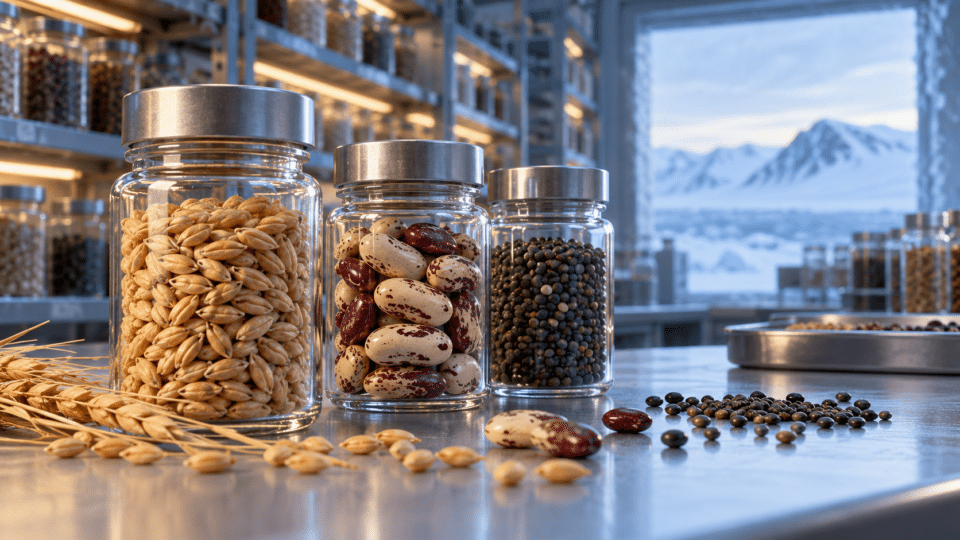
The Svalbard Global Seed Vault holds backup copies of agricultural collections, so that their diversity can be recovered if the original gene bank loses access to the material. Behind its entrance carved into a mountain lies a highly specific biological selection: cold storage works well for some seeds, while other plants require living collections, tissue cultures or cryopreservation. NordGen describes the vault’s role as a backup for gene banks.
Consider three foods on the same table: bread, chocolate and bananas. All depend on cultivated plants, but conserving their diversity does not follow the same path. The key question is what must remain alive so that researchers can produce the right plant again decades from now. The answer explains both Svalbard’s value and its limits.
For more on Svalbard, see also Paramacrobiotus klimaszyki: the new Svalbard tardigrade, the 100th known species in the archipelago, which provides complementary details on the area.
How the Svalbard Seed Vault works
The vault was established by Norway and is operated through a partnership with NordGen and the Crop Trust. Depositing institutions retain ownership of their material. Each box remains under their legal control: only the depositor may request the withdrawal of its own samples. Members of the public cannot order a packet for their garden directly from the vault, and private individuals are directed to relevant gene banks. These rules are set out in the official terms on access and ownership.
A useful comparison is a library’s backup archive. The working collection remains accessible where specialists study and use it; the safety copy is kept separately. The essential difference from a book is that a seed must be capable of producing a plant. An intact box alone does not prove that the material inside is still viable.
Natural cold helps, while equipment maintains the temperature
The storage area lies more than 100 metres inside the mountain. According to the technical description published by the Norwegian authorities, rock and permafrost provide a cold environment, while a cooling system brings the chamber temperature down to −18°C. The facility uses electricity and has generators for power outages. It officially opened on 26 February 2008.
At the seed vault, this combination illustrates the project’s logic: several layers of protection reduce dependence on any one component. The mountain provides thermal inertia, equipment controls storage conditions, and geographical distance separates the backup from many of the local risks facing the original collections. Cold slows biological processes, but the initial quality of a seed lot and its preparation still matter.
The figures on the collection portal change as deposits and withdrawals are made. For an up-to-date check, readers can consult the Seed Portal, the vault’s official database. The number of samples should be read as a collection inventory: it is not the same as the number of species, nor does it alone show how well diversity within a crop is represented.
A sample’s journey starts long before it is sent to the Arctic
Requirements for depositors include managing a collection over the long term and being able to produce new seed when needed. The material must already have a safety duplicate in a suitable gene bank, making Svalbard a second backup. The institution signs an agreement, prepares its sample list, and has the data checked before shipment. Storage is free of charge; transport costs are borne by the depositor, under rules published by the Norwegian government.
In a gene bank, preparing material involves far more than packaging it. FAO standards include identifying and documenting samples, drying and storing suitable seeds, monitoring viability, regenerating the collection and creating safety duplicates. Information on origin and characteristics helps researchers understand what they are looking at and under what conditions it may be useful.
This is where an important distinction emerges between keeping an object and conserving a biological resource. If a label falls off a photograph, the image can still be viewed. If a seed lot loses its identity, using it in research becomes much more difficult. The archive of material and the archive of information must remain connected.
Why the seed vault cannot accept every plant
Specialists call seeds that tolerate drying and low-temperature storage “orthodox”. “Recalcitrant” seeds are sensitive to dehydration, while intermediate behaviours and differences in longevity exist between these categories. Kew notes that some species face other difficulties: they produce too few seeds, do not last long enough in conventional freezers, or require complex conditions for germination. The classification describes a spectrum of behaviours, rather than three compartments into which every plant fits neatly.
| Biological situation | What specialists can conserve | Limitation to monitor |
|---|---|---|
| Seeds that tolerate drying and cold | Dried seed lots in controlled conditions | The viability and identity of the lot must be checked. |
| Seeds sensitive to drying or cold | Material conserved through methods adapted to the species | A conventional protocol can destroy the material. |
| Varieties maintained by vegetative propagation | Plants, tissues or shoot tips | Plants grown from seeds may have a different genetic combination. |
| Material for cryopreservation | Tissues prepared and cooled using validated protocols | A viable plant must be obtained after rewarming. |
The table summarises differences among methods presented by FAO and CGIAR. It is not a guide to freezing material at home. The choice depends on the species, the material being preserved and the purpose of the collection.
Bananas and potatoes show why a plant’s identity must also be preserved
For some crops, the issue is not only whether a seed can withstand storage. Many cultivated banana varieties are maintained vegetatively, while conserving a particular potato genotype relies on clonal material. A plant grown from a seed may combine its parents’ characteristics differently. CGIAR explains why such collections use living plants, in vitro cultures and cryopreservation.
Imagine trying to preserve a particular musical performance rather than just the score. The score allows new performances, but it does not automatically reproduce the voice, rhythm and timbre of a recording. Similarly, conserving a species and faithfully preserving a particular variety are closely related aims with different requirements. This distinction explains why agricultural diversity needs several types of collection.
Even within one category, conditions are not identical for every lot. A sample collected at maturity and prepared correctly may have a different lifespan from one that was damaged before storage. This is why documentation and germination testing are part of conservation. FAO standards treat viability monitoring and regeneration as distinct activities: the first shows the condition of the material, while the second makes it possible to replenish the lot by producing new seeds.
Cryopreservation: another infrastructure for plants that are difficult to store
Cryopreservation uses extremely low temperatures, usually liquid nitrogen at about −196°C or its vapour phase. Material is prepared through procedures designed to limit damage caused by cooling, and must then be recovered in a form able to grow. The method requires infrastructure, staff and tailored protocols, according to CGIAR documentation.
The value of such a collection is judged at recovery: can the sample reproduce the plant the institution intended to conserve? That is the relevant test for any biological backup. A striking image of cold containers says little about material identification, a laboratory’s capacity or checks carried out over time. Investment in conservation includes all of these activities, even if the public mostly sees the building.
The seed vault has already been used to rebuild a collection
In 2015, ICARDA requested the withdrawal of seeds from Svalbard after the war in Syria prevented the normal operation of its collection in Aleppo. The institution explained that the Aleppo material had been preserved, but could no longer be regenerated and distributed to researchers under the necessary conditions. The recovered seeds were grown for multiplication and to rebuild collections in Lebanon and Morocco. ICARDA’s account documents this recovery process.
The example changes how the investment is best understood. Its usefulness also becomes apparent when researchers lose access to a laboratory or an experimental field. In this sense, the seed vault supports continuity of work: a backup can restart selection, research and material distribution, provided there are institutions able to use it.
Why this matters for changing agriculture
FAO links the conservation of genetic diversity to the ability to develop crops adapted to different conditions. Losing diversity narrows agriculture’s options. For readers in Romania, the discussion has a concrete context: soil drought can continue even after rain arrives, while pressure on water resources requires agriculture to adapt.
A preserved collection offers research possibilities, not a guaranteed harvest the following year. Between an interesting trait and a variety that performs in the field lie testing, selection and verification of its behaviour in local conditions. The seed vault protects part of the options for the future, while farms, ecosystems and active gene banks keep those options connected to the living world.
Frequently asked questions about the Svalbard facility
Can I send seeds from my garden?
Direct deposits by private individuals are not provided for. NordGen recommends contacting a gene bank that can assess the material and, if the conditions are met, arrange its conservation and duplication.
Who owns the samples?
The depositor retains ownership and the right to withdraw the material. Storage at Svalbard does not automatically transfer it to Norway or turn it into a collection from which the public can directly request seeds.
Do all seeds last for hundreds of years?
There is no single lifespan. Species, seed-lot quality and preparation conditions affect longevity. The meaningful promise is a conservation system that is checked and maintained, not an identical expiry date for every crop.
Why are local gene banks needed if Svalbard exists?
Active collections identify, test, multiply and make material available for permitted uses. The Arctic backup depends on this work. Without the capacity to recover and use samples, merely storing them would not fulfil the purpose of conservation.
Sources and documentation
Research checked on 28 October 2026. The sources below explain the methods, conditions of use and limitations presented in this article.
- NordGen: questions and answers about Svalbard
- Government of Norway: the storage facility
- Government of Norway: conditions for depositors
- Royal Botanic Gardens, Kew: seed collection and species with special requirements
- FAO: standards for plant gene banks
- CGIAR: plant conservation through cryopreservation
- ICARDA: recovery and multiplication of samples withdrawn from Svalbard
Representative image: AI-generated editorial illustration for InfoBuz.


Discuția cititorilor
Ai o opinie sau o întrebare despre acest articol? Spune-ne ce crezi.
Fii primul care deschide discuția.
Te rugăm să păstrezi un limbaj civilizat și să discuți la subiect. Comentariile spam sunt filtrate automat.