
Repair or replace? When a washing machine stops before the spin cycle, a fridge no longer cools, or a dishwasher begins to leak, the first instinct is often to look up the price of a new appliance. But the decision is not simply a matter of comparing a repair quote with a sale offer. You also need to consider how much life a repair could add, delivery and installation costs, energy use, the risk of another fault, and your rights as the buyer.
In 2026, the issue also has a new legal dimension: EU Member States were required to transpose and apply the European right-to-repair directive from 31 July. That does not mean, however, that every appliance can be repaired free of charge, or that every rule in the directive automatically applies directly to every private company in Romania.
This InfoBuz guide explains when repairing an appliance may be worthwhile and when replacement may make more sense, using four illustrative calculations, a seven-step test, official sources, and an explanation of the difference between the legal guarantee and paid repairs.
Research date: 22 October 2026. The Romanian leu figures in the tables are calculation scenarios, NOT verified service quotes or guaranteed retail prices. For any specific decision, request a written quote and check the applicable legislation.
Repair or replace: the short answer before you pay
If the product is still within the period in which the seller is legally liable for lack of conformity, do not begin by paying a repair service. Contact the retailer and request a remedy under Emergency Ordinance No. 140/2021. If the appliance is no longer covered by a free remedy, ask for a diagnosis and a full quote before comparing it with an equivalent new product.
Outside the guarantee period, a relatively inexpensive repair with a precise diagnosis and a good prospect of adding several years of use can be an excellent choice. A costly intervention on an appliance with many components already worn down may simply prolong the financial pain. There is no universal threshold such as “repair below 30%, replace above 50%”. That is only a rough rule of thumb and can be misleading.
The true cost of a repair: the price of the part is not the whole price
A repair service may quote 150 lei for a part, but the final bill can be higher once diagnosis, call-out fees, labour, transport and installation are included. Before accepting an offer, ask for a document that answers six questions:
- Which component is faulty? Does the diagnosis identify a specific part, or is it merely an assumption?
- How much does the diagnosis cost? Is it included in the labour charge if you approve the work? Do you pay if you decline it?
- What is the final price? Does it include VAT, the part, labour, call-out costs, transport and any reinstallation?
- How long will the repair take? Is the part in stock or does it need to be ordered?
- What proof and warranty terms will you receive for the work? What happens if the same fault returns?
- Are other problems likely? Has the technician identified corrosion, leaks, worn bearings, deteriorated insulation or damaged electrical components?
The practical formula is: full repair cost = diagnosis + part + labour + call-out/transport + installation + other accepted costs. Do not include an invented price for “future risk” in that total; it should be assessed separately as uncertainty, rather than hidden in a quote.
An offer with a fixed price to replace a seal may be relatively predictable. A quote stating that an “electronic board may be faulty”, while excluding tests of other components, carries greater financial risk. That distinction matters more than a slogan about cheap repairs.
Four examples in lei: when repair makes sense and when replacement deserves serious consideration
| Appliance — hypothetical scenario | Full repair | Comparable replacement | Repair as % of new | What to check |
|---|---|---|---|---|
| Washing machine, 6 years old | 420 lei | 2,400 lei | 17.5% | Repair may make sense if the diagnosis is clear and the remaining components are in good condition |
| Dishwasher, 9 years old | 1,350 lei | 2,100 lei | 64.3% | Request a second quote and assess the risk of further faults; replacement may be more justified |
| Fridge, faulty door seal | 260 lei | 3,000 lei | 8.7% | A specific, reliable and effective repair may be preferable to replacement |
| Vacuum cleaner, 4 years old | 190 lei | 650 lei | 29.2% | Check whether the part is available and the estimated remaining operating life |
Editorial note: All amounts are examples created to explain a decision-making method, not Romanian market averages. Percentages are calculated strictly by dividing the repair cost by the replacement price selected for the scenario. They do not constitute mandatory recommendations.
The table shows why absolute value and proportion are not enough. For a washing machine with an isolated fault, 420 lei may be a reasonable cost. By contrast, 1,350 lei for an ageing dishwasher, where other faults are likely, may make replacement the better option. But if an appliance is expensive, robust, well maintained and the repaired part is likely to last, the conclusion can change.
The right test: compare what you pay for the years of use left
You can begin with a simple measure: repair cost per estimated additional year of use, then compare it with the purchase cost per estimated year of use of the new appliance. It is not a complete financial indicator, but it provides a starting point.
Example: repairing the washing machine in the first scenario would cost 420 lei. If a technician can justify an estimate of another three years of operation, the annualised cost of the repair would be 140 lei per year. For a new appliance costing 2,400 lei that you expect to use for eight years, the purchase cost would be 300 lei per year, before energy, maintenance, installation and residual value.
Caution: three and eight years are assumptions, not guaranteed lifespans or statistics for all brands. If the old machine lasts only six more months, the 420 lei is equivalent to 840 lei for one year of service, and the calculation reverses. This is why the quality of the diagnosis and the appliance’s overall condition matter.
There is another common mistake: the price paid six years ago should not be added again to the cost of today’s choice. It is a cost already incurred. The decision should compare the relevant future costs of repair and replacement, rather than attempting to “recover” money spent on a past purchase.
For more information on product guarantees, see also Custom-made or modular furniture: the real cost emerges at repair and moving time, which provides complementary detail on this subject.
Does an old fridge use more electricity? Calculate the saving; do not assume a new one pays for itself
A fridge runs every day of the year, so energy efficiency can matter more than it does for an occasionally used appliance. Even so, replacement should not be justified solely by a new energy label without comparing kWh figures.
The European energy label for fridges and freezers gives estimated annual energy use in kWh, alongside compartment volume and other data. For washing machines, the current label shows kWh per 100 ECO 40–60 cycles, rather than each household’s annual consumption.
Take an old fridge-freezer that, in this hypothetical example, uses 300 kWh per year, and a new model of comparable capacity using 180 kWh per year. The difference is 120 kWh per year. At a hypothetical final price of 1.20 lei per kWh, the saving would be 144 lei per year.
Assume also that a simple door-seal repair would cost 260 lei, while the new fridge costs 3,000 lei. The immediate difference between the options is 2,740 lei. If replacement were justified solely by the 144 lei annual saving, the simple payback period for that difference would be about 19 years — longer than a reasonable calculation period for many household decisions. The result would differ if the old appliance used much more electricity, the fault were serious, or the actual per-kWh bill were different.
This exercise does not recommend keeping a faulty fridge indefinitely. An appliance that does not maintain food-safe temperatures, has electrical problems, leaks refrigerant or repeatedly needs repairs calls for a different decision. Food and electrical safety take priority over payback.
For ways to reduce energy spending without immediately replacing appliances, see InfoBuz’s guide to lower electricity and gas bills. Actual savings should be checked for each home.
Washing machines: telling a relatively simple part from a major problem
Washing-machine faults can vary greatly: a blocked drain pump, damaged seal, heating element, door lock, electronic module, bearings, drum or tub. Some can be resolved through a well-defined intervention; others involve extensive dismantling or several components.
A machine that does not drain is not automatically suffering from a burnt-out pump. There may be a drainage, filter or control issue. Before any component is replaced, ask the repairer to confirm the cause. Any checks a user is permitted to carry out should be those set out in the manufacturer’s manual, with the appliance switched off and disconnected from the power supply where appropriate. Do not dismantle electrical parts, work around live voltage or disable safety protections.
Preventive maintenance can avoid some apparently costly problems. See also InfoBuz’s guide to cleaning a washing machine properly, without confusing the manual’s maintenance operations with electrical or mechanical work reserved for professionals.
Parts availability also matters. The European Commission says ecodesign rules for washing machines require certain parts, including seals and hinges, to be available under specified conditions and for specified periods, while professional repairers have access to other parts and information. These rules do not mean that every part for every model can be bought immediately or free of charge.
A frequently overlooked detail is the cost of being without the appliance: if you need to pay for a launderette or transport laundry temporarily, add that expense to the comparison. Do not confuse it with the value of a public guarantee service; it is a personal cost specific to the situation.
Dishwashers: a high quote is not the only warning sign
A dishwasher can develop faults in its pump, heating system, seals, solenoid valves, sensors or electronic module. If a single fault has been clearly identified and the part is available, repair may be justified. If the appliance has leaks, corrosion and control faults at the same time, a high quote may be only the beginning of recurring costs.
The European Commission states that ecodesign rules for dishwashers include requirements to make certain parts available for years after a model has been withdrawn from the market; some parts must be available to users, while others are intended for professional repairers. The right of access and the duration depend on the part and the applicable regulation.
Do not automatically accept “there are no parts left” without the exact model, part number and reasonable confirmation. But do not assume that a theoretically available part makes a repair economical. Technical repairability and economic viability are two different questions.
Your rights in Romania while the seller remains liable
For products bought by a consumer from a trader, Emergency Ordinance No. 140/2021 generally makes the seller liable for lack of conformity that existed at delivery and is discovered within two years. Second-hand goods may be subject to specific conditions and an agreed shorter period, subject to the statutory minimum.
In this situation, the consumer may request, subject to the conditions and exceptions in the law, repair or replacement free of charge. If the chosen remedy is impossible or disproportionate, the seller may propose the alternative; in certain situations, a price reduction or termination of the contract may be possible. For a lack of conformity discovered soon after delivery, and no later than 30 calendar days, the legislation provides specific protection concerning replacement.
Article 12 provides that the remedy must be carried out free of charge and within a reasonable period agreed in writing, which may not exceed 15 calendar days from notification of the seller, under the conditions of that article. A retailer cannot automatically turn a legally covered lack of conformity into a chargeable “out-of-warranty service” merely because it also offers paid repairs.
Importantly, the legal guarantee of conformity is not the same as an additional commercial guarantee offered by a manufacturer or shop. Nor does a fault arising solely from misuse or an accident automatically qualify for the same remedies. For the full structure of available rights, see InfoBuz’s analysis, “Defective product in 2026: when the shop repairs it free of charge and when the manufacturer may charge”.
The European right to repair from 2026: what it promises, and what it does not
Directive (EU) 2024/1799 promotes repair over replacement of goods. In a 31 July 2026 announcement, the European Commission said that, for certain products covered by EU legislation, consumers should be able to ask the manufacturer to repair them even after the seller’s liability period, free of charge or for a reasonable price, where repair is not impossible.
The European regime concerns products for which specific repairability requirements exist in the acts listed in Annex II, including certain washing machines, dishwashers, fridges, vacuum cleaners, phones and tablets. It does not automatically cover every electrical or electronic product. The applicability of the specific rules must be checked for the relevant category and model.
The directive also seeks access to indicative price information and reasonably priced spare parts, without unjustified technical barriers to independent repairers. Still, “reasonable price” does not mean “token price”, and a manufacturer may refuse a repair that is impossible.
A separate change concerns an extension of the seller’s liability period by at least 12 months when a consumer chooses repair rather than replacement for non-conforming goods, under the new rules. Under the transitional provisions, the amendment in Article 16 of the directive does not apply to contracts concluded before 31 July 2026. It is not a universal extension after every paid repair.
Are all these rights already applicable in practice in Romania?
This is the nuance missing from much reporting. Member States had to transpose Directive (EU) 2024/1799 by 31 July 2026. On the research date of 22 October 2026, the EUR-Lex page on national transposition measures showed zero notified measures for Romania.
That record does not by itself prove that no relevant national rule exists; notification and verification of transposition are separate processes. But neither does it justify presenting the directive’s additional obligations as an automatic and uncontestable Romanian procedure against every private business. For a specific claim, check the Romanian legislation in force, the manufacturer’s response and, if necessary, seek legal assistance.
As a general rule, a directive does not operate like an EU regulation directly applicable to every relationship between private parties. It is essential to distinguish between rights already in force under Emergency Ordinance No. 140/2021 and new obligations whose transposition and application must be verified. The European repairer-matching platform is planned for 2027; it should not be described as a service already operating in autumn 2026.
“Parts must be available for 10 years”: what the rule really means
The idea that every manufacturer must keep every spare part for 10 years is often repeated online. It is an inaccurate simplification. Parts requirements are specific to each product category, particular components, a reference date and categories of beneficiaries.
For example, the European Commission’s page on dishwashers indicates that certain parts, such as hinges, seals and filters, must be available for 10 years after a model is withdrawn from the market, under the conditions in the regulation; other parts and information have different access periods and arrangements for professional repairers. Washing machines have their own lists and requirements.
Check the exact model code on the appliance label, not only the brand. Another generation of the same machine may use different components. Request the part, compatibility, delivery time and total cost in writing before approving a repair.
Environmental impact: why repair may be better, but not always
Making a new appliance requires materials, energy, transport and industrial processes. Keeping an appliance in use through a safe repair can reduce demand for resources and the volume of waste. This is one reason why the European Union promotes the circular economy and repair.
The environmental comparison is not the same for every product, however. For a highly inefficient fridge used continuously, electricity consumption can matter greatly; for an appliance used rarely, the energy embedded in manufacturing a new one may weigh relatively more heavily. Without data on the model, age, use and consumption, the claim that “repair is always greener” is too categorical.
Electrical and electronic waste should not be thrown into household rubbish. Hand the old appliance over through an authorised collection system, and check whether it can be taken away when you buy a new product. Do not attempt to dismantle a refrigeration circuit or components that may contain hazardous substances.
When the prudent advice is not to repair it yourself
Certain symptoms require you to stop using the appliance immediately and call a professional, rather than follow a screwdriver tutorial: smoke, a smell of burnt insulation, an electric shock on touch, water near sockets or electrical components, damage to the power cable, unusual overheating, swollen batteries, or leaks from the refrigeration circuit. Stop use safely and contact an authorised repair service where appropriate.
Likewise, if a fridge no longer maintains temperatures needed to store food, do not postpone the decision simply because a repair would save money. Personal safety and preventing a fire or flood matter more than comparing prices.
Seven-step checklist before accepting a quote
- Check the guarantee and your legal rights: delivery date, invoice, commercial guarantee, nature of the fault and any previous interventions.
- Request a written diagnosis, stating the appliance model, the identified component and the risk of further faults.
- Request the total quote, not just the part price; establish whether the diagnosis is charged and when.
- Compare it with an equivalent new model, not the cheapest possible appliance in a lower category.
- Calculate energy and water use only from comparable values — labels, cycles and your actual tariff — rather than the A–G class alone.
- Estimate the additional service life cautiously, and make a pessimistic calculation including one further fault.
- Consider safety, convenience and waste, including time without the appliance and options for handing over the old one.
When a decision involves several thousand lei, obtaining two independent quotes for an expensive fault may be worth the effort. Do not approve replacement of an electronic board, motor or tub merely because someone assumes that “all models do that”. At the same time, avoid repair services that promise miraculously low prices without documentation, part identification and clear terms.
What to do if a retailer refuses a remedy under the guarantee
Begin with a written complaint to the seller concerning lack of conformity. State the model, delivery date, fault and remedy requested, and ask for a registration number and response. Attach proof of purchase and, where relevant, photographs and an inspection report. Keep all messages and records of handover and return dates.
If you do not receive a compliant solution, you can use the ANPC consumer complaints platform. It allows relevant documents to be uploaded and may require an approved account. Do not confuse an official complaint with a review or a comment on social media.
If the seller’s liability period has expired, first check whether there may be a hidden defect, a commercial durability guarantee or obligations applicable to the manufacturer. Otherwise, request a paid repair with a written quote. Do not assume that every fault arising after two years is automatically excluded from every legal avenue, but do not assume that ordinary wear and tear is a hidden defect either.
Frequently asked questions: repair or replace?
Is it worth repairing a seven-year-old washing machine?
It depends on the confirmed fault, the full price of the work, repair history, level of wear and the cost of an equivalent new appliance. A pump or seal may justify repair; multiple simultaneous structural and electronic faults change the assessment.
If the repair costs 40% of a new appliance, must I replace it?
No. The threshold is an informal reference point, not a financial or legal rule. What matters is how long you expect it to work after the intervention, as well as consumption, safety and the total costs of both options.
Are product repairs free under the EU’s 2026 directive?
Not in every situation. During the seller’s liability period for a covered lack of conformity, the remedy is free of charge under the applicable rules. The new European post-guarantee obligation for certain categories allows repairs free of charge or at a reasonable price; its specific application in Romania requires verification of transposition.
Is the guarantee automatically extended by 12 months after every repair?
No. The new European rule concerns choosing repair as a remedy for non-conforming goods and has transitional conditions; Article 16 does not apply to contracts concluded before 31 July 2026. A paid out-of-warranty repair does not automatically create that extension.
Must manufacturers sell every part for 10 years?
No. Requirements differ by product category and by particular components, and the access periods and beneficiaries are not the same for every part.
Is a new fridge always more cost-effective because it saves electricity?
No. The difference between annual consumption figures in kWh must be multiplied by the actual energy price and compared with the difference between the cost of replacement and repair. The example in this article shows why an energy payback period can be long.
Where can I complain if a shop does not accept my guarantee claim?
The initial complaint should be made to the seller. If no solution is reached under the law, you can use the ANPC electronic system with the appropriate documents and evidence.
Is repair more sustainable than buying new?
It often can be, because it avoids manufacturing and prematurely disposing of an appliance, but the comparison depends on energy use, the type of fault, estimated duration of use and the materials involved. There is no universal verdict for every model.
Official sources and documents consulted
- Romanian Legislative Portal — Emergency Ordinance No. 140/2021, available consolidated version: seller liability, repair, replacement and the remedy deadline.
- EUR-Lex — Directive (EU) 2024/1799: European repair obligations and transitional provisions.
- EUR-Lex — national transposition measures: checking Member State notifications.
- European Commission, 31 July 2026 — new right-to-repair rights.
- European Commission — washing machines: energy labels and ecodesign.
- European Commission — dishwashers: parts and repairability.
- European Commission — fridges and freezers: annual energy consumption.
- ANPC — complaints portal.
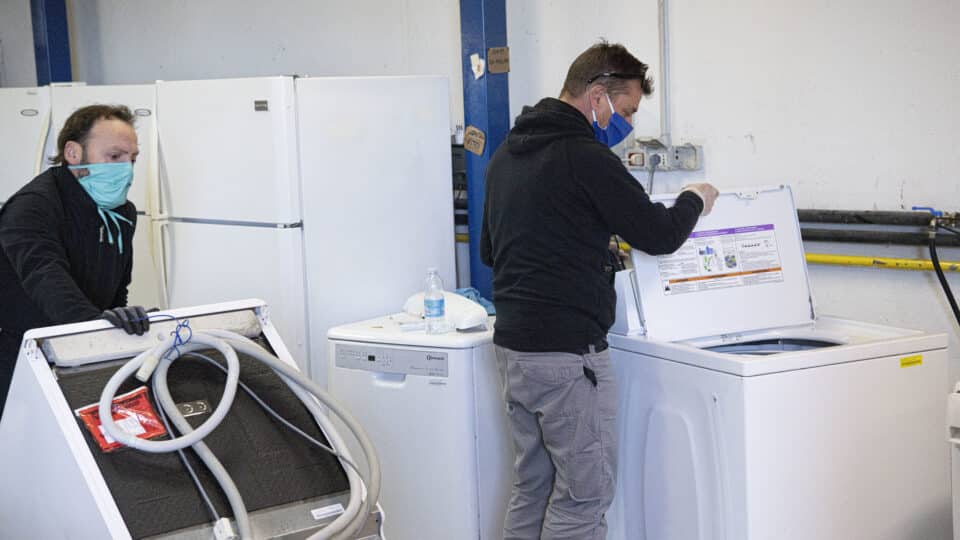
Illustrative archive main image: Pvt. Joshua Shaw / U.S. Army, Italy, 2020, public domain. Photo source. The image does not show a repair service in Romania in 2026.
The best appliance is the one that operates safely at a justified total cost
Repair or replace? The right financial answer is neither a magic percentage nor a reflex to buy the latest model. If the appliance qualifies for a free remedy under the law, use that right before paying. If the repair is chargeable, compare the full quote, additional expected service life, safety, energy use and the actual price of replacement.
Sometimes, a door seal costing a few hundred lei is all that separates a good appliance from an unnecessary replacement. At other times, an expensive repair to a heavily worn appliance merely postpones an inevitable purchase and doubles spending. The difference is found in the documents, calculations and diagnosis — not in promises.




Discuția cititorilor
Ai o opinie sau o întrebare despre acest articol? Spune-ne ce crezi.
Fii primul care deschide discuția.
Te rugăm să păstrezi un limbaj civilizat și să discuți la subiect. Comentariile spam sunt filtrate automat.