
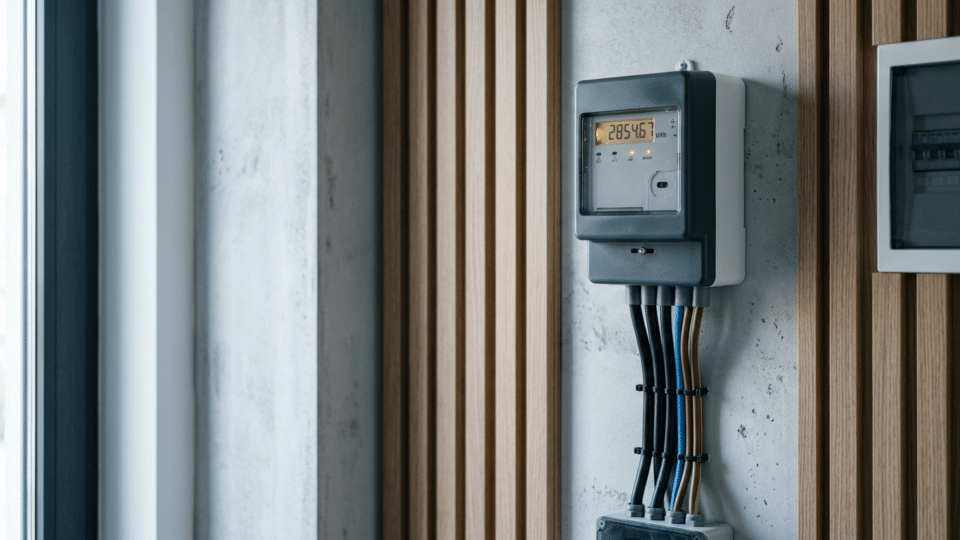
On 30 June 2026, Romania’s National Energy Regulatory Authority (ANRE) announced a mechanism under which final customers could activate, free of charge, a notification when their consumption reaches a pre-selected threshold of no more than 80% of the estimated monthly consumption set out in their consumption agreement. The alert would be sent by email, SMS or another electronic channel agreed with the supplier.
What matters for consumers: as of the reference date for this document review, 9 November 2026, ANRE had announced the measure and put it out for public consultation. However, the official sources reviewed did not identify a published final order demonstrating that the obligation was already applying uniformly to all suppliers. A statement on the authority’s intentions is not a substitute for a published legal act.
For more information about ANRE, see ANRE’s traffic-light system: six colours for energy suppliers, with complaints also counting from 2027, which provides further details relevant to this subject.
This does not mean that a comparable function may not already be available in your supplier’s app, or that you cannot access consumption measured by the distribution operator. It means you need to check separately what is offered under your contract, in the app and by the type of meter installed at your supply point.
ANRE’s announced electricity-use alert: what it is intended to do
In its 30 June 2026 statement, ANRE described the service as optional for the customer and activatable through a free online account provided by the supplier.
The wording “up to 80%” carries an important qualification. It does not necessarily mean a notification sent exactly at 80%. Under the announced model, the customer would set a threshold, which could not exceed 80% of the estimated monthly consumption in the consumption agreement.
The message was intended to show three basic pieces of information:
- consumption recorded up to that point;
- the estimated monthly consumption used as the benchmark;
- the percentage of that estimate already reached.
It is an information tool. It does not disconnect the supply, change the electricity price, rewrite the consumption agreement or remove any difference that may appear when the bill is adjusted. It may, however, flag earlier that the estimate no longer reflects how the home is being used.
Why the announcement does not confirm that the rule already applies
A general obligation applying to suppliers must follow the full process: a draft regulation, public consultation, approval by order, official publication and entry into force. These stages are not interchangeable.
In its June statement, ANRE gave 1 October 2026 as the implementation date for the online account. But on 2 October 2026, the authority was still publishing the third phase of public consultation on the draft amending the Regulation on the Supply of Electricity to Final Customers. The stated deadline for comments was 16 October 2026.
This timeline does not show that the draft was abandoned. It does show that it would be unwise to treat the date in the statement as automatic confirmation that every supplier was already under an enforceable obligation on 1 October.
Moreover, ANRE’s document on the Regulatory Committee meeting of 6 October 2026 indicates approval of an order on the framework procedure for resolving final-customer complaints, rather than an order explicitly introducing the consumption-threshold alert. The review of public documents available for this article did not identify the final order concerning the alert.
The accurate wording until a final act appears: ANRE announced and consulted on an alert mechanism; the general right to request this alert from any supplier is not demonstrated by that announcement alone.
A useful alert depends on the data reaching the supplier
The supplier manages your contract and bill. The distribution operator manages the network and consumption metering. For a supplier to send an alert close to the point when the threshold is passed, it needs sufficiently up-to-date consumption data.
This is where the difference between an online account and a smart meter matters. An online account can be available to any customer, but it does not guarantee daily or near-real-time data. A smart meter may transmit information more frequently, but only if it is integrated with, and actually communicating with, the distribution operator’s system.
| Situation at the supply point | What you can generally see | Limitation for a threshold alert |
|---|---|---|
| Connected smart meter | More frequent data, depending on the distribution operator’s system | Data transmission and processing are not necessarily instantaneous |
| Conventional meter | Periodically read meter index, self-reading or estimates | The alert may be delayed or based on data that are not sufficiently current |
| Estimated billing | Consumption calculated from the consumption agreement | An alert cannot turn an estimate into an actual reading |
| Supplier’s commercial app | Possible charts, bills and its own notifications | The function does not prove that an ANRE obligation applies to all suppliers |
The current billing framework explains why not all households can receive information of the same quality. The supply regulation amended by ANRE Order No. 6/2024 provides for a meter-reading interval of no more than three months for household customers and requires suppliers to state on the bill whether the meter index came from the operator’s reading, a customer self-reading or an estimate. The text is available on the Legislative Portal.
If your bill states “estimate”, an alert based on data that have not been updated may be less useful than it appears. If self-reading is available, submitting the meter index during the period shown on the bill remains one of the most concrete ways to reduce the gap between actual consumption and the estimate.
Smart meters are not evenly distributed across Romania
Metering is becoming more digital, but the pace differs between distribution areas. A nationwide notification promise should therefore also be seen in the context of local infrastructure, without confusing one operator’s service area with the situation across the country.
Delgaz Grid reported 586,000 smart meters installed at the end of 2025, of which 525,000 were integrated into the smart-metering system. In its development plan, the company indicated around 54% smart-metering coverage in 2026 and a higher target for subsequent years.
Rețele Electrice Romania says the data available in an account depend on the type of meter and its communication with the central system. Distribuție Oltenia, meanwhile, says it has installed more than 550,000 smart meters, but estimates that all consumers in its service area will be covered only by the end of 2033.
This does not mean an alert is impossible for customers without a smart meter. It means that its timeliness and accuracy may differ, and that an obligation framed nationally does not automatically produce data at the same frequency for every supply point.
What you can do now, without waiting for an automatic alert
- Log in to your supplier account. Check for notification options, consumption data, history, or email and SMS preferences. Some services may be offered voluntarily before any general obligation takes effect.
- Check the type of meter index on your latest bill. Look for a reference to an operator reading, self-reading or estimate. This indicates how closely the bill reflects actually measured consumption.
- Submit a self-reading on time, if that option is available. Record the index and keep the confirmation sent through the app, website or call centre.
- Compare your consumption with the consumption agreement. If household members work from home, you have installed air conditioning, a heat pump or an electric water heater, or the number of people in the home has changed, the old estimate may no longer be appropriate.
- Request missing information in writing. You can ask the supplier whether it offers consumption notifications, whether they are free, how they are activated and which data source they use.
For the difference between a meter reading, an estimate, the tariff and the total amount due, see also InfoBuz’s guide to reading an electricity bill and comparing offers.
What an 80% consumption alert does not solve
An alert can provide time to check what is happening, but it is not a safeguard against every high bill. It does not itself reduce consumption, automatically amend the agreement or correct an incorrect meter index.
Hypothetical example: if a household has an agreed estimate of 200 kWh a month and sets the maximum 80% threshold, the alert would concern reaching around 160 kWh. If the household actually uses 350 kWh in a month, the message may show early that the estimate has been exceeded. The final amount will still depend on actual consumption, the contractual price, applicable taxes and how the meter indices were obtained.
The alert may instead be useful as a prompt for two practical decisions: checking an unusual increase in consumption and updating the consumption agreement where the contract terms allow it. During periods of electric heating or intensive air-conditioning use, the difference between an old estimate and actual consumption can grow quickly.
How the situation was checked
The analysis compared the ANRE statement describing the measure with the official page for the draft under consultation, Regulatory Committee documents and the published legal framework for billing. Public information from distribution operators was consulted for the technical aspect. The limitation of this review is important: the absence of a final order from the official documents identified does not conclusively prove that an act could not later appear in another publication or update. This is why the article does not state that the measure was cancelled, but that its general application was not confirmed by a final order identified in the sources reviewed.
If a supplier tells you the service is available, ask for the practical details in writing: the possible thresholds, the alert channel, how often the data are updated, and whether the function relies on an actual meter reading, self-reading or an estimate. Those four answers are more useful than the simple promise of an SMS.
Frequently asked questions
Is the 80% consumption alert already mandatory for all suppliers?
ANRE announced the mechanism, but the review of official documents cited in this article did not identify a published final order confirming the general application of the obligation as of the reference date, 9 November 2026.
Will I automatically receive an SMS when consumption reaches 80%?
In the form announced by ANRE, the service was to be activated by the customer through an online account and could be sent by SMS, email or another agreed electronic channel. It was not described as an automatic SMS for every customer.
Will the alert prevent a large bill adjustment?
No. The alert is informational: it does not change actual consumption, the contractual price, the billed meter index or the amount owed. It may, however, help identify a difference from the estimate more quickly.
What can I do if my bill is based on an estimate?
Check the self-reading period displayed by the supplier and submit the meter index on time, if that option is available. The bill must state whether the meter index comes from an operator reading, self-reading or an estimate.
Sources consulted
- ANRE — Statement on the online account and the consumption-threshold notification
- ANRE — Draft order amending the Supply Regulation, phase III
- ANRE — Documents approved at the Regulatory Committee meeting of 6 October 2026
- Legislative Portal — ANRE Order No. 6/2024 on the Supply Regulation
- Delgaz Grid — 2026–2035 development plan





Discuția cititorilor
Ai o opinie sau o întrebare despre acest articol? Spune-ne ce crezi.
Fii primul care deschide discuția.
Te rugăm să păstrezi un limbaj civilizat și să discuți la subiect. Comentariile spam sunt filtrate automat.