
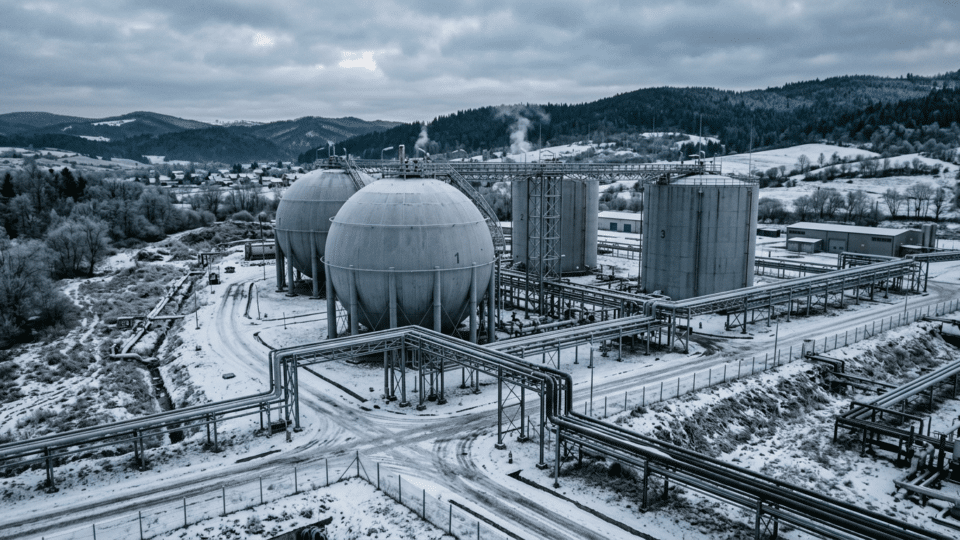
Romania began the 2026–2027 heating season with gas storage facilities fuller than the European Union average. On 2 November 2026, the AGSI+ platform of Gas Infrastructure Europe (GIE) showed storage facilities in Romania were 88.62% full, equivalent to 30.01 TWh, compared with 74.56% and 844.25 TWh across the EU as a whole.
The difference matters, but it does not guarantee prices. The International Energy Agency (IEA) warns that Europe entered winter with its lowest storage buffer in more than a decade. In an interconnected market, a cold winter, infrastructure failure or stronger competition for liquefied natural gas shipments could raise the price of gas bought in the region. Romania is physically better positioned than the European average, but it is not economically insulated.
What we know now: the available data do not support the claim that Romania is entering the 2026–2027 winter “without gas”. They do, however, point to a more nuanced risk: Europe’s low gas reserves may keep pressure on the regional market, with possible effects on industry and electricity generation. For households, any effect on bills also depends on contracts, consumer-protection mechanisms, tariffs and regulatory decisions.
Europe’s low gas reserves: Romania starts above the EU average
Gas Infrastructure Europe data provide a snapshot of the gas in storage on the reporting date. They are not a forecast for the whole winter, nor can they be directly converted into “days of self-sufficiency”. Consumption, domestic production, imports, withdrawal capacity and transport routes differ from country to country.
| Indicator, 2 November 2026 | Romania | European Union | What it actually shows |
|---|---|---|---|
| Gas in storage | 30.01 TWh | 844.25 TWh | The volume held in storage, not guaranteed future consumption. |
| Storage level | 88.62% | 74.56% | Romania was 14.06 percentage points above the EU average. |
| Cautious interpretation | A relatively better starting position for Romania | It does not remove exposure to the regional market and price shocks. | |
The 14.06-percentage-point difference is a simple editorial calculation: 88.62% minus 74.56%. It does not compare the absolute size of Romania’s reserves with those of Europe as a whole, nor does it automatically measure how long consumption could be covered. A country may have storage facilities that are full in percentage terms but have lower total capacity, a different consumption profile or other network constraints.
The European average, moreover, conceals sharply different situations. On the same date, GIE reported 61.05% in Germany, 66% in Austria, 86.4% in France, 91% in Italy and 99.28% in Poland. There is therefore no single “gas situation” that applies in the same way to every member state.
Why healthy local storage does not stop price pressure
Gas does not circulate in a completely separate economy for each country. Romania has domestic production, storage facilities and interconnections, but wholesale prices are influenced by the balance of supply and demand at regional and European level. When Europe needs to buy more gas at short notice, competition for available volumes can intensify.
In an analysis published on 3 November 2026, the IEA says that lower European storage levels increase reliance on LNG, or liquefied natural gas transported by ship. LNG volumes that can be redirected quickly are not reserved exclusively for Europe: they compete with demand from Asia and other markets.
This is the practical link for Romania. Even if a Romanian supplier or consumer does not buy an LNG cargo directly, the cost of gas on European markets can influence offers, contracts and commercial decisions in the region. The effect is neither automatic nor identical for every customer, but the transmission mechanism exists.
The IEA identifies several conditions that could intensify the strain: below-normal temperatures, technical outages, supply disruptions and stronger demand for LNG. The agency does not say these scenarios will necessarily occur, nor does it forecast a Romanian household’s bill. It signals that Europe’s buffer is smaller, reducing the market’s ability to absorb shocks.
Full storage does not mean gas is available instantly
A storage percentage is useful, but incomplete. On very cold days, what matters is not only how many TWh are stored, but also how much gas can be withdrawn each day, how much the network can transport, and the simultaneous demand from households, district heating systems, power plants and industry.
The development plan for the National Gas Transmission System prepared by Transgaz explains this complementarity: storage helps balance seasonal demand and cover peaks, but gas must be injected, withdrawn and delivered through the transmission network to consumers.
In other words, the question “how much gas is in storage?” is not the same as “how much gas can reach consumers on a given day?”. A complete operational assessment would require data on withdrawal rates, storage pressure, transmission capacity, cross-border flows and daily consumption forecasts. These factors cannot be inferred from the GIE percentage alone.
Who may feel a tighter European market first
The pressure is not transmitted evenly. Companies buying gas on the wholesale market, or holding contracts exposed to quoted prices, may feel volatility sooner than households with administratively protected prices. Large industrial consumers may also have less room to manoeuvre if gas becomes more expensive during periods of high demand.
Gas can also matter for electricity. Gas-fired power plants become more important when renewable generation is low, hydropower is weak or consumption rises. More expensive fuel can increase the cost of electricity generation during those hours, without automatically meaning an immediate rise in every bill.
For households, the connection is more indirect. The final price depends on the applicable regulatory framework, contract terms, suppliers’ procurement, network tariffs and taxation. Without an official decision and specific offers for the period after 31 March 2027, there is no solid basis for calculating or forecasting an exact bill.
Readers receiving assistance with heating costs should separately follow the eligibility rules and administrative deadlines. These are explained in InfoBuz’s article on heating assistance for the 2026–2027 season; the level of European gas storage does not, by itself, change the conditions for receiving it.
Why pressure may continue after the cold season
The IEA’s warning is not limited to the winter months. If European storage facilities are drawn down further during a cold season, they must be refilled in the following months. The agency estimates that this need to replenish stocks could sustain competition for LNG into the summer of 2027.
It is a counterintuitive point: a winter may pass without supply interruptions, while the cost of preparing for the next one remains high. This is not a certainty about the course of market prices. Industrial demand, weather, new LNG capacity and production from other sources can alter the picture. It is, however, why storage levels at the start of the season remain relevant after temperatures rise.
Indicators worth watching in winter 2026–2027
- GIE storage: not only the filling percentage, but also the pace of withdrawals from storage during cold spells.
- Temperatures and consumption: prolonged freezing periods increase demand for heating and power generation.
- European wholesale prices: these indicate market pressure, but do not directly represent a household bill.
- LNG flows and infrastructure: delays, failures or route changes can quickly alter available supply.
- Announcements by authorities and operators: these may clarify security levels, market rules or measures applied to consumers.
The sound conclusion, based on data from 2 November 2026, is a balanced one: Romania enters the season with a storage advantage over the EU average, reducing its vulnerability to an immediate shortage. The gas market, however, remains European and global. Europe’s lower reserves may put pressure on costs even in a country with relatively well-filled storage facilities.
For more information on natural gas, see also Romania’s gas storage facilities: Bilciurești and Depomureș enter a new phase, which provides complementary details on the subject.
Frequently asked questions
Does Romania have enough gas for winter 2026–2027?
On 2 November 2026, Romanian storage facilities were 88.62% full, above the EU average of 74.56%, according to GIE. This indicator suggests a relatively strong starting position, but it is not by itself sufficient to assess every peak-demand day, as withdrawal, transport, consumption and imports also matter.
Why do European gas stocks matter for Romania?
Romania has its own production and storage facilities, but it participates in a regional market. If Europe has to compete more intensely for LNG or supply disruptions occur, wholesale prices can also be affected in the region.
Do lower EU storage levels mean higher household bills?
Not automatically. The final price for households depends on regulation, the supply contract, suppliers’ procurement, tariffs and taxes. Storage data indicate a market risk, not an individual bill estimate.
What is the difference between gas in storage and gas delivered on a cold day?
Storage facilities show the volume accumulated for the season. On a cold day, the withdrawal rate, pipeline capacity and simultaneous consumption also matter. A high storage percentage is therefore not equivalent to unlimited instant availability.



Discuția cititorilor
Ai o opinie sau o întrebare despre acest articol? Spune-ne ce crezi.
Fii primul care deschide discuția.
Te rugăm să păstrezi un limbaj civilizat și să discuți la subiect. Comentariile spam sunt filtrate automat.