
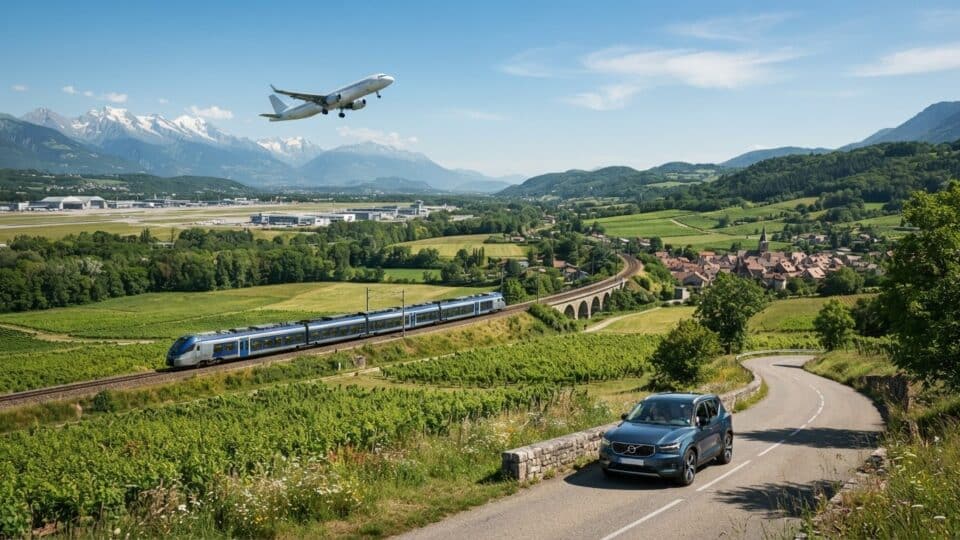
Holiday transport can cost much more than the flight or rail fare, or the fuel estimate shown at first. To choose between flying, taking the train and driving, add up fees, baggage, transfers, parking, time and costs for the whole family. This InfoBuz guide provides formulas, scenarios and a booking checklist.
Holiday transport: how to compare plane, train and car travel properly
When planning a trip, the lowest advertised price is not always the cheapest option. A promotional flight may add baggage and transfer costs; rail travel may require reservations; and driving involves fuel, tolls, parking and wear and tear. A proper comparison runs from your front door to the destination, for every traveller.
The choice also depends on the time available, baggage flexibility, comfort, the number of people travelling, the children’s ages and the route. No single mode of transport wins at every distance. This guide uses calculation methods and hypothetical examples, not current price offers.
Cost per person versus group cost
For flights and rail journeys, prices are usually calculated per ticket, subject to available exceptions and discounts. With a car, some costs are shared by the group. That is why an option that is good value for one traveller can become much more expensive for a family of four.
Before booking, create two columns: the total cost for the group and the average cost per person. Remember that children may be eligible for reduced fares, subject to age limits or rules on occupying their own seat. Check each operator’s terms.
What is included in the real cost of a car journey
Calculate the round-trip distance, realistic fuel consumption and the price paid at the pump. Add road and bridge tolls, parking, any overnight stay en route and the cost of extra stops. If you are crossing borders, check driving rules and the documents required.
For a full economic comparison, it is also worth including wear and tear: tyres, servicing, depreciation and maintenance. This is not a cash payment for every journey, but using a car carries a per-kilometre cost that can change the outcome over long distances.
How to calculate fuel costs without misleading yourself
The basic formula is: kilometres travelled multiplied by consumption in litres per 100 km, divided by 100, then multiplied by the price per litre. For 1,400 km and a hypothetical average consumption of 6.5 l/100 km, the result is 91 litres. At an illustrative price of 7.50 lei per litre, fuel would cost 682.50 lei.
Do not treat these figures as current prices or consumption figures for any particular car model. Baggage, speed, traffic, air conditioning and terrain can all affect fuel consumption. Use your car’s real average on a comparable route and the actual prices on your chosen route.
Parking can change the ranking
An urban destination with expensive parking can make driving less appealing. Hotels sometimes include parking; at other times, the daily charge is substantial. If you will use public transport at the destination while the car remains parked, that cost should be considered.
When comparing with rail or air travel, also include the local journey from the station or airport. A 50 km transfer can add money and time; the airport is not always in the final city. Look for official bus, rail or local-transport options.
Airfare: why the advertised price can be misleading
Check the personal item allowance, cabin bag, checked baggage, seat selection, whether you can sit beside children and any fees for changing the flight. A promotional fare may work well for one person travelling light, but not for a family with several suitcases.
Compare the final price after adding the services you need. In some cases, it is also worth checking flights to different airports, but any saving on the ticket should be weighed against transfers and the extra journey time.
An airport journey involves more than the flight time
Total time includes travelling to the airport, arriving before departure, security screening, any formalities, boarding, landing, collecting baggage and transferring to the accommodation. A one-hour flight can involve many hours of door-to-door travel.
For a family, a delay or missed connection can have greater practical consequences than a price difference. Compare both the estimated median journey time and the risk of delays, without claiming that this risk can be predicted precisely.
Train travel: the advantages of a city-centre-to-city-centre journey
On some routes, trains connect central areas, allow passengers to move around the carriage and can avoid airport time. Travellers can read or work, while parents can manage children’s breaks differently. These advantages matter especially on medium-distance trips with convenient connections.
The cost depends on class, train type, purchase date and ticket flexibility. Check seat reservations, family facilities, accessibility, bicycle transport and baggage rules. Separate connections may offer different protections from those under a single ticket.
Separate tickets versus a single itinerary
By rail, one ticket covering several segments may provide specific rights if you miss a connection because of a delay. Two separately purchased tickets may be subject to different rules. Similarly, for air travel, it matters whether the segments are part of the same booking.
Before choosing the cheapest combination, check the time allowed between connections, the operator’s obligations and the cost of possible rebooking. A slightly more expensive but more robust itinerary can significantly reduce travel stress.
An illustrative example for a family of four
Assume a holiday 700 km away, or 1,400 km return. For the car: 682.50 lei for fuel, 90 lei in tolls and 100 lei for parking, for a total of 872.50 lei in direct expenses. Adding estimated wear and tear at 0.40 lei/km brings the economic cost to about 1,432.50 lei.
For comparison, imagine rail travel costing 720 lei in total for the group, and flights costing 960 lei for tickets plus 500 lei for baggage and transfers: 1,460 lei. These figures are entirely hypothetical and were chosen to demonstrate the method. The destination, period, family and actual operators can reverse the order.
Time also has a cost, but not the same one for everyone
If a long car journey takes two days and requires an overnight stop, add accommodation, meals and the driver’s effort. For someone working to a fixed schedule, the hours saved may justify a more expensive flight. In other cases, the journey itself can be part of the holiday.
Do not automatically convert every hour into money using the same value for every person. A family with young children, a business traveller and a tourist who wants spontaneous stops have different priorities. Write down explicitly what matters to you before choosing a mode of transport.
Holiday travel with children: schedules, breaks and baggage
By car, you can transport bulky equipment more easily, but you need to plan breaks and use child restraint systems appropriate for children. On some routes, rail travel may provide more freedom to move around. Flying shortens certain distances, but involves formalities and baggage limits.
Check operators’ policies on pushchairs, car seats, liquids and products needed for a child. Do not assume that all companies apply identical rules. On long journeys, safety and the driver’s rest should take precedence over saving a few hours.
Holiday travel with a pet
Rules vary considerably by type of transport, country and operator. Airlines may impose weight limits, cabin-travel restrictions and carrier requirements; rail operators apply their own conditions. In a car, an animal needs a safe means of transport and breaks.
Check veterinary documents and entry requirements for the countries you will visit well in advance. Do not decide on price alone: the animal’s welfare and the total journey time are important criteria.
Flexibility and cancellation risk
A private car often offers greater flexibility over the departure time, but may be affected by traffic, breakdowns or weather. Rail travel has a timetable and may involve connections; flights may have change restrictions, cancellations and delays. For each option, consider a backup plan.
Choose flexible tickets only if the value of flexibility justifies the price difference. Save the booking terms and the operator’s contact information. Travel insurance may provide certain cover, but exclusions and limits should be read carefully.
EU air and rail passenger rights
The European Union provides specific rights in certain cases of cancellation, delay or denied boarding. The conditions vary by mode of transport, operator, route and the circumstances of the event. Not every delay automatically results in the same compensation, and the right to assistance is separate from the right to compensation.
Check the current rules at Your Europe – Air Passenger Rights and Your Europe – Rail Passenger Rights. Keep tickets, communications from the operator and proof of extra expenses.
Environmental impact
Distance, occupancy, vehicle technology and the energy source all matter when comparing climate footprints. A well-filled train can have significant advantages on many routes, but it is not accurate to apply the same emissions figure to every train. Nor does an electric car automatically have a zero footprint over its full life cycle.
If climate impact is a decisive criterion, use transparent calculators that state their assumptions. Avoid drawing conclusions solely from whether a means of transport has an internal-combustion engine on board.
When driving may be preferable
A car can be attractive for larger groups, dispersed destinations, substantial baggage and itineraries with stops. If public-transport infrastructure is limited at the destination, savings made later may justify the drive.
Disadvantages may include fatigue, the stress of driving, parking and running costs. Check local access restrictions and, on long routes, share driving where possible and take proper breaks.
When rail or air travel may be preferable
Rail can come out ahead on comfort, the central location of stations and avoiding driving on well-connected routes. Flying can be advantageous over long distances or when a rail connection would take too much time. Neither advantage is guaranteed on every route.
The comparison should be repeated for the exact travel period, as prices and timetables change. A combination of train, plane and local transport can sometimes be more suitable than a single mode for the entire route.
Final checklist before booking
Put the cost for all travellers, included baggage, transfers, road tolls, parking, departure and arrival times, total door-to-door time and cancellation conditions on the same sheet. Add the time buffer needed for connections and a backup plan.
Check travel documents, relevant insurance, conditions for children and pets, and each operator’s policies. Do not book on the basis of a single price displayed by a search engine; confirm the total and the terms when completing the booking.
Frequently asked questions
Is driving always cheaper for a family? No; it depends on distance, fuel consumption, tolls and ticket costs. Does a cheap flight beat the train? Not always, once baggage and transfers are added. Should wear and tear be included? Yes, for a full economic comparison; for an immediate budget, you can show direct expenses separately.
Can I claim compensation for a delayed train? Under certain conditions, yes, according to the applicable rules. When should I book? There is no universal rule; monitor fares and flexibility for your period.
Recommended further reading
For further details, read How to plan charging stops for an electric car on holiday, a complementary guide published by InfoBuz.ro.
For further details, read Which documents to check when travelling on holiday with a child, a complementary guide published by InfoBuz.ro.
Sources and methodology
For the European passenger-protection framework: Your Europe – air travel, Your Europe – rail travel and European Commission – passenger rights, 2026. Other guides are available from InfoBuz.ro.
All fares and fuel-consumption figures in the examples are hypothetical, not the results of a ticket search or fuel-price offers for an actual date and route. Editorial review: 22 November 2026.


Discuția cititorilor
Ai o opinie sau o întrebare despre acest articol? Spune-ne ce crezi.
Fii primul care deschide discuția.
Te rugăm să păstrezi un limbaj civilizat și să discuți la subiect. Comentariile spam sunt filtrate automat.