
Spider sleep is more complex than their apparent stillness might suggest. A study presented by the University of Bonn on October 27, 2026 describes two distinct states in Portia fimbriata, including one with REM-like features. The research provides behavioural evidence of regulated sleep; it has not demonstrated that the spiders experience dreams. The university’s announcement explains the findings and the experiments’ limitations.
The appeal of the subject is obvious: an animal so unlike us appears to go through familiar nightly alternations. Scientifically, though, the more precise question is this: how can researchers distinguish a sleeping spider from one that is simply keeping still?
The answer requires more than striking footage. It calls for repeated observations, controlled interventions and a definition of sleep that can be tested without the animal being able to report what it experienced.
What the study shows about spider sleep
The team monitored Portia fimbriata specimens over several days and nights. It used infrared recordings, different lighting conditions, sound stimuli and tests following sleep disruption. The researchers observed quiet phases as well as episodes involving eye movements and muscle twitches. They also assessed recovery of lost sleep, known as sleep rebound. Bonn describes this combination of observations and tests as the basis for identifying behavioural sleep.
The paper is titled Behavioral evidence for two-stage sleep in spiders and is authored by Nadja Geiger and colleagues. The wording of the title matters: the evidence is behavioural. The authors state that they did not measure the spiders’ brain activity in these experiments.
Why stillness is not enough
Imagine two motionless animals. One is tracking prey; the other is deeply at rest. A photograph might make them look almost identical. To tell the difference, researchers need to examine what happens before, during and after that period.
One useful test examines the response to a stimulus. If that response changes according to the observed state, it provides information beyond the mere absence of movement. Alternative explanations must still be ruled out: the animal may not perceive the stimulus, may have become accustomed to it, or may be affected by the experimental conditions.
That is why a convincing protocol does not rest on a single sign. The evidence has to work together. Posture describes the context; the response to disruption tests readiness to react; and subsequent behaviour shows whether the organism compensates for losing a state.
| Researcher’s question | What the observation can show | What it cannot prove on its own |
|---|---|---|
| Is the animal motionless? | Identifies a period of rest. | That the rest is sleep. |
| Does it respond differently to disruption? | Helps define the behavioural state. | What mental content the animal has. |
| Does it make up for disrupted rest? | Supports the existence of a regulated need. | That the mechanism is identical to the human one. |
| Do repeated episodes involving movement occur? | Allows distinct states to be investigated. | That the animal dreams. |
The table sets out the logic of verification; it does not replace the study’s protocol. A conclusion gains strength from agreement among tests and from controlling for alternative explanations.
Spider sleep and the precise meaning of “REM-like”
REM stands for rapid eye movement. In humans, sleep phases are classified using several measurements, including brain activity. The US National Heart, Lung, and Blood Institute (NHLBI) describes an alternation between non-REM sleep, which has three stages, and REM sleep. Dreams often occur during REM sleep, but naming a phase does not record the content of a dream.
The term REM-like keeps the comparison at the level supported by the data: certain features are similar. It does not state that all mechanisms, functions and experiences are the same. That distinction is necessary when comparing organisms with very different nervous systems.
A methodological analogy may help: two devices can have an indicator light that flashes in the same way without performing the same internal operation. The similarity is worth investigating, but what produces the signal still needs to be established. In biology, this is harder, because a living organism does not come with a complete operating diagram.
For further context, see also Two earthquakes of the same magnitude can cause different levels of destruction: why depth and soil matter, an article that develops an aspect directly related to this topic.
For that reason, saying that “spiders dream” would go beyond the observations. It may be a legitimate research question, but it is not the result demonstrated by their nocturnal movements.
Clues predated the 2026 study
In 2022, a paper published in PNAS described repeated episodes of retinal movement in juveniles of Evarcha arcuata, another jumping spider. Their temporarily translucent exoskeletons made it possible to track internal structures. Jumping spiders do not move their lenses as humans do, but can move their retinal tubes to redirect their gaze.
The observed movements occurred in regular sequences and were associated with some limb movements. The authors discussed the existence of a REM-like state. The 2026 study therefore continues a question that had already been raised, adding tests of sleep’s nature in another species.
This is a common progression in science: an unusual observation generates a hypothesis, and experiments are then designed to support or challenge it. For readers, the chronology helps put the novelty in perspective. Not every study starts from zero, and not every press release announces the first observation of a phenomenon.
A small animal can raise a large question
Spider sleep belongs to a broader body of research on rest across the animal kingdom. In 2017, a Caltech team described a sleep-like state in jellyfish of the genus Cassiopea: reduced activity, an altered response to stimuli and compensation after rest was disturbed. The study in Current Biology is relevant because these animals have a decentralised nerve net.
The jellyfish finding does not demonstrate REM sleep, nor does it automatically explain the case of spiders. It does, however, show how far the question of sleep can extend when researchers choose very different organisms. A definition limited to the way humans sleep could miss other biological forms of the phenomenon.
In research on spider sleep, comparisons between species may help separate shared traits from species-specific adaptations. If a particular process occurs in organisms that are evolutionarily very distant, it is worth investigating how old it may be and what biological problem it solves. Similar behaviour alone does not establish a shared ancestral mechanism; further evidence is needed.
What questions remain open
One important next step is linking behaviour to the neural processes that produce it. Another question is how widespread the observed alternation may be: a finding in one species cannot automatically be extended to all spiders, insects or invertebrates.
Future experiments could test the relationship with learning. A persuasive demonstration would need to compare measurable performance, under controlled conditions, before and after interventions affecting sleep. The fact that an animal has complex hunting behaviour does not in itself prove that a particular nocturnal phase consolidates its memory.
The environment also matters. The university mentions research into the effects of artificial light at night on these animals. The subject connects with InfoBuz’s analysis of light pollution and the changing night. In the study presented here, however, sleep disruption caused by urban lighting is not an established finding.
What this research says about our own sleep
Research on spider sleep contributes, first and foremost, to the understanding of biology. It does not produce a new treatment recommendation for insomnia, nor a sleep schedule that can be borrowed from spiders. Questions about human sleep require studies in people and an assessment of an individual’s medical circumstances.
If the starting point is a feeling of tiredness, InfoBuz’s article on waking tired after eight hours of sleep addresses that issue separately. Its connection to the zoological finding is an interest in sleep, not a clinical conclusion transferred between species.
Frequently asked questions about spider sleep
Has it been proven that spiders dream?
No. Behavioural traits similar to a REM state have been identified. Observing a movement and identifying a subjective experience are different levels of evidence. The study provides no access to the animals’ mental content.
Were all spiders studied?
No. The research presented in October 2026 concerns Portia fimbriata. The 2022 paper examined Evarcha arcuata. The diversity of species makes further verification necessary before drawing general conclusions.
How can sleep be studied without electrodes on the brain?
By defining and testing behavioural criteria. The regularity of the state, the response to disruption and the reaction after interrupted rest all matter. The findings nevertheless remain different from a direct measurement of neural activity.
Why does the finding matter if it does not prove dreams?
Because it enables more precise questions about the organisation and evolution of sleep. Identifying a regulated state and distinct phases provides a basis for future experiments, even though the issue of subjective experience remains open.
A finding worth examining closely
Spider sleep is becoming a more clearly defined experimental subject. The most interesting shift is from the image of a motionless animal to tests that examine what kind of state it is in. The finding is surprising enough without adding dreams that researchers have not been able to demonstrate.
Sources and further reading
- University of Bonn: How deeply do spiders sleep? — October 27, 2026
- Geiger and colleagues: Behavioral evidence for two-stage sleep in spiders, PNAS; paper cited by the authors — 2026
- Rößler and colleagues: retinal movements and REM-like states in spiders, PNAS — August 8, 2022
- Nath and colleagues: The Jellyfish Cassiopea Exhibits a Sleep-like State, Current Biology — September 21, 2017, online publication
- NHLBI: Sleep Phases and Stages — March 24, 2022
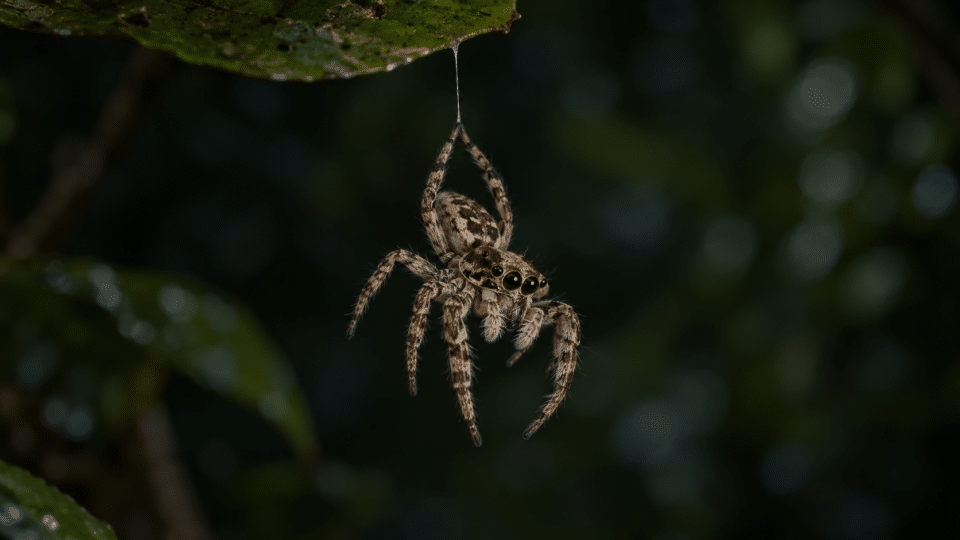
Representative image: AI-generated editorial illustration for InfoBuz.


Discuția cititorilor
Ai o opinie sau o întrebare despre acest articol? Spune-ne ce crezi.
Fii primul care deschide discuția.
Te rugăm să păstrezi un limbaj civilizat și să discuți la subiect. Comentariile spam sunt filtrate automat.