
Updated: 27 October 2026 la 00:12. Articolul a fost revizuit pentru a reflecta informațiile disponibile la această dată.
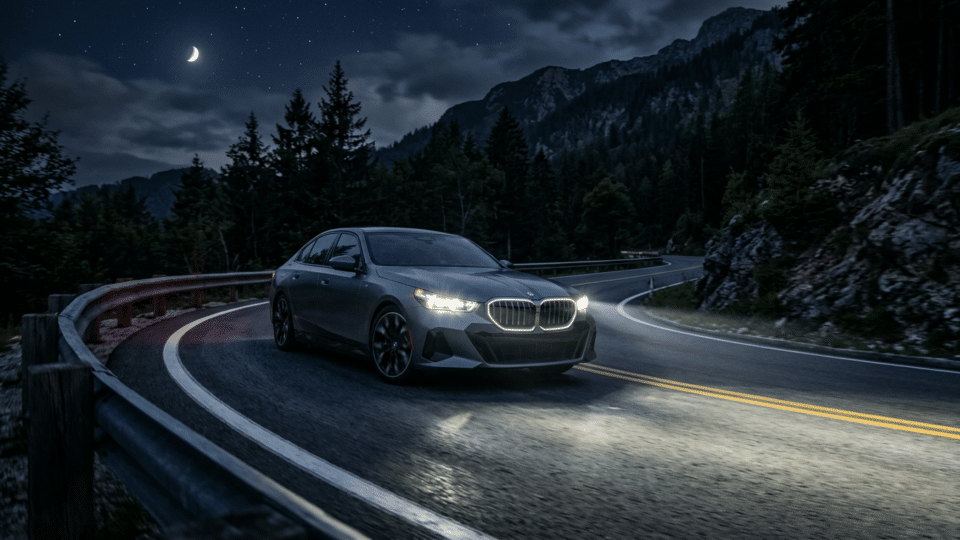
Adaptive LED and Bi-Xenon headlights are among the most useful technologies for night driving, but also among the most misunderstood systems in a modern car. Bright light alone is not enough: the beam must illuminate the road without dazzling oncoming drivers, adapt in corners and, in some configurations, take account of speed, weather and other vehicles. If just one component stops working properly, the performance of the entire system can deteriorate sharply.
This guide explains the differences between Bi-Xenon AFS headlights, adaptive LEDs and Matrix LED, how VarioX mechanisms work, the sensors required, signs of a fault and the repair costs that may arise. It also examines what Romania’s vehicle authority, the Romanian Auto Registry (RAR), says about replacement LED bulbs, and why an undocumented lighting retrofit can create technical and legal problems.
InfoBuz research: 26 October 2026. The explanations are based on HELLA documentation, UN technical regulations and RAR communications. The prices cited are examples from public listings, not workshop quotations, and the compatibility of any part must be confirmed against the vehicle’s exact configuration.
What does AFS mean, and why are adaptive headlights different from conventional ones?
AFS stands for Adaptive Front-lighting System or Advanced Frontlighting System, terms used for systems that adjust light distribution to driving conditions. In a conventional headlight, light distribution is largely fixed, with a separation between dipped and main beam. An AFS headlight can alter the geometry of the beam or the direction of the projector to provide light where it is most useful, within the manufacturer’s configuration and type approval.
Lighting-system manufacturer HELLA explains that the data used can include steering-wheel angle, vehicle speed and information about driving conditions. Some systems offer modes for urban areas, rural roads, motorways and poor weather. It is a mistake, however, to assume that every car equipped with “AFS” automatically offers all of these modes: implementation differs by brand, model year and version.
Bi-Xenon, adaptive LED and Matrix LED: a technology comparison
| System | How it produces and shapes light | Advantages | Limitations |
|---|---|---|---|
| Adaptive Bi-Xenon | HID electric arc; projector lens and shutter or moving optical element | Intense, well-focused beam; mechanical adaptation | HID bulb, ballast, mechanisms and calibration |
| Adaptive LED | LED semiconductors; optical modules and/or beam movement | Fast response and efficient energy use in many implementations | Thermal management; sometimes costly integrated modules |
| Matrix LED | Individually controlled LED segments, linked to cameras and electronics | Can selectively reduce light directed at other road users | Complex calibration; reliance on camera, sensors and software |
The term “Bi-Xenon” describes an architecture in which the same xenon source can provide both dipped and main beam by changing the light distribution. Some systems use a movable shutter, while others use more sophisticated optical solutions. Adaptive LED does not necessarily mean Matrix LED: some LED headlights turn mechanically, while others adjust the beam electronically without individual segments that mask other vehicles. Likewise, simple automatic high beam should not be confused with Matrix LED.
How VarioX works: different light distributions from the same xenon source
In HELLA VarioX technology, a cylinder with different optical shapes sits between the light source and the projector lens. A stepper motor rotates it, changing the outline of the beam projected on to the road. In practical terms, the light distribution can change without requiring a separate bulb for every driving mode. Combined with a horizontal swivelling module, the projector can also direct light into a bend.
HELLA documentation describes, as implementation examples, urban modes at speeds of up to around 55 km/h, rural-road modes between 55 and 100 km/h, and motorway adaptation above 100 km/h. These thresholds are HELLA technical examples, not universal values; the carmaker sets the actual activation conditions. In a VarioX configuration, light distributions can be provided for town driving, rural roads, motorways and difficult weather conditions, but not all cars have these functions activated in the same way.
What is dynamic cornering light?
When cornering, the system can turn the projector towards the direction in which the car is travelling. HELLA describes a swivel angle of up to around 15 degrees in certain configurations. This does not mean that the headlight “sees around a corner”; it means it illuminates the area the car will enter in the next moments more effectively. In urban traffic, there are also static cornering-light solutions, where an additional segment or bulb lights the side of the road without turning the main assembly.
How Matrix LED works, and why it can keep high beam active for longer
In a Matrix LED headlight, an array of light emitters can be controlled by zone. A camera detects vehicles ahead or approaching from the opposite direction, and the electronic control unit reduces light towards those areas while retaining illumination in other directions. The system therefore does not always have to switch between fully illuminated and fully extinguished high beam. Advanced implementations may control dozens or hundreds of zones, although the number and precision depend entirely on each model’s architecture.
According to HELLA’s description of high-beam assist, these systems use a camera and selective segment control to limit glare for other road users. A poorly calibrated Matrix LED system can lose this masking capability. Replacing a headlight or camera may therefore require specific software procedures and a check of the light distribution using dedicated equipment.
Why adaptive headlights fail: seven causes found during diagnosis
1. The HID xenon light source is worn
HID lamps wear over time and may develop a changed colour, reduced intensity or difficulty igniting. If a xenon headlight flickers on or takes on an unusual pink-purple hue, the light source should be checked. Do not assume, however, that every dim bulb is faulty: the lens, reflector and ballast can produce similar symptoms. A D3S, D1S or D2S lamp is not automatically interchangeable with another; the exact marking and power system must be checked.
2. The xenon ballast or ignition module has a fault
HID headlights use power and ignition electronics operating at very high voltages. HELLA describes ignition pulses that can reach up to 30 kV in certain ballast generations. A faulty ballast may prevent full ignition, but lack of power supply, a poor ground connection, fuses or the light source should be ruled out first. People without training should not open or improvise tests on an HID installation. See HELLA’s technical guide to xenon systems and ballasts.
3. The swivelling motor or optical mechanism is jammed
If the headlight comes on but no longer follows bends, or positions itself incorrectly during its self-test, the fault may lie with a stepper motor, a damaged mechanical linkage or the control module. In some cases, the mechanism works physically but the electronic control unit disables it because of a sensor error or missing calibration. Replacing the entire headlight without reading the fault codes first can be unnecessary expenditure.
4. Suspension level sensors are sending incorrect values
Many xenon and LED configurations with automatic levelling monitor vehicle load to adjust beam height. If a level-sensor link is broken, a connector oxidised or the measured position implausible, the headlights may point too low, remain too high or display an error. The sensor and link should be checked against the suspension geometry and values read with a compatible diagnostic tester.
5. The internal lens, reflector or outer cover is deteriorated
Even with new bulbs, a headlight can perform poorly if the reflector has been damaged by heat or the outer cover has become cloudy. A projector lens may be dirty, while the reflective coating in the optical module may have lost efficiency. Polishing can help only when the issue lies in the outer polycarbonate, not when the reflector is burnt or an internal surface is deteriorated. The cover’s UV protection must be restored, otherwise the effect of polishing can fade over time.
6. Excessive condensation and water ingress have corroded connections
Light, temporary misting after temperature changes does not automatically indicate a fault. Persistent droplets, water pooling at the bottom of the headlight or oxidisation deposits, by contrast, point to a problem that needs investigation. HELLA recommends checking seals, ventilation and connections; moisture can reach the electronic module and cause costly damage. See the manufacturer’s explanation of condensation.
7. The Matrix LED camera, software and calibration are out of sync
In advanced systems, the headlight is only one element. The front camera, sensors and electronic modules must provide consistent information. Calibration may be needed after replacement of the windscreen, camera or a level sensor, or after work affecting the vehicle’s geometry. A headlight that appears to illuminate normally is not necessarily correctly set up for adaptive light distribution. HELLA describes the special adjustment procedure for HD Matrix headlights.
Proper diagnosis: what a specialist workshop checks
- Identification of the OEM configuration: headlight code, source type, presence of AFS, sensors and control modules.
- Visual inspection: housing, mountings, lenses, condensation, connectors, ventilation and evidence of previous work.
- Fault-code reading: the AFS unit, headlight electronics, level sensors and camera, where fitted.
- Live-data checks: angles, positions, power supply, actuator statuses and communication between modules.
- Active tests: lawful and safe control of actuators with suitable diagnostic equipment, under workshop conditions.
- Photometric adjustment: verified headlight-aiming equipment and the manufacturer-specific basic-setting procedure.
- Functional road test: checking behaviour after repair without dazzling other road users.
A simple screwdriver adjustment “against a wall” is not enough for every AFS and Matrix system. On some vehicles, the electronic module stores reference values that must be updated through diagnostics; otherwise, it may return to previous angles. Similarly, a headlight that moves down and up when the car is started does not automatically prove that its adaptive cornering function works perfectly.
What does adaptive-headlight repair cost in Romania? Budget examples, not universal rates
Costs vary greatly according to the model, headlight type, parts availability and extent of the damage. For that reason, it would not be responsible to give a single “standard Matrix LED repair price”. As a guide, Romanian automotive-parts listings reviewed in 2026 showed Bi-Xenon AFS headlights for the Škoda Superb II at widely differing prices, including used examples at about 1,000 to 2,400 lei, as well as new units that can exceed 4,700–5,200 lei. These are asking prices for specific parts and may exclude the ballast, bulb, fitting and adjustment.
For example, Piese.ro’s listing page includes a new HELLA AFS headlight for the Superb II at around 4,731 lei and a 2013–2015 version without a ballast at around 5,244 lei, while an example of a dismantled Superb facelift headlight is listed at 1,750 lei for the bare headlight. Do not compare these amounts without checking the package contents and part number. A unit with a different AFS system, steering position or generation may look similar but be incompatible.
| Fault | Possible work | What changes the price |
|---|---|---|
| Ageing xenon bulb | Replacement with the approved type, possibly as a pair | D1S/D2S/D3S type, brand, access and labour |
| Xenon ballast | Check power supply, then repair or replace | Original code, OEM module or compatible aftermarket part |
| Level sensor | Check link, wiring and sensor; calibrate | Suspension access and electronic procedure |
| Condensation and leaks | Diagnosis, seals, ventilation and oxidation check | Extent of internal damage |
| Mechanical AFS projector | Actuator diagnosis, compatibility check and recalibration | Whether the part can be repaired separately |
| LED/Matrix module | Electronic diagnosis, module or complete unit, calibration | Whether the manufacturer supplies components separately |
| Completely damaged headlight | New OEM assembly or verified used unit | Part price, equipment level and warranty |
LED or xenon retrofits: what does RAR permit, and what can invalidate type approval?
In Romania, the most important practical document is the Romanian Auto Registry’s communication on LEDr light sources. RAR says it has issued certificates of conformity for certain replacement H1, H4, H7 and W5W LED sources, under precise conditions. Each product has a list of compatible vehicles, markings and documentation that must be retained. This does not mean that every LED bulb can legally be installed in every headlight originally designed for halogen, nor that H7 certification authorises conversion of a D3S xenon headlight.
A headlight is type-approved as an optical assembly in specific configurations of light source, reflector, projector lens, levelling and adjustment. Replacing the internal projector, fitting a bulb with a different technology or changing the control system can alter the beam distribution and the assembly’s compliance. The fact that a part is marketed as “plug and play”, bears a CE logo or fits mechanically into the housing does not automatically prove that the resulting retrofit is legal for road use. For structural modifications, approval and inspection requirements should be discussed with RAR or an authorised operator.
Why do the 2,000-lumen limit and headlight washers matter?
UN regulations on the installation of lighting devices include requirements for headlamp-cleaning systems in certain configurations exceeding 2,000 lumens. That limit must, however, be read in the precise context of the source, lighting unit, approval type and applicable version of the regulation, rather than turned into a universal rule that “any installation below 2,000 lumens is legal”. UNECE technical documents on Regulation No. 48 set out such conditions in detail.
When refurbishment makes sense, and when replacing the headlight is safer
Refurbishment makes sense when the fault is isolated, the part can be repaired and the beam can subsequently be checked professionally. A housing without cracks, for example, with a cloudy cover but intact electronic modules, may be a good candidate for maintenance work. By contrast, severely deteriorated reflectors, repeated water ingress, broken mountings or improvised AFS mechanisms can make repair unsafe or uneconomical.
Before fitting a used headlight, check the complete OEM code, left- or right-hand-traffic version, AFS equipment, bulb type, included accessories and any signs of crash damage. Headlights intended for right-hand-drive vehicles may have a beam pattern unsuitable for driving on the right, unless they have been appropriately adapted and approved. A part that fits the same three bolts is not necessarily photometrically equivalent.
Keeping headlights in good condition: preventive maintenance
- Clean headlight covers regularly and periodically check headlamp washers, where fitted.
- Watch for differences in colour or intensity between the two headlights; sudden changes can indicate a fault.
- Do not ignore condensation with persistent droplets or water collecting inside the housing.
- After replacing suspension components, an impact or removal of the headlights, check whether adjustment and calibration are needed.
- Keep the battery and charging system in good condition, as incorrect voltage can trigger electronic errors.
- Do not open live xenon assemblies or use improvised electrical adaptors.
- Use light sources approved for your configuration and ask a workshop to measure the beam.
Frequently asked questions about adaptive headlights
Is a Bi-Xenon headlight automatically adaptive?
No. Bi-Xenon refers to using the same HID source for dipped and main beam, whereas AFS means adapting the beam distribution. A system can be Bi-Xenon without all AFS functions.
Do Matrix LED and adaptive LED mean the same thing?
No. Matrix LED involves control of separate lighting zones to selectively mask traffic. Some adaptive LED headlights can only turn or shape the beam in simpler ways.
If the headlight “dances” at start-up, is AFS working perfectly?
Not necessarily. A position self-test is an indication that certain components move, but it does not prove that every mode, sensor or the on-road calibration is working correctly.
Can any H7 LED bulb be fitted in place of halogen?
No. RAR permits only certain certified LEDr sources, in the vehicles and under the conditions specified in the conformity documentation. A commercial marking does not replace that check.
Does the entire headlight have to be replaced if it no longer turns in corners?
Not automatically. The sensors, wiring, electronic units, mechanisms and calibration should be checked. The decision follows identification of the cause, available parts and the possibility of safe adjustment.
A good headlight illuminates correctly, not merely brightly
Adaptive LED and Bi-Xenon headlights can genuinely improve night-time visibility, but only when the light source, projectors, sensors and control units work together. The costliest mistakes occur when components are replaced before diagnosis, or when a retrofit is judged by apparent brightness rather than beam distribution and technical compliance. For general vehicle maintenance, also read InfoBuz’s guide to AGM and EFB batteries and its guide to diagnosing a diesel thermostat.
Technical and legal sources
- HELLA – AFS principles, VarioX, cornering lights and light modes.
- HELLA – how Matrix LED and high-beam assist work.
- HELLA – xenon ballasts, diagnosis and retrofit risks.
- HELLA – condensation and water ingress in headlights.
- HELLA – HD Matrix LED testing and calibration.
- Romanian Auto Registry – conditions for replacement LEDr bulbs.
- UNECE – technical requirements for lighting systems and headlamp cleaning.
- Romanian car-parts listings consulted for price examples.




Discuția cititorilor
Ai o opinie sau o întrebare despre acest articol? Spune-ne ce crezi.
Fii primul care deschide discuția.
Te rugăm să păstrezi un limbaj civilizat și să discuți la subiect. Comentariile spam sunt filtrate automat.