
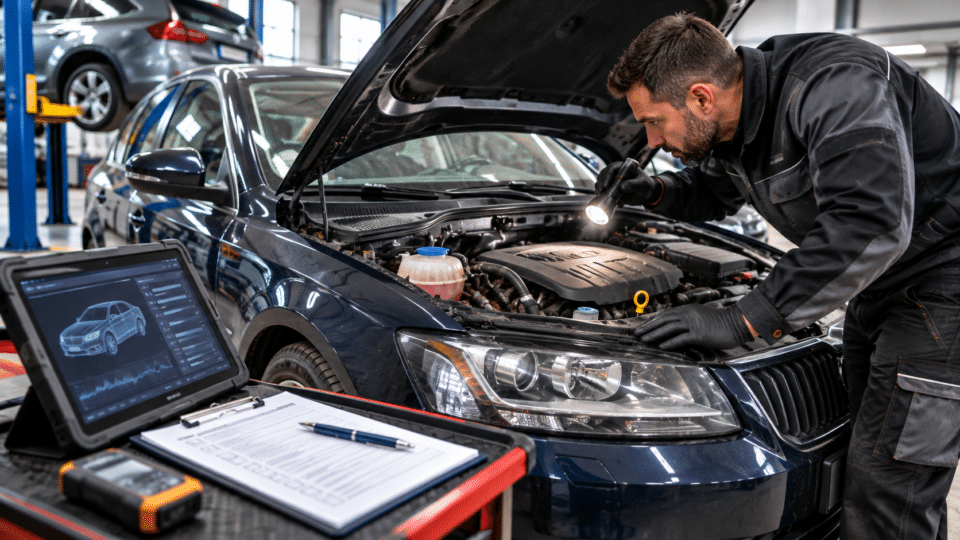
VIN history for used cars: an advert promises “genuine mileage, accident-free, VIN checked”. The buyer receives a PDF, sees a mileage timeline and a section showing no damage, and assumes the car is safe. That may be the costliest possible reading of a vehicle report: the absence of a record does not prove that an event did not occur.
In Romania, RAR Auto-Pass provides official information on odometer readings, certain interventions and repairs, technical inspections, and available information on recall campaigns. It costs 42 lei on the official platform, and the document is valid for 60 days under Law No. 142/2023. A recently imported vehicle, however, a repair carried out outside data-reporting channels, or an incomplete history may leave gaps.
This InfoBuz.ro documentary investigation brings together Law No. 142/2023, Order No. 210/2024, recommendations from RAR and ANPC, and European rules, and addresses a question that a commercial report alone cannot answer: what evidence does each document actually verify, and what must you inspect on the car itself? For the detailed method of reconstructing mileage, see our InfoBuz guide to RAR Auto-Pass and mileage. Here, we examine the limits of the evidence and the final buying decision.
VIN history: a vehicle identifier is not a universal vehicle record
The VIN (Vehicle Identification Number) is the identification number assigned to a vehicle, usually comprising 17 characters on modern cars. It allows the body shell, documents and certain records to be linked. The number itself does not contain a log of accidents, distance travelled or every service visit. That information comes from separate databases, populated by institutions and operators at different points in time.
The first check is physical: compare the number stamped on the vehicle in the location specified by the manufacturer with the details in the vehicle identity card (CIV), registration certificate, invoice or contract, and provenance documents. Any discrepancy, or signs that markings have been altered, must be clarified before payment. The ANPC recommendations for used cars specifically regard checking the stamped number as an essential step.
A paid VIN report may aggregate useful data from inspections, insurers, auctions or other sources, depending on the provider. Coverage is not the same for every country, year, insurer or workshop, however. The price of a report does not turn its sources into complete registers. Every claim must be read alongside the origin and date of the information.
RAR Auto-Pass in 2026: what it contains, what it costs and what the buyer should receive
The main legal framework is Law No. 142/2023, implemented through Order No. 210/2024 of the Minister of Transport. The law establishes the electronic vehicle-history register and requires the relevant operators to submit certain data; the certificate can be requested online through the RAR website. RAR has expressly warned against buying “Auto-Pass” through pages that imitate the institution’s brand and charge mark-ups.
| Item checked | What RAR Auto-Pass may show | What it does NOT establish on its own |
|---|---|---|
| Mileage | Successive readings at periodic technical inspections (ITP), RAR and reported interventions | Every kilometre ever travelled, or the absence of any manipulation |
| Service interventions | Certain operations submitted by authorised workshops | That every service visit in every country has been uploaded |
| Serious damage | Reported repairs involving steering, brakes, structure or safety systems | That there were no unreported accidents or repairs outside the database |
| Recalls | Available data on relevant campaigns and failure to attend | That all global campaigns have been completed and are up to date |
| Vehicle data | Identification and registration information | That physical markings have not been altered, or that the vehicle is in impeccable technical condition |
Under Article 9 of Law No. 142/2023, a person transferring a vehicle within the law’s scope must provide the acquirer with a valid RAR Auto-Pass certificate, or the document issued when the register contains no information. The certificate is valid for 60 days from issue. Where data are available, the official fee announced by RAR is 42 lei.
Where no information is available for the VIN, RAR issues free of charge a document confirming that situation, known as a negative document or negative certificate. It is not a “certificate that the car has never been in an accident”: it confirms that the queried register contains no information on that vehicle under the terms of the service. Confusing “no data” with “no problematic history” is one of the most significant traps.
Why foreign mileage records may be missing
An imported car may have had years of use and repairs before its first registration in Romania. RAR has stated that the register is being developed gradually and that the availability of pre-import history depends on sources that actually transmit information. Law No. 142/2023 also provides for authorised operators in a manufacturer’s network to submit certain readings recorded before registration in Romania, in regulated circumstances. The existence of a legal obligation does not guarantee that every imported car’s report contains its entire European history.
For a car brought from another country, it is therefore worth requesting inspection documents from that country, any maintenance history available through the manufacturer’s network, verifiable invoices and, where they exist, official local records. Sources should be compared chronologically by VIN, date, mileage and issuer identity. A photograph of a stamp with no document number or verifiable workshop has limited evidential value.
Three reports that may look reassuring but do not answer the same question
| What the report shows | The tempting but wrong conclusion | The justified conclusion |
|---|---|---|
| “No recorded damage” | The car has never been hit | There is no damage in the sources queried; a physical inspection remains necessary |
| “No VIN data” | The car has a clean past | The register does not have sufficient information within its coverage scope and period |
| Increasing mileage readings | Mileage is guaranteed 100% | The available readings are consistent; periods without records remain unknown |
| “No recalls in the report” | There is no open campaign | This must be confirmed separately with the manufacturer, using the VIN |
| Valid ITP | The engine, gearbox and bodywork have no faults | The vehicle passed the inspection requirements applicable at the time it was checked |
Mileage: how to investigate a drop without automatically accusing the seller of fraud
A purely hypothetical example: a reading of 164,000 km appears in 2021, followed by 112,000 km in 2023. The difference deserves investigation because the displayed odometer reading has fallen. Documents may nevertheless point to different explanations: a data-entry error, a documented instrument-cluster replacement, a vehicle wrongly identified in a record, or an unauthorised intervention. An inconsistent sequence is a signal for checking, not a criminal verdict.
Ask who recorded the values, request the invoice for the replacement instrument if such work is claimed, and compare the records with information held by the dealership. Law No. 142/2023 prohibits fraudulent odometer manipulation and requires authorised operators to report its repair or replacement. EU Directive 2014/45 on periodic roadworthiness testing provides for the use of previous odometer readings to help detect manipulation.
There is another trap: a car with 210,000 km and documented servicing may be more predictable than one showing 120,000 km with a broken history. There is no universal threshold at which a car becomes “good” or “bad”; use, maintenance and actual condition matter. For a separate analysis, see the InfoBuz article on cars with 200,000 km versus 100,000 km.
Hidden damage: why a car may show no accident in a database but have been repaired
Some damage may never reach the register used by a platform: accidents settled directly between parties, cash-paid repairs, work carried out outside workshops that submit data, or events occurring in another country. Therefore, the absence of damage in a report is not proof that no accident occurred. Conversely, a report showing recorded repairs does not automatically mean that a vehicle is unsafe: the nature of the damage and the quality of the repair must be assessed.
A repainted wing, a replacement windscreen and straightened load-bearing structure do not have the same significance. The risk is greater where work involves chassis rails, structural sills, mounting points, restraint systems, airbags, seat belts, brakes or steering. If a correctly repaired serious accident is claimed, request documentation of the work and an inspection by a competent workshop.
| Area checked | Useful inspection sign | Limitation or alternative explanation |
|---|---|---|
| Paint and exterior panels | Differences in shade, uneven paint thickness | Cosmetic repainting does not establish structural damage |
| Joints and load-bearing elements | Unusual welds, deformation, changed sealant | Interpretation requires a specialist and repair documentation |
| Airbags and seat belts | SRS warning light, inconsistent components or data | An extinguished warning light alone does not guarantee a functioning system |
| Brakes, steering and suspension | Uneven alignment, play, damaged components | These may also result from wear, not necessarily an accident |
| Electronic diagnostics | Stored faults, inconsistencies between modules | A fault can have multiple causes; the code must be diagnosed |
A paint-thickness gauge is useful as an indicator, but it cannot by itself establish whether the car has been in an accident. Likewise, OBD diagnostics may offer warnings, not a certificate of authentic history. Structural checks generally require access to a lift, lighting, experience and, where serious concerns arise, specialist assessment.
Manufacturer recalls: a VIN check may matter more than accident history
A recall campaign is an action initiated when a manufacturer identifies a relevant risk in a group of vehicles or components. It does not mean that a particular car was damaged or poorly maintained. Campaigns may concern airbags, steering, brakes, electrical systems, powertrain components or other safety-related items.
RAR publishes an official page on manufacturers and recall campaigns and warns that it is being updated. For some brands, public checkers cover certain campaigns, such as Takata airbags, but other actions may exist. The most relevant check for a specific car is to query its VIN through the manufacturer’s authorised network and request confirmation that applicable work has been completed.
The European Safety Gate database publishes alerts on dangerous products, including motor vehicles. You can search by make and model, but identifying a campaign for a model does not prove that every example of that model is affected. Conversely, not finding an alert in a search does not guarantee that the VIN has no unresolved campaigns.
For a buyer, a written note from the dealership is useful, covering the VIN, applicable campaign, open/closed status and date of remedy, insofar as the network can provide it. If a safety-risk recall appears, follow official instructions and clarify the remedy before use; specific recommendations depend on the campaign.
RAR Auto-Pass, certificate of authenticity, RAR eXpert and ITP: four different things
The terms are often confused in car adverts. RAR Auto-Pass is an electronic history certificate based on available data. Authenticity certification concerns the vehicle’s identity and its identification elements, under the RAR procedure. RAR eXpert is a separate service involving the physical inspection of a vehicle, which may assess identity, structure, technical elements and certain electronic records. ITP is the periodic check of compliance with legal technical requirements at the time of inspection.
For more information on buying a car, see also RAR Auto-Pass: how to check the mileage of a used car, which provides complementary details on this subject.
| Service/document | Main purpose | What it does not replace |
|---|---|---|
| RAR Auto-Pass | Recorded history, mileage, interventions and known recalls | Physical inspection and the vehicle’s foreign documentation |
| RAR certificate of authenticity | Checking identity, identification elements and documents, as applicable | A full assessment of wear and running costs |
| RAR eXpert | Technical expert assessment with the vehicle physically present | An exhaustive history of every accident worldwide |
| ITP | Compliance at periodic inspection under statutory checks | A mechanical guarantee for the years ahead |
| Independent workshop inspection | Technical condition, faults and repair estimates | A final legal ruling on ownership |
RAR states that the RAR eXpert service requires the vehicle to be presented and was available, according to the official page consulted in November 2026, at the RAR Grivița–Bucharest and RAR Cluj centres. If you cannot access this service, you can request an independent inspection from a competent workshop authorised for the relevant work. We do not claim that a private workshop can issue an RAR eXpert certificate.
RAR has also drawn attention to imported vehicles offered for sale without a vehicle identity card (CIV), on the promise that the documents “will be sorted out after payment”. The institution recommends checking the CIV and provenance documents, as non-compliance or technical modifications may create difficulties with approval and registration. The authenticity document and CIV must correspond to the vehicle’s actual identity and circumstances.
Who is liable when a car is sold by a dealer or a private individual?
The legal distinction is essential. If you buy from a professional/trader as a consumer, the rules on conformity of goods in the consolidated version of Emergency Ordinance No. 140/2021 apply. The general rule is that the seller is liable for non-conformities existing at delivery and identified within two years. For second-hand goods, the parties may agree a shorter period, but not less than one year. The statement that “all used cars must have exactly a one-year warranty” is therefore imprecise: two years is the general reference point, while one year is the minimum for a period shortened by agreement, under the conditions of the law.
During the first year from delivery, non-conformities found are, under the conditions of Article 10, presumed to have existed at delivery unless proven otherwise, subject to the stated exceptions. Remedies may include repair, replacement where possible and proportionate, price reduction or termination of the contract, as provided by law. Not every normally worn component in an older car automatically creates an obligation of free replacement; the description of the goods, disclosed wear, conformity and cause of the fault all matter.
If the seller is a private individual who is not acting as a professional, European consumer-protection rules for commercial sales do not apply in the same way. Rights may exist under the Civil Code, including in relation to hidden defects or false statements, but these must be assessed against the contract and evidence in the case. Do not assume that the “private individual” label conclusively settles the legal status of a seller who is in fact conducting commercial activity.
ANPC recommends checking the trader’s identity, the full price, documents, warranty and remedy conditions. For a car bought from a dealer, do not accept unexplained blanket wording such as “no liability whatsoever” or “warranty for engine only” if it would restrict statutory rights applicable to the vehicle. In a dispute, the specific documents and facts matter.
A seven-point protocol before payment: documents, vehicle and risk
- Identity: request the VIN and CIV before travelling; compare the physical number, registration documents and the seller’s identity.
- Official certificate: request a valid RAR Auto-Pass or negative document; check the issuer and date, without confusing an absence of data with an absence of damage.
- Timeline: align the mileage in the report, ITP, service invoices, manufacturer history and any documents from the country of origin.
- Damage: request photographs and invoices for significant repairs; check the structure, airbags, brakes and steering in an independent inspection.
- Recalls: request a VIN check through the brand’s authorised network and confirmation of open or completed campaigns.
- Technical condition: carry out diagnostics, a lift inspection and a test under lawful, safe conditions, with the owner’s agreement; record faults and estimated costs.
- Contract: state the parties, VIN, price, declared mileage, known defects and documents handed over accurately; retain proof of payment.
The sequence makes economic sense: if the vehicle’s identity cannot be substantiated or the seller refuses any independent check, it may not be worth paying for the rest of the investigation. Conversely, if the paperwork is consistent and a history exists, a serious technical examination is the next step, not a decorative option.
Four real-world types of scenario, with illustrative figures
Scenario A: a clean report, but no entries before import
A car is registered in Romania in 2025 and has only one Romanian ITP reading. The advert says “history checked”, but no documents are provided for the car’s first eight years. The justified conclusion is that the Romanian register does not cover those years sufficiently to confirm the complete mileage. Request documents from the country of origin, history from the manufacturer’s network and a physical inspection.
Scenario B: two chronologically incompatible mileage readings
In a simulation, the report shows 178,000 km in 2022 and 126,000 km in 2024. This is a discrepancy that requires an explanation and evidence, not a public accusation of fraud. Check whether the odometer was replaced, whether there was a data-entry error, and what the workshop history says. If the seller cannot explain the difference, the risk remains with the buyer.
Scenario C: a reported accident, but documented repairs
A car has had bodywork repairs, with invoices and photographs. Risk depends on the parts affected, repair methods and structural verification, not the simple label “it has been hit”. Not every cosmetic repair makes a car unsafe, but faults concerning safety systems may justify stopping the process until technical clarification is obtained.
Scenario D: no accident, but an airbag campaign remains open
A model may be subject to a safety recall despite not having been involved in an accident. In that case, the absence of damage in the report is irrelevant to the recall issue. Check the VIN with the manufacturer and request details of the remedy; if warnings require restricted use, follow official instructions. We do not present these scenarios as real vehicles inspected by the editorial team.
When to walk away, even if the price looks excellent
Some signs call only for negotiation or an additional check. Others should lead you to suspend the purchase until they are clarified: an inconsistent VIN, missing or suspicious original documents, refusal to verify identity, structural damage with unjustified repairs, non-functioning safety systems, or a seller who makes any inspection conditional on full payment. We do not infer criminal offences from these signals, but they may make the risk disproportionate.
The ANPC guide recommends an independent mechanic and checking that documents match. RAR separately warns against buying vehicles on the promise that a CIV or other necessary documents will be obtained after the transaction. This kind of caution matters more than a small price difference between otherwise comparable adverts.
What to put in the contract so that evidence is not lost after the sale
A contract or signed annex should usefully include full identification of the vehicle, the displayed mileage and the qualification of the statement about it, known condition and defects, the declared accident history, documents handed over and the seller’s specific promises. The exact wording depends on the nature of the transaction. A verbal statement such as “the car is perfect”, without further evidence, is much harder to assess later than a documented description.
Do not conceal a known problem and do not sign to say you received documents you have not seen. For the separate deadlines for tax declaration and transfer of ownership after purchase, see the InfoBuz article on the 30- and 90-day deadlines. These formalities do not, however, resolve an authenticity defect or a technical problem discovered before payment.
Frequently asked questions about VIN history and buying used cars
Does RAR Auto-Pass guarantee that the car has never had an accident?
No. The certificate shows information in the register about certain repairs and other events. Damage that was not reported or falls outside the scope of the sources may not appear.
How much does RAR Auto-Pass cost and how long is it valid?
RAR has announced an official fee of 42 lei, and Law No. 142/2023 provides for a validity period of 60 days. Use only the official access point at rarom.ro.
What does it mean if I receive a negative document?
It means that relevant data for the requested certificate are not available in the queried register. The document is issued free of charge; it does not certify the absence of accidents, recalls or manipulated mileage.
Can I check a recall solely with a VIN report bought online?
The report may indicate some campaigns, but for a specific vehicle check the VIN’s status through the manufacturer’s authorised network. Safety Gate and RAR lists are complementary resources.
Does a valid ITP mean that the engine and gearbox are sound?
No. ITP checks legal requirements at the time of inspection; it does not provide an extended guarantee for the engine, transmission or future service life.
What rights do I have if I buy the car from a dealer?
In a professional-to-consumer transaction, Emergency Ordinance No. 140/2021 applies: there is general two-year liability for non-conformities, with the possibility of agreeing a period of at least one year for second-hand goods, under the conditions of the law. The situation differs in a sale between private individuals who are not professionals.
Can I prove mileage rollback from diagnostics alone?
Not always. Diagnostics may reveal differences or indicators, but they must be interpreted technically and correlated with documents, repair history and any interventions involving the odometer.
What should I check first if the car was recently imported?
The vehicle’s identity, CIV and provenance documents, pre-import history, RAR Auto-Pass or the document issued by RAR, then technical condition and recalls. Do not treat the absence of Romanian records as an advantage.
Official sources and methodology
- Law No. 142/2023 on the electronic vehicle-history register, especially Articles 2–9 on mileage, data transmission, the certificate and validity.
- MTI Order No. 210/2024, data categories and RAR Auto-Pass document templates.
- RAR – official Auto-Pass presentation, data included and issue of the certificate/document where no data are available.
- RAR – warning on platforms reselling Auto-Pass certificates, official fee of 42 lei.
- RAR – recommendations on buying used cars and checking the CIV.
- RAR – make-by-make recall campaign page and RAR eXpert.
- ANPC – recommendations for buying used cars.
- Emergency Ordinance No. 140/2021, consolidated version, Articles 9–14 on conformity of goods and remedies.
- Directive 2014/45/EU on periodic roadworthiness testing, odometer history.
- European Commission – Your Europe, guarantees for second-hand goods and the difference between a trader and a private seller.
InfoBuz.ro editorial note, 14 November 2026: this investigation is based on legislation, official recommendations and explanations from institutions. We did not check a real VIN, access an individual’s history, physically inspect a car or order a commercial report for this article. The scenarios are hypothetical examples designed to explain how evidence should be assessed; they do not represent established cases of fraud. Service terms and data availability may change. For a specific transaction, up-to-date document checks and an independent technical inspection are needed; for a dispute, appropriate legal advice is required.






Discuția cititorilor
Ai o opinie sau o întrebare despre acest articol? Spune-ne ce crezi.
Fii primul care deschide discuția.
Te rugăm să păstrezi un limbaj civilizat și să discuți la subiect. Comentariile spam sunt filtrate automat.