
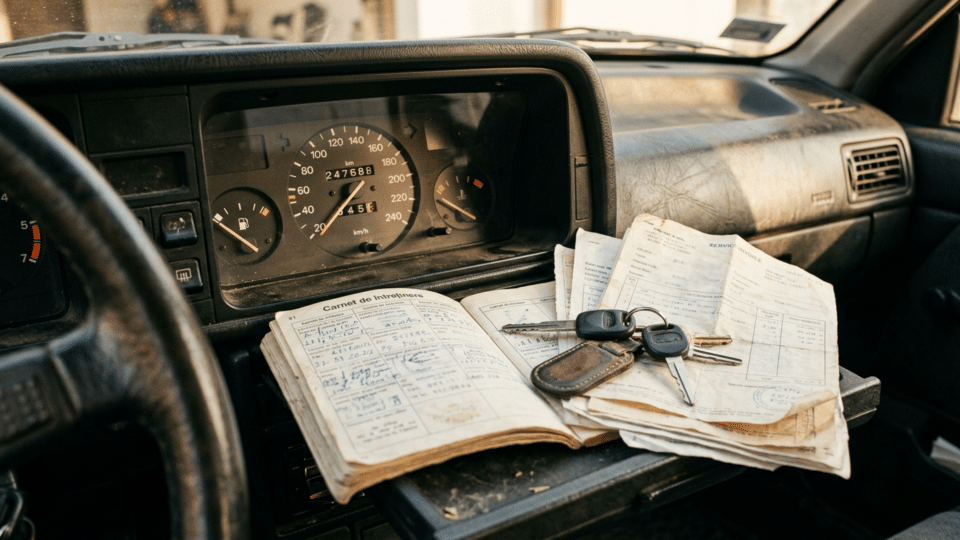
A car with 200,000 km on the odometer can be a better choice than one with 100,000 km. It may sound counterintuitive, but the odometer is only part of the story. Far more important are how those kilometres were driven, how often the car was serviced, whether its fluids were changed on time, whether it was driven mainly in town or on longer routes, and whether major repairs have already been carried out properly.
AAA stresses that mileage is only one important consideration when buying a used car, and should be assessed alongside its age, service history and current condition.
Low mileage does not automatically mean low wear
A car that has covered 100,000 km almost entirely in urban traffic may have undergone hundreds or thousands of cold starts, braking and acceleration cycles, interrupted DPF regenerations, and long periods running below its optimum temperature.
By contrast, a car that has covered 200,000 km largely on motorways may have had far fewer thermal cycles and starts, and operated under more stable conditions.
Cold starts account for a significant share of wear
At start-up, oil has not yet reached every part of the engine at the ideal pressure and temperature. The engine has different clearances than it does under normal operating conditions, while fuel can condense more easily on cylinder walls.
A car used for 20 short trips in a week may accumulate more start-up and warm-up cycles than one used for two long journeys, even if its total mileage is lower.
For diesels, the type of journey is crucial
The diesel particulate filter, or DPF, needs heat to regenerate. RAC explains that long drives at a steady speed encourage passive regeneration, while short trips can prevent active regenerations from being completed.
That is why a diesel with 200,000 km covered predominantly outside urban areas may have a DPF in better condition than one with 100,000 km that has been used almost exclusively in town.
Urban use also takes a greater toll on the EGR system
Low operating temperatures, driving at low revs and short trips encourage soot to build up in the EGR system and intake.
A higher-mileage car that has regularly reached normal operating temperature may have a cleaner intake system than a “low-mileage” car used almost entirely in urban traffic.
Service history is worth more than the number on the dashboard
When buying a used car, a complete, verifiable history can be more valuable than a difference of 50,000–100,000 km.
- documented oil changes;
- invoices and estimates;
- timing-belt replacement carried out on schedule;
- automatic transmission oil changed;
- brakes, suspension components and bearings replaced when needed;
- major repairs carried out preventively, rather than after a breakdown.
A 200,000 km car may already have had many expensive parts replaced
At higher mileage, some costly work may already have been completed: timing belt or timing-chain work, clutch, dual-mass flywheel, shock absorbers, control arms, bearings, thermostats, water pump or automatic-transmission servicing.
A 100,000 km car that has not yet reached the point where this work is needed may look more attractive, but could require substantial investment soon after purchase.
Automatic transmissions: maintenance matters more than headline mileage
An automatic transmission whose oil and filter have been changed at the recommended intervals can perform very well at high mileage. Conversely, a transmission with only 100,000 km but no maintenance may show premature wear.
For more information on DPFs, see What happens to your car after 200,000 km: the parts that age even when everything seems fine, which provides complementary details on the subject.
For DSG, torque-converter, CVT and other automatic transmissions, the oil-change history is among the first things to check.
Timing: ask what has been done, not just how many kilometres the car has covered
Where an engine has a timing belt, the replacement interval may be set both in kilometres and years. A low-mileage but older car may be overdue for replacement because of its age.
With a timing chain, inadequate maintenance, the wrong oil or very long oil-change intervals can cause wear even at relatively low mileage.
Infrequent oil changes can do more harm than high mileage
An engine with 200,000 km and regular oil changes may be in better mechanical condition than one with 100,000 km that has run for years on very long service intervals.
Oil quality, the correct specification, the interval and the type of use all matter.
Motorway mileage is often gentler
At a constant speed, the engine, transmission and cooling system operate in a stable range. There are fewer starts, fewer load changes and less braking.
For that reason, 100,000 km in urban driving does not produce the same kind of wear as 100,000 km outside town.
The suspension can tell the real story
A car used on poor roads can develop play in control arms, bushes, ball joints, shock absorbers and bearings even at low mileage.
A higher-mileage car used on motorways may have less suspension wear than one driven daily over uneven roads and potholes.
Mileage can be falsified
NHTSA warns that odometer fraud is real and recommends checking the mileage shown on the dashboard against maintenance and inspection records.
- compare the mileage with invoices and service records;
- check vehicle-history reports;
- look for discrepancies between wear and stated mileage;
- check oil-change and timing-service stickers;
- use the VIN for further checks.
Pedals, steering wheel and seat can reveal wear
NHTSA recommends comparing the displayed mileage with the vehicle’s physical wear. The pedals, steering wheel, gear lever and driver’s seat can offer useful clues.
They are not conclusive evidence—these parts can be replaced—but major inconsistencies deserve investigation.
Diagnostic testing before purchase is essential
A thorough diagnostic check can uncover issues that may not appear during a test drive.
- stored fault codes;
- DPF differential pressure;
- the number and frequency of regenerations;
- injector corrections;
- temperatures and thermostat operation;
- automatic-transmission parameters;
- ABS, airbag and comfort-system faults.
A cold test is more useful than one after the engine has warmed up
Ideally, view the car with the engine completely cold. This makes it easier to spot difficult starting, timing noises, smoke, vibration, weak glow plugs or injection issues.
If the seller has warmed up the car before you arrive, it is worth asking why.
Check the actual temperatures
A thermostat stuck open can keep the engine too cold. In a diesel, this can affect fuel consumption, DPF regeneration and cabin heating.
Do not rely only on the dashboard needle; some cars display 90°C across a broad range of actual temperatures.
Compression and oil consumption matter more than the dashboard figure
A healthy engine should be assessed by its starting, pressure, compression, oil consumption, smoke, corrections and noises—not mileage alone.
A well-maintained 200,000 km engine may have better parameters than a neglected one with 100,000 km.
What to check on a high-mileage diesel
- the DPF and ash level;
- EGR and intake;
- injectors;
- turbocharger;
- dual-mass flywheel and clutch;
- thermostat and operating temperature;
- timing system;
- oil-change history.
What to check on a 100,000 km car
Do not assume it is “like new”. Check exactly the same things. Also consider whether the stated mileage is plausible for the car’s age.
A 12- to 15-year-old car with only 80,000–100,000 km may be genuine, but it warrants especially careful checks.
More important than mileage: the cost of the next 30,000 km
When comparing two cars, the right question is not only “which has fewer kilometres?”, but “which will require less money over the next two to three years?”
If one has recently had its timing system, brakes, suspension and transmission serviced, it may be the better-value option despite its higher mileage.
A simple example: 100,000 km versus 200,000 km
| Criterion | Car A | Car B |
|---|---|---|
| Mileage | 100,000 km | 200,000 km |
| Service history | Incomplete | Complete |
| Use | Urban | Motorway |
| Timing system | Unknown | Recently replaced |
| Automatic transmission | No evidence of an oil change | Documented service |
| DPF | Frequent regenerations | Good parameters |
| Suspension | Worn | Overhauled |
In such a case, the 200,000 km car may be the more logical choice.
A pre-purchase inspection matters more than any advert
AAA recommends a pre-purchase inspection carried out by a qualified mechanic, alongside checks of the vehicle’s history, fluids, tyres, bodywork and electronic systems.
Quick checklist before buying
- VIN and vehicle-history report;
- service invoices;
- cold start;
- full diagnostic check;
- a test drive of at least 20–30 minutes;
- an inspection on a lift;
- oil and coolant leaks;
- brakes and suspension;
- transmission condition;
- actual operating temperature.
Conclusion: maintenance beats mileage
Do not buy the number on the dashboard. Buy the history, technical condition and the way the car has been used.
A 200,000 km car with documented servicing and predominantly non-urban mileage may be healthier and less expensive over the medium term than a 100,000 km car with an uncertain history, deferred maintenance and demanding urban use.
Frequently asked questions about high-mileage cars
Is 200,000 km too much for a car?
Not automatically. The model, maintenance, type of mileage and technical condition all matter.
Is a car with 100,000 km better?
Only if the mileage is genuine and the car has been properly maintained. Lower mileage does not guarantee better condition.
How can I check whether the mileage is genuine?
Compare the odometer with service records, inspections, VIN reports and the car’s physical wear.
Is a motorway diesel better than a city diesel?
Often, yes—particularly in terms of the DPF and thermal operating conditions—but the actual condition must be checked case by case.
What matters more: mileage or history?
Documented history and technical condition are generally more relevant than the isolated number on the dashboard.





Discuția cititorilor
Ai o opinie sau o întrebare despre acest articol? Spune-ne ce crezi.
Fii primul care deschide discuția.
Te rugăm să păstrezi un limbaj civilizat și să discuți la subiect. Comentariile spam sunt filtrate automat.