
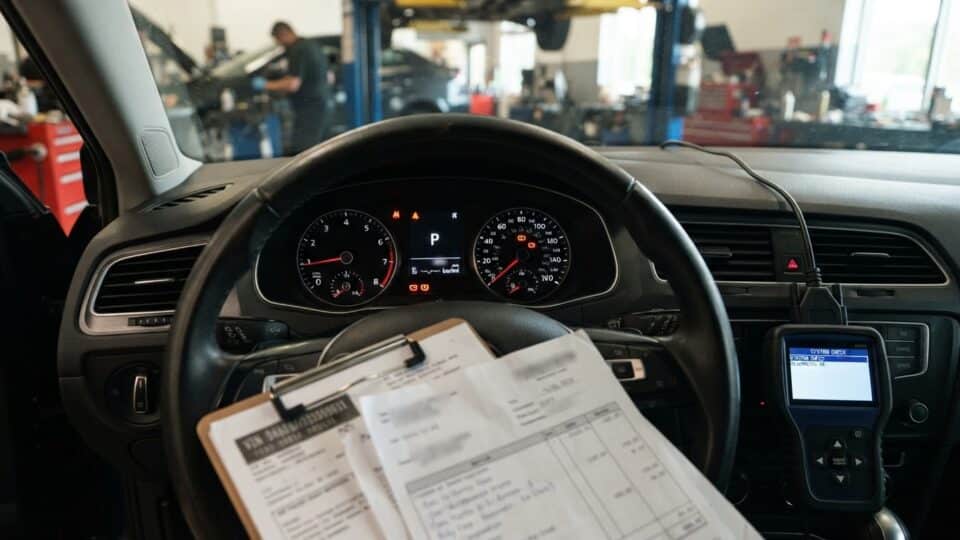
RAR Auto-Pass is the first official tool to check when you want to know whether a used car’s mileage is credible. The safest approach is to build a timeline: RAR Auto-Pass, periodic technical inspections (ITP), service invoices, dealer history, documents from the country of origin and the car’s physical wear. No single indicator is perfect, but several sources that corroborate one another can reveal a great deal.
For more information on buying a car, see VIN history for used cars: what reports do not show about mileage, damage and recalls, which provides complementary details on the subject.
In Romania, the first step in 2026 is RAR Auto-Pass. When transferring ownership of a passenger car, the seller must provide the buyer with a valid RAR Auto-Pass certificate or, if the register contains no data, the document issued by RAR confirming that situation. The certificate is valid for 60 days.
RAR Auto-Pass and mileage checks: start with the VIN
Before any check, ask for the complete VIN — the vehicle identification number.
The VIN must match across:
- the car;
- the vehicle identity document;
- the registration certificate;
- RAR Auto-Pass;
- invoices and service documents;
- any external reports.
If the seller refuses to provide the VIN before you travel to see the car, or sends only part of it, treat that as a warning sign.
1. Request RAR Auto-Pass before negotiating seriously
RAR Auto-Pass is the official document issued by the Romanian Automotive Register (RAR) containing the vehicle’s available history.
According to RAR, the certificate may contain:
- the sequence of odometer readings recorded at ITP inspections and by RAR;
- data on work carried out at authorised workshops;
- information on certain repairs following serious accidents;
- ITP data;
- recall campaigns, to the extent that the information exists in the register.
In November 2026, RAR lists an official Auto-Pass fee of 42 lei and warns that the document must be obtained exclusively through RAR’s official platform, not websites that imitate the institution’s identity.
2. Review the mileage sequence, not just the latest reading
The most important element is the chronology.
A normal example might look like this:
| Year | Reported mileage |
|---|---|
| 2021 | 82,400 km |
| 2022 | 101,600 km |
| 2024 | 134,900 km |
| 2026 | 161,200 km |
The figures rise logically and form a coherent story.
By contrast, if the record shows:
| Year | Reported mileage |
|---|---|
| 2022 | 184,000 km |
| 2024 | 121,000 km |
there is a problem that needs explaining.
A drop in mileage is a strong signal, but before reaching a conclusion, rule out a data-entry error or the legitimate replacement of the instrument cluster.
3. A reading that barely changes for years can also be suspicious
Mileage does not have to decrease to raise questions.
If a car appears with:
- 145,000 km in 2022;
- 146,200 km in 2024;
- 147,100 km in 2026;
but the owner says it was used daily, it is worth investigating.
There can, however, be legitimate explanations:
- it was the family’s second car;
- the owner lived abroad;
- the car was kept in a garage;
- there were long periods without use.
This is why mileage must be interpreted alongside the rest of the history.
4. For imported cars, Auto-Pass may not tell the whole story
This is one of its most important limitations.
RAR Auto-Pass is highly valuable for data collected in Romania, but an imported vehicle’s earlier history may be incomplete.
RAR says the database is being progressively completed and that the information available depends on data submitted by authorised entities.
The law also provides for the transmission to RAR of information held by manufacturers or representatives for vehicles previously registered in other countries. In practice, however, one should not assume that every kilometre in an imported car’s life is already recorded in Auto-Pass.
5. Request documents from the country of origin
For an imported car, ask for:
- service invoices;
- technical inspection reports;
- leasing documents;
- tyre or brake invoices;
- authorised dealer documents;
- the service book, if one exists.
Do not look only at the printed mileage. Check whether:
- the VIN is correct;
- dates are chronological;
- the workshop names are real;
- the documents have different, logical formats over time;
- the work performed matches the mileage.
6. Check the dealer’s digital service history
Many brands have used digital service histories for years.
If the car was maintained within the manufacturer’s network, a dealer of that brand may have information about:
- services;
- recall campaigns;
- warranty work;
- mileage recorded at certain visits.
Actual access to this data depends on the brand, country, internal rules and data-protection requirements. Not all dealers will provide a complete history to someone who is not yet the owner.
The simplest option is for the seller to request the history, or for both of you to visit the dealer together.
7. Invoices are more useful than an empty service book
A stamp in a service book can be easily forged.
A long sequence of invoices is much harder to fabricate coherently.
Look for invoices showing:
- the VIN;
- the date;
- the mileage;
- parts fitted;
- the workshop;
- an order or invoice number.
If the timing belt was replaced in 2023 at 178,000 km and the car is being sold in 2026 with 142,000 km, no sophisticated analysis is needed.
8. Check service stickers
Workshops sometimes leave stickers for:
- oil changes;
- timing-belt replacement;
- automatic gearbox oil;
- filters;
- air-conditioning work.
Common locations include the engine bay, door pillar, timing-belt cover or inside the document compartment.
An old sticker stating “oil changed at 212,000 km” in a car now showing 167,000 km is clearly relevant.
9. Check steering-wheel wear — but do not rely on it alone
A heavily shiny, peeling or reupholstered steering wheel in a car claimed to have 70,000 km can raise questions.
But materials wear differently.
Wear depends on:
- the type of leather;
- hand perspiration;
- cleaning products;
- sun exposure;
- urban use;
- possible reupholstery.
The steering wheel is an indicator, not proof.
10. Pedals can reveal a lot
On a low-mileage car, pedal rubbers should generally be in reasonable condition.
Very heavy wear on the:
- brake pedal;
- clutch pedal;
- footrest;
may suggest intensive use.
But these parts can also be replaced very cheaply.
11. The driver’s seat is harder to reset perfectly
Check:
- the seat cushion bolster;
- the backrest bolster;
- stitching;
- foam;
- adjustment mechanisms;
- the leather or fabric in the area used when getting in and out.
A car with 50,000–70,000 km and a badly flattened, torn seat warrants close scrutiny.
Likewise, a completely refurbished interior in a very cheap car may conceal the real wear.
12. The gear selector, buttons and handles complete the picture
Look at:
- the gear selector;
- climate-control buttons;
- the light switch;
- door handles;
- the driver’s seatbelt;
- window switches.
One worn item proves nothing.
But a worn steering wheel, heavily worn pedals, a flattened seat and a rubbed-off gear selector in a car advertised with “63,000 km” create a picture that is much harder to ignore.
13. Annual mileage must be plausible
There is no universal “correct” figure.
A car may cover 5,000 km a year or 60,000 km a year.
The useful question is whether the seller’s story matches the figures.
If the owner says they commuted 80 km every day for five years, but the mileage rose by only 12,000 km, the explanation does not add up.
14. Fleet cars can have high mileage and a good interior
There is a trap here.
A car that travelled hundreds of kilometres on motorways every day may have:
- a relatively well-preserved steering wheel;
- a decent seat;
- lightly worn pedals;
- a clean, well-maintained engine.
It may nevertheless have 250,000–350,000 km.
Conversely, a car used exclusively in urban traffic may look more worn at 100,000 km.
Physical wear must be interpreted in the context of how the vehicle was used.
15. Diagnostic testing may find mileage stored in other modules
In some models, different electronic control units may retain values related to mileage, operating hours or the history of certain events.
Depending on the make and generation, information may exist in:
- the instrument cluster;
- the engine ECU;
- ABS/ESP;
- the automatic gearbox;
- service modules;
- keys or other units.
But this is not a universal rule.
Not all modules store total mileage, and some values may be reset or changed after a module is replaced.
16. A difference between modules does not automatically prove fraud
If the dashboard shows 150,000 km and a module reports another figure, investigate:
- was the module changed?
- was the instrument cluster replaced?
- does the value represent total mileage or another counter?
- is the diagnostic tool interpreting the parameter correctly?
Diagnostics should be carried out by someone who knows the brand and understands exactly what each data channel represents.
17. Operating hours can be a strong clue
Some vehicles store engine operating hours.
If you have both the hours and the mileage, you can calculate a theoretical average speed:
kilometres ÷ operating hours = average speed
Example:
- 120,000 km;
- 6,000 engine hours;
- average speed: 20 km/h.
For an urban car, that may be plausible.
But 90,000 km and 9,000 hours would mean an average of only 10 km/h, which would require a very specific explanation.
This calculation is only an indicator, too, because the definition of “hours” varies among manufacturers.
18. Check service intervals
The mechanical history should fit the mileage.
If the manufacturer specifies servicing every 30,000 km and there is:
- service 1 at 30,000;
- service 2 at 60,000;
- service 3 at 90,000;
- service 4 at 120,000;
but the dashboard now shows 88,000 km, there is an obvious contradiction.
19. Timing-belt work can reveal past mileage
Some timing-belt invoices include the exact mileage.
The same applies to:
- DSG/automatic gearbox oil;
- the clutch;
- the flywheel;
- the particulate filter;
- injectors;
- the turbocharger.
A major repair does not prove high mileage, but its associated documents can establish a clear point in the timeline.
20. Check manufacturing dates on certain components
Tyres, windows, seatbelts and some components have date codes.
They do not reveal the mileage, but they can identify inconsistencies in the story.
For example, four successive sets of tyre invoices for a car claimed to have 45,000 km would merit an explanation.
21. Beware of “real mileage” without evidence
Phrases such as:
- “100% genuine”;
- “guaranteed”;
- “an old person’s car”;
- “driven only on Sundays”;
- “personally imported”;
do not replace documents.
Ask for verifiable evidence.
22. A commercial VIN report is useful, but not a verdict
Commercial VIN-history services can, in some cases, find:
- mileage readings;
- damage;
- auctions;
- photographs;
- previous registrations.
But the absence of a damage record or a reading does not mean the event did not occur.
No private database contains all information from every country.
Use reports as an additional source, not as an absolute certificate.
23. Have the car inspected before paying
Even after the mileage history appears coherent, the car still needs a technical inspection.
InfoBuz has a separate guide: Used car: the 15-minute filter that tells you whether it is worth taking to a workshop.
After the initial filter, a thorough inspection at an independent workshop may include:
- diagnostic testing;
- a vehicle lift inspection;
- paint-thickness measurement;
- checking for leaks;
- brakes and suspension;
- a road test.
24. Check the seemingly “small” items, too
A car can have correct mileage and still require serious investment.
For example, sealing or moisture problems may be overlooked on a first visit. InfoBuz has separately explained why a windscreen can repeatedly fog up on the inside and when this may point to leaks or air-conditioning problems.
25. Ask the seller to explain every anomaly before paying a deposit
If you find a discrepancy, do not immediately make an accusation.
Ask directly:
“There is a reading of 197,000 km in 2023, while the dashboard shows 154,000 km. How do you explain the difference?”
A legitimate seller may have documents for a dashboard replacement or the correction of an error.
A vague or aggressive response, or changing the subject, is information in itself.
26. Do not pay a deposit before seeing the documents
If the seller pressures you with:
- “someone else is coming in an hour”;
- “send €500 now so I can reserve it”;
- “we’ll do the report afterwards”;
do not let pressure replace verification.
Cars with a good history will generally stand up to scrutiny.
27. Save the listing and conversations
Before buying, save:
- screenshots of the listing;
- the stated mileage;
- the description;
- messages with the seller;
- RAR Auto-Pass;
- reports;
- invoices.
If a dispute arises later, the original information is far more useful than recollections of the conversation.
28. Record the mileage in the handover documents
When buying, it is prudent for the odometer reading to appear in the contract, handover report or a document signed by both parties.
If you also want a statement on the authenticity of the mileage or additional contractual guarantees, word them clearly and, for significant transactions or disputes, seek advice from a legal professional.
What the law says about odometer manipulation
Law No. 142/2023 prohibits placing on the market, making available or using equipment, software and associated services intended to manipulate vehicle odometers.
The same law requires the seller, when transferring a passenger car covered by the system, to provide the buyer with a valid RAR Auto-Pass certificate or a document confirming the absence of data where the register contains no information.
How much RAR Auto-Pass costs in 2026
RAR currently lists a fee of 42 lei.
The certificate:
- is requested online;
- does not require taking the car to RAR;
- may be requested by the seller or buyer;
- is issued using the VIN and the applicant’s details;
- is valid for 60 days.
If no information exists in the register for the VIN, RAR issues the document indicating the lack of data free of charge.
You can separately check whether the ITP is valid
RAR also provides an online service to check the validity of an ITP inspection using the VIN or the vehicle identity document (CIV) number.
It does not replace Auto-Pass or a pre-purchase technical inspection, but it is another straightforward check that can be carried out before the transaction.
Quick checklist before buying
- Request the complete VIN.
- Request a valid RAR Auto-Pass.
- Compare all mileage readings.
- Request invoices and service history.
- For an import, also check documents from the country of origin.
- Compare wear on the steering wheel, pedals and seat.
- Have diagnostics performed at a workshop familiar with the brand.
- Check operating hours, if the model provides them.
- Inspect the car on a lift.
- Save the listing and documents.
- Do not pay a deposit before the checks.
- Record the mileage at handover.
How to check a used car’s mileage: the conclusion
The biggest mistake is to look for a single “magic proof”.
RAR Auto-Pass is the official foundation and should be checked, but the best protection is a timeline assembled from independent sources:
- RAR;
- ITP inspections;
- invoices;
- the authorised dealer;
- foreign documents;
- diagnostic testing;
- the car’s actual wear.
If they all tell the same story, the risk is considerably lower.
If one says 130,000 km, another says 210,000 km, and the seller refuses to explain, the least expensive decision may be to look for another car.
Frequently asked questions
Does RAR Auto-Pass guarantee that the mileage is genuine?
Not in an absolute sense. It presents the data available in the RAR register. It is very useful for establishing a timeline, but other sources should also be consulted for imported vehicles or periods with no data.
How much does RAR Auto-Pass cost?
In November 2026, RAR lists an official fee of 42 lei.
How long is RAR Auto-Pass valid?
Law No. 142/2023 sets a validity period of 60 days from issue.
Can the buyer request Auto-Pass?
RAR states that the document may be issued to either the seller or the buyer, based on the VIN and the details required for issue.
Does diagnostic testing always show the real mileage?
No. Some modules may store mileage or operating hours, while others do not. The values must be interpreted by a specialist familiar with the make and model.
Sources: Romanian Automotive Register — RAR Auto-Pass; RAR — warning on unofficial websites and the Auto-Pass fee; Law No. 142/2023 — Electronic register of vehicle histories; RAR — ITP check.







Discuția cititorilor
Ai o opinie sau o întrebare despre acest articol? Spune-ne ce crezi.
Fii primul care deschide discuția.
Te rugăm să păstrezi un limbaj civilizat și să discuți la subiect. Comentariile spam sunt filtrate automat.