
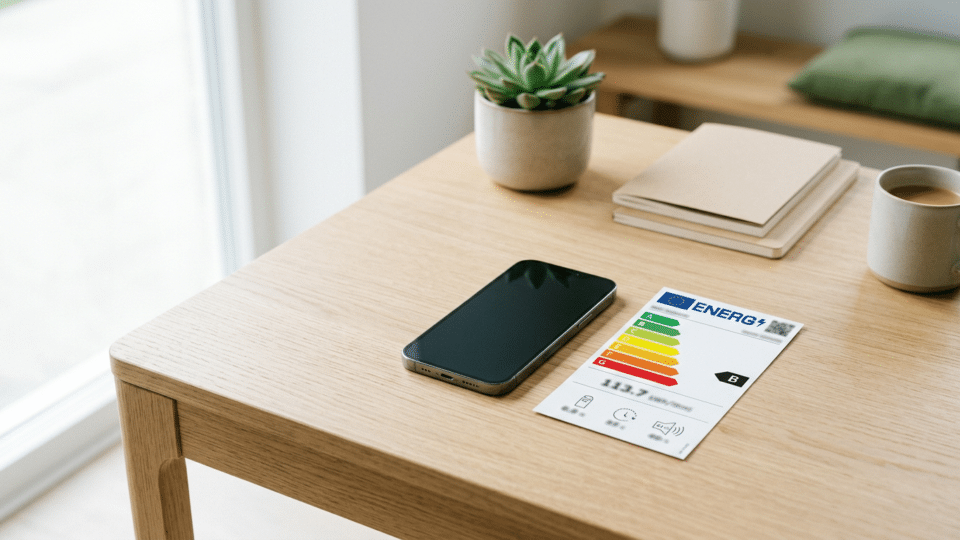
A smartphone placed on the European Union market after 20 June 2025 may carry a label showing not only its energy class, but also how many hours it operates in a standardised test, how many cycles its battery lasts, how it performs in repeated drops, its protection against dust and water, and how repairable it is.
For buyers, the important change is that the label can shift comparisons beyond megapixels, RAM and a discounted price. But it is not a complete verdict on a device’s lifespan. It is a useful initial filter, not an estimate of the bill a Romanian repair shop will issue.
In brief: first read the label to rule out models that do not suit the way you use your phone; then open the QR code and the EPREL product sheet; separately check parts availability, repair services and the cost of a local repair. These three steps answer different questions.
The phone label compares six things, not just one
The new European rules apply to smartphones, mobile phones and tablets placed on the EU market from 20 June 2025. The framework is set out in Commission Delegated Regulation (EU) 2023/1669 on energy labelling. The label uses a standardised methodology, allowing two products to be compared on the same basis.
It generally includes the following information:
- energy-efficiency class, from A to G;
- battery life per cycle, expressed in hours and minutes;
- repeated-drop reliability class;
- number of battery cycles;
- dust and water protection, indicated by the IP code;
- repairability class, from A to E;
- a QR code leading to the product sheet in the European EPREL register.
The label does not measure the camera, gaming performance, screen brightness, charging speed, signal quality, software stability or resale value. A phone may look good on this label and still not be the right choice for a user who prioritises photography or a particular app ecosystem.
Battery life, battery cycles and lifespan are three different measures
The easiest confusion is between the number of hours of battery life and the number of battery cycles. The first figure shows how long a phone can operate in a standardised test scenario under controlled conditions. It is comparable across labelled models, but it is not a promise that every user will get the same result.
In real-world use, a weak mobile signal, high brightness, GPS navigation, games, video recording or active background apps can substantially change battery life. The European Commission’s consumer guide explains this limitation: the figure on the label is useful as a common benchmark, not as a simulation of every day of use.
The number of cycles answers another question: how long the battery can retain a meaningful share of its original capacity. A cycle does not necessarily mean plugging the phone in once. It is cumulative use equivalent to 100% of the battery’s capacity: for example, two discharges of about 50% each amount to one cycle.
Ecodesign rules require the battery to withstand at least 800 cycles while retaining at least 80% of its initial capacity. This is a minimum product requirement, not a straightforward guarantee that the battery will “last five years”. The time needed to reach that threshold depends on how often the phone is charged, the temperature and how it is used.
| Indicator | Question it answers | What it cannot tell you on its own |
|---|---|---|
| Battery life per cycle | How long does it last on one charge in a standardised test? | How long it will last for each user, on every network and in every app. |
| Battery cycles | How well should the battery withstand repeated charging? | The precise date when daily battery life becomes inadequate. |
| Energy class | How does the product’s efficiency rank under the EU methodology? | Which phone is faster or has the best camera. |
For those intending to keep a device for several years, the relevant combination is: battery life sufficient for current needs, a good number of cycles, software updates and a realistic possibility of replacing the battery.
Drop resistance and the IP code reduce risk; they do not eliminate it
The repeated-drop reliability class comes from a standardised test. It is more informative than an advertising phrase such as “durable glass” because it provides a common basis for comparing products. Even so, it cannot be turned into an exact probability that your phone will survive a fall onto tiles, asphalt or the edge of a kerb.
The angle of impact, height, case, an old crack and the contact surface can completely change the outcome. A good score means the model performed better in the test specified by the regulation; it does not mean that it is indestructible.
The IP code should be read in the same way. It indicates tested protection against dust and water ingress under defined conditions. It is not an insurance policy for every liquid, salt water, worn seals or damage caused after unauthorised work on the casing. In addition, a manufacturer’s warranty terms may deal separately with liquid damage.
A repairability class is not an estimate of repair cost
The A-to-E repairability class is one of the most useful new features, but also one of the easiest to misinterpret. It is calculated from an index combining criteria such as disassembly steps, the type of fasteners and tools needed, the availability of parts, access to repair information, and elements relating to software support.
In other words, the letter on the label is not the result of a single test in which somebody takes the phone apart. This is why two phones in the same class may differ in practice. An analysis by the German consumer organisation Stiftung Warentest of models with an A class found that the same letter can conceal important differences in the extent of disassembly required and in the numerical score behind the class.
For a buyer, the practical conclusion is simple: an A class is a better signal than a lower class, but it is not enough to infer that the screen can be replaced quickly, the battery is inexpensive, or any repair shop can carry out the work.
What to check after scanning the QR code
The QR code leads to EPREL, the European register for energy labelling. The model sheet may include details that do not fit on the label: the numerical repairability score, its subcriteria and, depending on the sheet, links to information about parts and repairs.
EPREL is an official platform, but product data are supplied by manufacturers as part of their compliance obligations. They should not automatically be confused with an independent laboratory test or with the experience of a repair service in Romania.
Before buying, it is worth checking the following:
- whether the EPREL sheet matches the exact model variant being sold, rather than only its commercial name;
- which part is most likely to need replacement over time: the battery, screen, charging connector or back cover;
- whether the manufacturer provides instructions and parts for the type of repair envisaged;
- whether there is an accessible authorised repair service and what the estimated labour cost is;
- what effect a repair has on the warranty and IP protection.
A market check by consumer organisations affiliated with BEUC in six European countries reported better access to smartphone parts and instructions after the new rules, but identified repair prices as a significant obstacle. The study is not about Romania, so it cannot say how much a repair costs there; it does, however, confirm why the letter on the label should not be confused with the final bill.
Updates and parts change the calculation for a phone kept for five years
The European ecodesign regulation requires manufacturers to provide operating-system updates for at least five years from the date on which the last unit of the model was placed on the EU market. That reference point matters: it is not automatically the day each buyer purchases their phone.
If a model has sat in stock for a long time or is bought at a steep discount, part of the minimum support period may already have elapsed. For an older-generation phone, the useful question for the seller or manufacturer is the model’s reference date and the specific update timetable, rather than the vague claim that it “receives updates”.
The rules also provide for certain spare parts to be available for at least seven years after sales of the model cease in the EU, with delivery periods of 5–10 working days for the relevant parts, under the conditions set out in the regulation. Obligations differ according to the part and the category of person carrying out the repair: some information, tools, parts or updates may be intended primarily for professional repairers.
This does not require a shop in Romania to keep every part permanently on the shelf, nor does it set a price for a battery, screen or labour. The European framework makes it more likely that a repair will remain possible; it does not guarantee that it will always be cheap or convenient.
A quick guide for three types of buyer
If you want to keep the phone for around five years, do not choose based solely on battery life on day one. Put battery cycles, repairability class, the update period and the possibility of replacing the battery on the same list. A phone with very long initial battery life but shorter software support or difficult repairs may become less attractive than it first appears.
If you often drop your phone, check the repeated-drop reliability class first, then the price of a screen. The IP code is useful for dust or water accidents in the conditions for which it was tested, but it does not fully offset the risk of impact. A case and screen protector may remain a more predictable investment than assuming a good rating makes a phone immune to accidents.
If you want to be able to repair it, start with the repairability class, then go into EPREL and look for the details. Finally, check in Romania whether repair services are available, how long a part takes to order and what the total cost would be. This is the point at which a European label meets the local market.
The three-step method before paying
- Compare the labels of two or three models in the same price range. Do not chase a single letter. Consider battery life, cycles, drops, IP rating and repairability together.
- Scan the QR code and read the EPREL sheet for the exact model. Check the repairability score and information on parts or documentation when available.
- Check the reality in Romania. Ask for estimates for battery and screen replacement, and about original parts, repair times, warranties and servicing. The shelf price is not the total cost of ownership.
In this sense, the European label is more valuable as a tool for ruling out options than as an absolute podium. It can show from the outset whether a phone risks being poorly suited to how you will use it. The final choice should be complemented by the specifications that matter to you and by a local check of repair options.
Frequently asked questions
When does the European label for smartphones apply?
The rules apply to smartphones, mobile phones and tablets placed on the European Union market from 20 June 2025. Older models or stock placed on the market earlier may not have this label.
Does an A repairability class mean repairs will be cheap?
No. The class reflects a standardised index with several criteria, including disassembly, parts and repair information. The final cost depends on the price of the part, labour, repair service, shipping and warranty terms.
Are the five years of updates counted from the date of purchase?
Not automatically. The European requirement is tied to the date on which the last unit of the model was placed on the EU market. A model bought later may already have used up part of that period.
Is EPREL an independent testing website?
EPREL is the official European register of labelled products. The sheets are useful for comparison and transparency, but product values are supplier declarations within the compliance system, not the equivalent of an independent editorial test for every model.
Sources consulted
- Commission Delegated Regulation (EU) 2023/1669 — Energy labelling of smartphones and slate tablets
- Commission Regulation (EU) 2023/1670 — Ecodesign requirements for smartphones, mobile phones, cordless phones and slate tablets
- European Commission — New EU rules for durable, energy-efficient and repairable smartphones and tablets start applying
- European Commission — New energy label for smartphones and slate tablets: Explanations for consumers
- Stiftung Warentest — Repairing smartphones and tablets: what the energy label leaves out








Discuția cititorilor
Ai o opinie sau o întrebare despre acest articol? Spune-ne ce crezi.
Fii primul care deschide discuția.
Te rugăm să păstrezi un limbaj civilizat și să discuți la subiect. Comentariile spam sunt filtrate automat.