
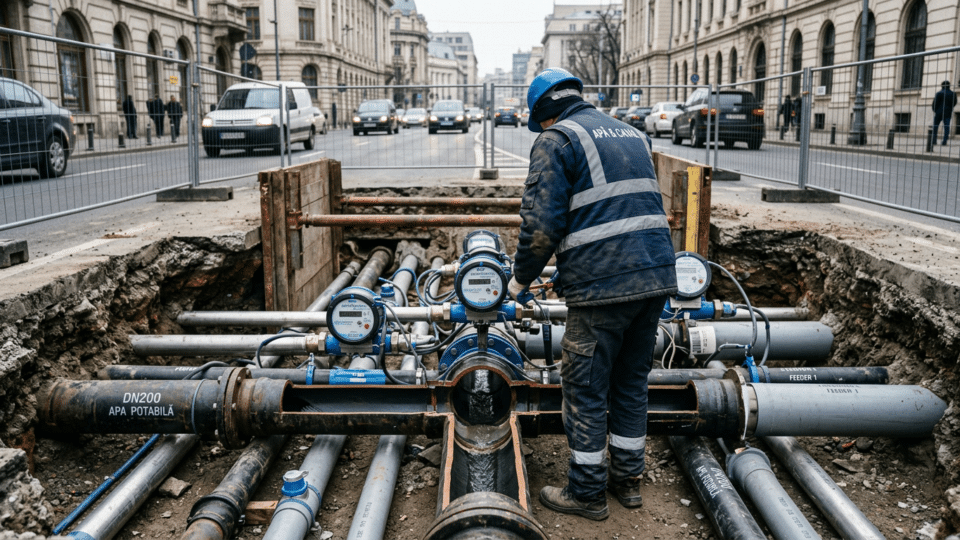
A significant part of the water problem does not begin in households or during droughts. It begins between the treatment plant and the tap. The European Commission says that 23% of treated water in Romania is lost before reaching consumers. This is a significant figure, but it should not be read too quickly: it is not automatically equivalent to all losses reported by operators or to non-revenue water.
In brief: Romania needs expanded networks, repaired pipes and better data on what happens inside the infrastructure, all at the same time. Sensors, remote-reading meters and data platforms can help locate problems. They cannot, however, replace physical works, response teams or a common method through which operators measure the same reality.
Water losses in Romania: why two percentages can mean different things
Discussions about water often involve indicators with similar names but different meanings. Presented side by side without explanation, they can appear either contradictory or to confirm the same problem. They are neither.
| Indicator | What it may include | What it does not prove on its own |
|---|---|---|
| Treated water lost before the tap | Water that does not reach users through the distribution system | How much is strictly due to leaks, and how much to measurement issues or incomplete records |
| Non-revenue water | Physical leaks, unmetered consumption, inaccurate meters, unregistered connections or unauthorised use | That the entire volume is water leaking into the ground |
| Population connected to the network | Residents’ access to the public water-supply service | The efficiency of the pipes or the actual continuity of supply |
In its economic survey of Romania, the OECD estimates that more than 565 million cubic metres of drinking water are lost each year through public distribution networks, and says that almost half of that volume falls within the broader category of non-revenue water. This should not be translated directly as “half of the water leaks from pipes”. The category also includes commercial losses and record-keeping issues.
The distinction has practical consequences. A burst pipe requires locating and repairing. An inaccurate meter requires checking, replacement or recalibration. A connection that does not appear properly in the records requires administrative oversight. All affect an operator’s balance sheet, but they do not have the same cause and do not require the same investment.
Data is infrastructure before a network becomes “smart”
A water network becomes easier to manage when the operator can compare the volume fed into an area with the volume measured at customers’ premises, pressure across different sectors, and alerts received from the field. This requires district meters, pressure or flow sensors, systems that detect noises associated with faults, and a database in which the information can be linked.
But the first question is less spectacular: are the data calculated in the same way, using the same definitions and over the same intervals? Without this minimum common ground, a ranking of operators may compare different methods rather than different performance.
ANRSC has published its report on the state of the sector in 2024 and is running a project, supported by the World Bank, to improve loss measurement, establish a common methodology and develop a national plan to reduce losses. The initiative, outlined by ANRSC, matters precisely because a simple national figure cannot replace a comparable data system across operators and network sectors.
In this sense, digitalisation does not simply mean placing more devices in the field. It means that data from plants, pipes, meters and repair works can answer operational questions: where does water enter, where does the discrepancy emerge, how quickly is an alert checked, and how much water is recovered after the work?
What the European Union is preparing, and what is not yet mandatory
On 9 November 2026, the European Commission discussed an action plan to digitalise Europe’s water sector. According to the Commission’s announcement, the proposal seeks to address fragmented data, a lack of interoperability, shortages in digital skills and procurement rules regarded as outdated. Smart meters and data infrastructure are among the measures being considered.
The plan was expected to be adopted in the first half of 2027. That matters for describing the issue accurately: in November 2026, it was not yet a finalised European obligation, with fixed deadlines and confirmed funding for every operator in Romania.
The European direction is nevertheless relevant. Incompatible data between systems can make both fault management and investment justification more difficult. An operator that cannot consistently separate leaked water from unmeasured water may invest in technology without being able to demonstrate the outcome clearly.
From alert to repair: what technology can do in the field
An acoustic logger listens for vibrations and sounds associated with a possible leak. If the signal is analysed alongside data on pressure, flow and the pipe’s location, the team can narrow down the area that needs to be checked. The advantage is not that the device repairs the pipe, but that it reduces the time spent looking for the problem.
In Buzău, the local water company said in material carried by AGERPRES that using acoustic loggers was followed by a 13% reduction in losses, and that it is targeting 20% by 2030. The figure should remain within its limits: it is a result reported by the operator, not an independently published assessment of the comparison period, methodology or net cost of the programme. As an example, however, it shows a useful path for digitalisation: signal, verification, intervention and measurement of the result.
This process is not uniform across the country. In a dense city, sector-based monitoring may locate anomalies more quickly in a relatively compact network. In long systems serving dispersed settlements, connectivity and maintenance costs may be higher, and teams may take longer to reach a fault. A fair comparison must take account of network length, pressure, the number of connections, terrain and the age of the infrastructure.
Water bills are not calculated automatically from the loss rate
It is tempting to conclude that every reduction in losses will immediately lower bills. There is no general rule of that kind. An operator may save treated water and pumping energy while also facing costs for rehabilitation, equipment, communications, cybersecurity and technical staff.
The effect on tariffs depends on regulatory rules, the financing of investments and the decision whether to pass savings on through tariffs, new works or both. For households, the verifiable promise is not a particular percentage reduction in the bill, but a more predictable service: fewer faults, faster interventions, accurate metering and an operator able to plan works before a major failure.
The link with energy also deserves attention without simplification. Water is treated and pumped before entering the distribution system; when treated volume is lost, energy is also used without the service reaching the user. This principle does not, however, allow a calculation of a national cost of lost energy without comparable data on the consumption of each system.
Four questions for any promise of a smart water network
- Which indicator is being reduced? Physical losses, non-revenue water, unmetered consumption and response time are different indicators.
- What is the comparison baseline? The period, the volume fed into the network, the monitored area and changes in methodology all matter.
- Who responds after the alert? An alarm without a team, parts and a verification procedure does not automatically result in water being recovered.
- Who bears the cost, and how is the result verified? Procurement, connectivity, maintenance, security and evaluation need to be visible, rather than concealed within a technological promise.
Romania does not have to choose between expanding networks and reducing losses: they are distinct objectives competing for the same resources. Digitalisation replaces neither. Its value emerges when it helps an operator decide which pipe to repair first, which meter to check, where to send a team and how to demonstrate the result publicly. Before a smart network, there needs to be a water balance that everyone can understand and compare.
The discussion also connects to investment in wastewater treatment: InfoBuz’s analysis of the three bills of wastewater treatment shows why networks, treatment and financing must be considered together, without assuming that a single technology can resolve the entire public service.
Frequently asked questions
What does “non-revenue water” mean?
It is a broader indicator than water physically leaking through pipes. It may include real losses, unmetered consumption, meter errors, incompletely recorded connections or unauthorised use.
Can a smart meter repair a water leak?
No. A meter can provide faster and more accurate data on consumption or anomalies. Actually reducing the loss depends on checking the alert, locating the problem, response teams and the repair itself.
Will digitalisation automatically reduce water bills?
Not automatically. Lower losses can reduce some operating costs, but the effect on tariffs depends on investment, financing, regulation and operators’ decisions.






Discuția cititorilor
Ai o opinie sau o întrebare despre acest articol? Spune-ne ce crezi.
Fii primul care deschide discuția.
Te rugăm să păstrezi un limbaj civilizat și să discuți la subiect. Comentariile spam sunt filtrate automat.