
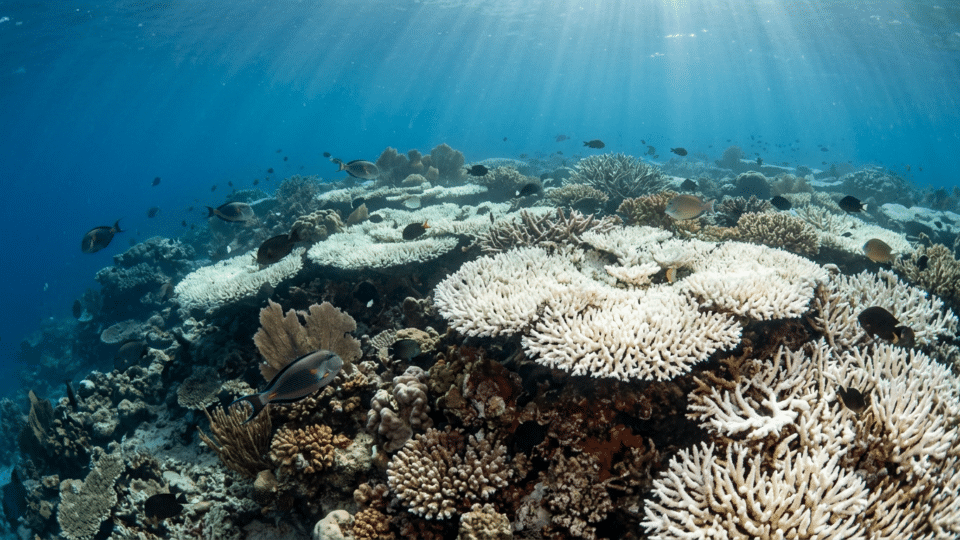
A global reassessment published in Nature on 15 October 2026 finds that 340 of the 774 reef-building coral species for which sufficient data were available — 44% — fall into extinction-risk categories. The finding is serious, but the figure needs careful interpretation: it does not mean that 44% of corals have died, that 44% of reefs have disappeared, or that extinction is inevitable for every species included.
What we know now: the assessment measures relative extinction risk at species level. Separately, global monitoring shows that reefs have undergone a recent thermal-stress episode unprecedented in its extent. The two findings reinforce each other as evidence of ecological pressure, but they are not the same indicator.
What the assessment shows about threatened reef corals
The study reassessed 892 warm-water, reef-building coral species. The authors had enough data to classify 774 of them. Of those, 340 were considered threatened under the International Union for Conservation of Nature (IUCN) Red List criteria: 33 are “Critically Endangered”, 251 are “Endangered”, and 56 are “Vulnerable”.
The calculation is simple but important: 340 divided by 774 is approximately 44%. The remaining 118 reassessed species did not have enough information for a comparable classification. This is why the percentage is not based on all 892 species examined.
The authors explain in the study published in Nature that risk was estimated using IUCN criteria. For many species, there are no complete, long-term records of the size and trajectory of every population. Researchers therefore used indirect indicators: coral-cover trends, projections of severe bleaching events, and vulnerabilities linked to species’ biological traits.
This method does not invalidate the finding, but it defines its limits. It is a global assessment of the relative likelihood of decline and extinction, rather than a direct census of every coral colony on the planet.
Three percentages describing three different things
Eye-catching percentages often appear in discussions of reefs. The problem is that they are sometimes placed in the same sentence as though they measured the same phenomenon. They do not.
| Indicator | What it measures | What it cannot establish on its own |
|---|---|---|
| 44% | The share of assessed species classified as threatened: 340 out of 774 | The percentage of reefs lost, current mortality, or the date of an extinction |
| 9.5% | The relative decline in global hard-coral cover in 2020–2024 compared with 1980–2009 | The percentage of species that are threatened or extinct |
| 84.4% | The area of the world’s reefs exposed to bleaching-level heat stress between 1 January 2023 and 30 September 2025 | Actual mortality or the extinction risk of each species |
The first figure concerns species. The second concerns hard-coral cover, an ecosystem characteristic. The third concerns thermal stress across reef areas. Keeping them separate does not diminish the problem; it helps explain it without making incorrect extrapolations.
The Global Coral Reef Monitoring Network (GCRMN) report, which analyses observations from 1980 to 2024, estimates a relative 9.5% decline in global hard-coral cover in 2020–2024 compared with the 1980–2009 reference period. This is a reef-level snapshot, not a list of species at risk of extinction.
NOAA Coral Reef Watch, meanwhile, estimated that around 84.4% of the world’s reef area was exposed to bleaching-level thermal stress between the start of 2023 and 30 September 2025. According to the NOAA update, mass bleaching was documented in at least 83 countries and territories during this fourth global bleaching event.
Bleaching is a warning signal, not an automatic death certificate
During extreme and prolonged heat, corals can expel or lose the microscopic algae with which they live in symbiosis and from which they receive much of their energy. This is the mechanism of bleaching: coral tissue becomes transparent and the pale skeleton beneath becomes visible.
A bleached coral is not automatically dead. If temperatures return to a tolerable level and other pressures remain controlled, some colonies can recover. But a period of severe or repeated stress can lead to starvation, disease, mortality and changes in reef structure.
This is where one of the GCRMN report’s more uncomfortable findings emerges. The network also identified periods of recovery: global hard-coral cover rose by around 6% in relative terms between 2017 and 2019, after the previous global bleaching event. But recovery depends on the time between disturbances. If heatwaves return before a reef can rebuild its populations and structure, every episode begins from a more fragile baseline.
Why the 44% assessment may be conservative without becoming a prediction
The authors of the Nature study stress that the assessment predates the three warmest years on record and the 2023–2025 global bleaching event. That does not justify saying that “the real percentage is certainly higher now”. There is not yet a comparable global IUCN reassessment that converts the effects of that event into a new official percentage of threatened species.
Something more precise can, however, be said: the 44% figure does not fully include the consequences of the most recent global thermal-stress event, while independent ecosystem and temperature data confirm that pressure on reefs was exceptionally widespread during that period.
IUCN presents 44% as its central estimate and gives a possible range of 38% to 51%, depending on assumptions used for species classified as “Data Deficient”. This range is not a dispute between incompatible findings. It is how the assessment makes the remaining uncertainty visible for species that cannot be firmly classified with the available information.
What “reef-building” means
This article concerns warm-water corals that help form the limestone structure of tropical reefs. It does not automatically include every organism popularly called a “coral”, nor every vulnerable marine ecosystem.
The distinction matters for Romania as well. The Black Sea does not have tropical coral reefs comparable to those assessed in the study. There is therefore no direct local extrapolation of the 44% figure. Its relevance for readers in Romania is global: reefs are key ecosystems for biodiversity, fisheries and natural coastal protection, and their case shows how the same ocean warming can be measured differently, from species level to the area of an ecosystem.
This kind of careful reading of indicators is useful in other climate issues, too. For example, in InfoBuz’s analysis of Arctic and Antarctic sea ice, the meaning of a figure depends on the hemisphere, season, averaging period and data product used. For reefs, the key question is different: are we discussing species, coral cover, thermal stress, bleaching or mortality?
The cautious conclusion: confirmed degradation, incomplete post-bleaching accounting
The new assessment provides the clearest available answer on risk at species level: nearly half of reef-building corals assessed with sufficient data are considered threatened. GCRMN and NOAA monitoring does not repeat that calculation, but adds to the picture with different measures: reefs have lost global hard-coral cover compared with the reference period, while recent thermal stress has been exceptional in scale.
What is still missing is an updated global accounting that translates the 2023–2025 event into a new extinction-risk classification for each species. Until then, the most accurate wording remains the most useful: 44% is an assessed risk for species, not a count of corals that have disappeared; the other data show that the ecosystems on which these species depend have entered a period of increasingly recurrent pressure.
Frequently asked questions
Does 44% mean that nearly half of reef corals have died?
No. The percentage is the share of species assessed with sufficient data that IUCN placed in extinction-risk categories. It is not a measure of current coral mortality or reef area lost.
Why are 774 species classified if the study reassessed 892?
There were enough data for 774 species to apply the classification criteria. The remainder were treated as Data Deficient, and how those species are handled contributes to the 38%–51% uncertainty range reported by IUCN.
Does coral bleaching mean the reef has died?
Not always. Bleaching indicates severe stress, usually thermal stress, through the loss of symbiotic algae. Corals can recover if the stress subsides, but intense or repeated exposure can cause mortality and reef degradation.
Sources consulted
- Nearly half of reef-building corals face elevated relative risk of extinction
- PubMed: Nearly half of reef-building corals face elevated relative risk of extinction
- Status of Coral Reefs of the World: 2025 — Global Coral Reef Monitoring Network
- Current Global Bleaching: Status Update & Data Submission — NOAA Coral Reef Watch
- Q&A: IUCN Red List of Threatened Species Corals Assessment









Discuția cititorilor
Ai o opinie sau o întrebare despre acest articol? Spune-ne ce crezi.
Fii primul care deschide discuția.
Te rugăm să păstrezi un limbaj civilizat și să discuți la subiect. Comentariile spam sunt filtrate automat.