
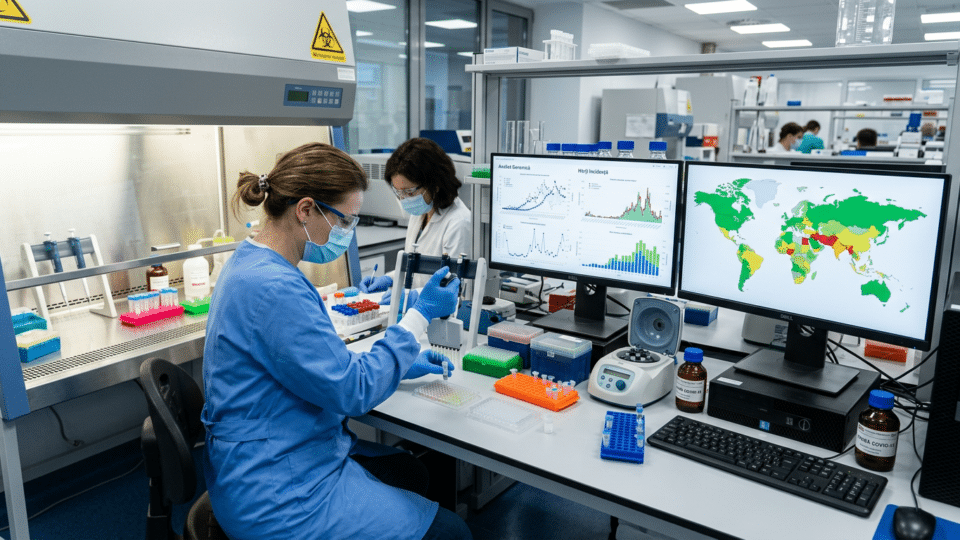
On 12 October 2026, the World Health Organization announced a strategy intended to ensure that, by 2030, every country can detect and understand a new health threat within no more than 24 hours of its emergence. The rationale is straightforward: time gained at the start of an outbreak can allow targeted testing, protection for healthcare staff, contact tracing and preparation of health services before case numbers rise.
The target does not mean WHO will instantly learn of every case worldwide, nor that an outbreak will be brought under control in a single day. It is a capacity goal for countries, based on local reporting, laboratories, epidemiological analysis, digital data and rapid information-sharing. In its announcement of the new strategy, WHO describes the goal as detecting and understanding new health threats, rather than immediately identifying a pathogen, having treatment available or automatically communicating the information to the public.
In brief: a rapid signal is valuable only if it can be verified, classified and passed on without overwhelming health services with false alarms. The 24 hours therefore mark the beginning of a response, not its end.
What detecting outbreaks within 24 hours involves
In everyday language, “detection” may suggest that a laboratory establishes the cause of an illness on the same day. In practice, the first sign can emerge much earlier and take very different forms: a doctor notices an unusual cluster of patients, a laboratory records atypical results, authorities receive a notification, or a system analysing public sources identifies information that needs to be checked.
WHO also uses Epidemic Intelligence from Open Sources, known as EIOS, to identify signals in open sources. A signal is not the same as a confirmed outbreak. It may be an incomplete report, duplicated information or an event unrelated to a communicable disease. This is why the WHO Hub strategy refers to surveillance, analysis, digital infrastructure and collaboration, rather than an algorithm capable of deciding on its own.
The distinction also matters for public communication. An authority that presents unverified information as certain may cause panic or divert resources in the wrong direction. At the other extreme, slow verification can allow transmission to advance before hospitals and exposed populations are prepared.
| Stage | What it can mean | Where delays arise |
|---|---|---|
| Signal | A doctor, laboratory, local authority or digital source notices something unusual. | Late access to medical consultation or testing, incomplete reporting, inconsistent data. |
| Verification | Establishing whether the information describes real cases and whether there is an epidemiological link. | Insufficient samples, differing case definitions, staff shortages. |
| Characterisation | Laboratories and epidemiologists investigate the cause, extent and groups exposed. | Diagnostic capacity, sample transport, sequencing, access to data. |
| Notification and response | Authorities decide what information to communicate and which measures are proportionate. | Limited interoperability, administrative procedures, slow risk assessment. |
There is no single WHO “radar”
WHO’s 2026–2030 strategy identifies five areas of work: epidemiological analysis of open sources, the international pathogen surveillance network, a collaboration space for experts, the collaborative surveillance initiative, and digital tools for public-health information. The strategy document is available in WHO’s publication on the Hub for Pandemic and Epidemic Intelligence.
These components address distinct problems. Public sources can help identify an anomaly quickly. Laboratory networks and genomic surveillance can provide clues about the pathogen and its changes. Clinical and epidemiological data show whether there is sustained transmission and who is exposed. Digital infrastructure, meanwhile, must allow data to remain comparable and protected as they move from one institution to another.
Speed, then, does not depend solely on artificial intelligence or better software. It also depends on less visible factors: compatible forms and definitions, staff able to assess alerts, properly transported samples, functioning laboratories, and clear rules on who notifies whom and who makes decisions.
The European route: the national level comes before an EU alert
In the European Union, the exchange of information on cross-border threats relies on tools administered or developed in connection with the European Centre for Disease Prevention and Control. The Early Warning and Response System, EWRS, is a restricted-access platform for authorised authorities and institutions; it is not a public website where citizens can follow real-time alerts. Its role is set out by ECDC in its overview of the EWRS.
ECDC is also developing Epi+, an open-source platform for event-based surveillance, whose pilot phase is planned for June 2027. The institution stresses a principle that directly matters to every member state: national reporting and coordination must be in place before an event can be effectively shared at European level.
For Romania, the useful question is not whether a European platform exists, but how quickly an observed indication can be turned into a verified notification. Depending on the situation, the route runs through doctors and hospitals, public-health directorates, laboratories and the competent national authorities before reaching European mechanisms and global coordination. The existence of institutional connections alone does not demonstrate a consistent response time across all counties or for every type of threat.
To supplement the information above, readers can also consult SPIT Constanța: counter appointments can be cancelled automatically. The 48-hour rule many people miss, an article that develops an aspect directly related to this subject.
Reporting cases of communicable diseases remains relevant even after the acute phase of a news story has passed. For example, monitoring West Nile virus infections shows why epidemiological data, testing and communication between administrative levels must be read together rather than separately. InfoBuz previously explained how reported West Nile cases in Romania are tracked.
Why time gained matters even without a perfect treatment
A specific treatment or vaccine may be unavailable in the initial phase of a threat. Even so, early information can change the immediate response: hospitals can adapt testing and staff protection, laboratories can prioritise particular samples, and authorities can begin epidemiological investigations.
This is why early detection does not compete with research into medicines. It can give researchers and authorities faster data on the pathogen, its geographical distribution and vulnerable groups. But this mechanism does not guarantee that an outbreak will be stopped: the effect depends on the disease, its mode of transmission, the capacity of health services and the measures taken after the alert.
How the 2030 target should be assessed
The phrase “from emergence” presents a measurement problem. The first case may not reach a doctor, the first patient may not be tested, and the first digital signal may appear after the disease is already circulating. The public documents consulted do not specify a single indicator applicable to all countries that unambiguously establishes the starting point for the 24 hours.
A serious assessment of progress should distinguish at least four intervals: the time to the first signal, the time to verification, the time to notify the competent institutions, and the time to the first public-health measure. Combining them into a single figure can conceal the real bottleneck.
- Signal speed shows whether the system sees an anomaly early enough.
- Validation quality shows whether alerts are credible and useful.
- Laboratory capacity shows how quickly the cause of an event can be clarified.
- Interoperability shows whether data can move between local, national and European levels without being repeatedly re-entered or reinterpreted.
- Time to action shows whether information produces proportionate measures, rather than only reports.
WHO’s stated target is therefore an ambitious standard for organising public health. It may narrow the window in which an outbreak develops unnoticed, but it does not remove the need for confirmation, specialised staff and transparent decisions. The real test by 2030 will be whether alerts reach those able to act more quickly, without haste turning every rumour into a health emergency.
Frequently asked questions
Does the WHO target mean every outbreak will be discovered in exactly 24 hours?
No. WHO aims for countries to be able to detect and understand new health threats quickly. The exact moment of “emergence” is difficult to define, and an outbreak may be observed before, during or after the first confirmed illnesses.
Is an epidemiological signal the same as a confirmed outbreak?
No. A signal may come from a laboratory, clinical reports or open sources and requires verification. A confirmed outbreak requires an assessment of cases and a possible epidemiological link.
What role does Romania have in a European alert system?
For information to reach the European level usefully, it must first be observed, verified and coordinated nationally. Then, when the relevant conditions are met, authorities can use European information-sharing mechanisms, including EWRS.









Discuția cititorilor
Ai o opinie sau o întrebare despre acest articol? Spune-ne ce crezi.
Fii primul care deschide discuția.
Te rugăm să păstrezi un limbaj civilizat și să discuți la subiect. Comentariile spam sunt filtrate automat.