
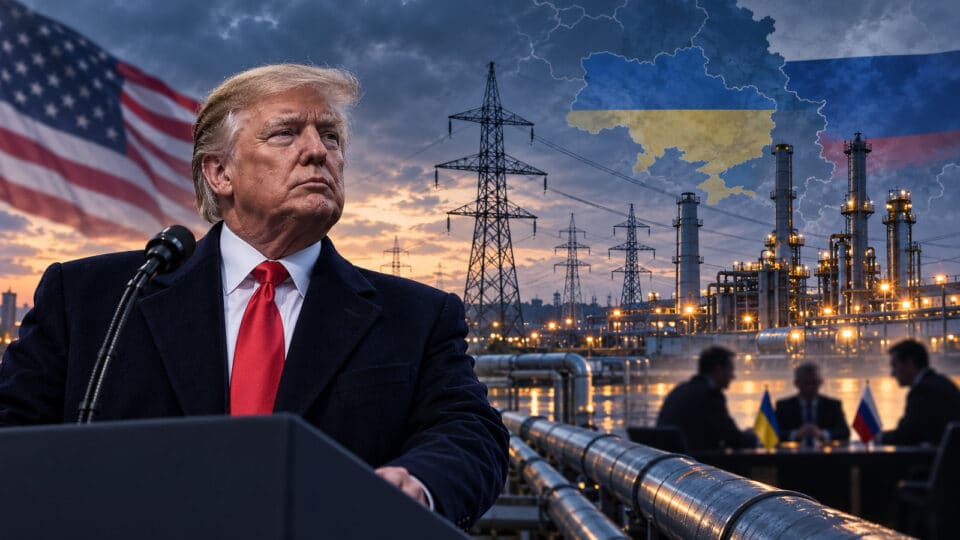
US President Donald Trump announced on Sunday, 11 October 2026, that Russia and Ukraine had agreed to an “energy ceasefire” with immediate effect. The stakes are significant: reducing attacks on power plants, grids, refineries and other energy targets ahead of the cold season. At the time the information was checked, however, there was no public confirmation of a bilateral agreement setting out its terms and enforcement mechanisms.
Ukrainian President Volodymyr Zelenskyy said he was surprised by the announcement and stated that Ukraine could accept a reciprocal ceasefire if Russia also observed the halt in attacks. Moscow had not publicly confirmed that an agreement existed. The accurate wording is therefore not “the energy war has ended”, but “Trump says an agreement has been reached, though it has not yet been confirmed by the parties.”
For more on Ukraine, see Ukraine–Romania wind energy: the 650 MW WIND project could reshape the region’s energy map, which provides further relevant context.
What Donald Trump announced
In a post on his social-media platform, the White House leader said both sides had agreed to immediately suspend energy attacks. Reporting by Associated Press and Axios noted that the message included no details on the measure’s duration, the institutions that would monitor it, or the consequences of any breach.
In an operational agreement, such elements matter at least as much as the political announcement. Who determines whether a site that has been hit is energy infrastructure? Are oil refineries, storage facilities, electricity grids, terminals and transport infrastructure included? Is there a reference date and time accepted by both sides? Until clear terms are published, those questions remain unanswered.
What Ukraine says, and why its response matters
Volodymyr Zelenskyy indicated that such a ceasefire would be an acceptable option for Kyiv only if it were reciprocal. In comments reported by The Guardian, the Ukrainian leader said the announcement had come as a surprise and called for clarity on when it was supposed to take effect.
This creates a distinction between diplomatic intent and the concrete obligation governments undertake. Without explicit acceptance, verification and a mechanism for resolving incidents, it is difficult to establish whether a subsequent attack constitutes a breach of an understanding or evidence that the understanding did not exist in the form announced.
Refineries, power plants and grids: what is at stake in the term “energy”
Attacks on energy infrastructure can affect electricity supplies, household heating, industrial operations and fuel revenues. For Ukraine, the availability of grids and power plants is both a social and security issue on the eve of winter. For Russia, oil facilities are both industrial assets and sources of revenue.
A genuine, verifiable halt to such attacks could reduce risks for civilians and energy markets. That is a possible consequence, however, not a confirmed outcome of Sunday’s announcement.
Why the announcement comes at a tense moment
Trump’s message comes amid differences between Washington and Kyiv, including over Ukrainian strikes targeting Russian refineries and US policy on the marketing of fuels from Russia. Trump has criticised attacks on refineries, while Ukraine argues that pressure must also be applied to Moscow to stop the bombing of its infrastructure.
A ceasefire limited to energy facilities is not equivalent to a ceasefire across the entire front. Even if observed, fighting, attacks on other targets and humanitarian problems may continue. Confusing the two types of arrangement would create false expectations.
What needs to be confirmed before this can be called a real agreement
- Separate official confirmations from Kyiv and Moscow, rather than Washington’s statement alone.
- A precise definition of the targets covered by the ceasefire.
- The start time, duration and monitoring rules.
- A joint procedure for assessing incidents and violations.
- The first verifiable data showing an effective reduction in attacks on energy infrastructure.
What it could mean for Romania and Europe
Europe remains sensitive to developments in the war, regional energy security and fuel prices. A durable agreement could reduce some uncertainty, but no automatic fall in pump prices or electricity bills can be inferred from an unconfirmed announcement. Prices also depend on demand, supply, contracts and global events with no direct connection to Ukraine.
InfoBuz assessment: the US president’s statement is significant news, but for now its status is that of a major political claim, not a documented ceasefire confirmed by both sides. It will be possible to speak of a real change when there are clear terms and evidence that they are being observed.
From the InfoBuz archive: for context on fuels and sanctions policy, see our analysis of OFAC Licence 135 concerning Russian diesel. It examines a separate measure that does not in itself confirm any ceasefire.
Sources and verification
Associated Press, 11 October 2026; Axios, 11 October 2026; The Guardian, 11 October 2026. This article distinguishes between leaders’ statements and facts confirmed at the time of publication.









Discuția cititorilor
Ai o opinie sau o întrebare despre acest articol? Spune-ne ce crezi.
Fii primul care deschide discuția.
Te rugăm să păstrezi un limbaj civilizat și să discuți la subiect. Comentariile spam sunt filtrate automat.