
Russian diesel in the United States has returned to the attention of energy markets following a decision announced in Washington on 9 October 2026. US President Donald Trump said he had reached an agreement with Vladimir Putin on diesel-fuel deliveries, while the Treasury Department issued OFAC General License No. 135. The document temporarily authorises certain transactions involving the sale, delivery, unloading and import of Russian-origin diesel.
The change is significant, but it needs to be read precisely: it does not mean that all US sanctions against Russia have been lifted; it does not confirm that the announced volumes have actually arrived in ports; and it does not guarantee an immediate reduction in prices at the pump.
Russian diesel in the US: what Donald Trump announced
According to Associated Press reporting from 9 October, Trump said that, following a telephone conversation with Putin, Russia would supply more than 300,000 tonnes of diesel in the first stage and a further 500,000 tonnes in November. The US president also mentioned additional volumes for the period thereafter.
These are volumes stated in a political announcement, not quantities already verified through loading and unloading documents. At the time of the announcement, not all details on buyers, contracts, routes and the exact delivery timetable were public.
The administration presented the measure in the context of high fuel costs. Diesel is particularly important to freight transport, agriculture and logistics, and its fluctuations are passed on over time through the costs of commercial activity. A potential increase in supply, however, does not instantly translate into an identical reduction in retail prices.
OFAC General License No. 135: which transactions are permitted
The official document, published by the Office of Foreign Assets Control (OFAC), the US Treasury body that administers numerous sanctions programmes, is entitled General License No. 135.
Under the conditions set out in its text, the licence permits transactions that would otherwise be prohibited under two sets of US regulations concerning Russia, where they relate to the sale, delivery, unloading and import of Russian-origin diesel, including imports into the United States.
The authorisation remains in force until 12:01 a.m. Eastern Daylight Time on 7 April 2027, according to the full text of the licence. It is therefore a temporary exemption with a clear expiry date, rather than a permanent change to the entire sanctions regime.
There is also an important exception: the licence does not authorise debits to accounts held at US financial institutions by the Central Bank of the Russian Federation, the National Wealth Fund or Russia’s Finance Ministry. Other restrictions not explicitly waived by the document do not automatically disappear.
Why this does not mean the US has lifted sanctions on Russian oil
A sanctions regime can include general prohibitions, exemptions and licences for specific transactions. A general licence grants permission for a defined category of transactions; it does not operate as a wholesale cancellation of sanctions against a country.
In this case, the scope of the measure is explicit: Russian-origin diesel fuel. Its text does not indicate unlimited authorisation for all oil, financial products, technology exports or transactions with sanctioned entities. For the companies involved, legal compliance depends on all rules that remain in force and on the terms of each specific transaction.
The distinction also matters for readers: headlines such as “The US has lifted sanctions on Russia” would misrepresent the scope of the document. The decision is nevertheless relevant because it temporarily opens a legal route for certain transactions involving an energy product that had previously been restricted.
Will diesel prices fall in the United States?
On 9 October, Associated Press cited AAA data showing that the US national average diesel price was around $6.28 per gallon. This is a US indicator, expressed in a different unit from the litre used at petrol stations in Romania, and cannot be directly compared with European prices without conversions and without accounting for taxes.
For further context, see Inflation falls only on paper: Romanians are still paying huge prices on the shelves, an article examining an aspect directly related to this subject.
Whether prices fall depends on actual deliveries, transport capacity, global demand, refinery operations, regional distribution and commodity prices. Michael Lynch, an expert cited by AP, cautioned that some of the fuel could simply be redirected among customers rather than representing an equivalent net increase in global supply.
What has been verified today: the existence of the OFAC licence and its legal content. What has not yet been verified: how much fuel will arrive in practice, on what timetable, and how much drivers will save at the pump.
Ukraine’s response and the diplomatic implications
The decision drew criticism from Ukrainian authorities, who argue that easing energy restrictions could provide Russia with additional revenue in the context of the war. President Volodymyr Zelensky publicly challenged the measure, according to an interview with Axios.
From the US administration’s perspective, the stated objective is to ease price pressure on US consumers and hauliers. Those two priorities — energy costs and the effectiveness of sanctions — can come into tension. The real effects need to be assessed through trade and price data, and through the implementation of the legal regime, rather than solely through statements by the parties.
What this could mean for diesel prices in Romania
For Romania, there is currently no factual basis for forecasting a specific price reduction in lei per litre. The local market is influenced by international petroleum-product quotations, exchange rates, taxation, refining, transport and distribution costs, as well as commercial competition.
A change in global flows may affect benchmark prices, but neither the direction nor the scale of the effect is guaranteed. For domestic context, InfoBuz has separately examined the difference between diesel and petrol prices, and the theoretical impact of an excise-duty cut in Romania. Local fiscal measures are distinct from the US exemption.
What to watch in the coming weeks
The first verifiable elements will be documents and data on shipments actually completed, any clarifications published by OFAC, wholesale-market reactions and movements in diesel quotations. If the terms of the political announcement change, they should be distinguished from the text of the licence already issued.
In essence, a temporary authorisation has been issued. The actual scale of trade and the impact on prices remain open questions at the time of writing.
Verified sources
- US Treasury Department / OFAC — announcement of the issuance of General License No. 135, 9 October 2026.
- OFAC — full official text of License 135 (PDF).
- Associated Press — statements on the deliveries and market context.
- Axios — the Ukrainian president’s response.
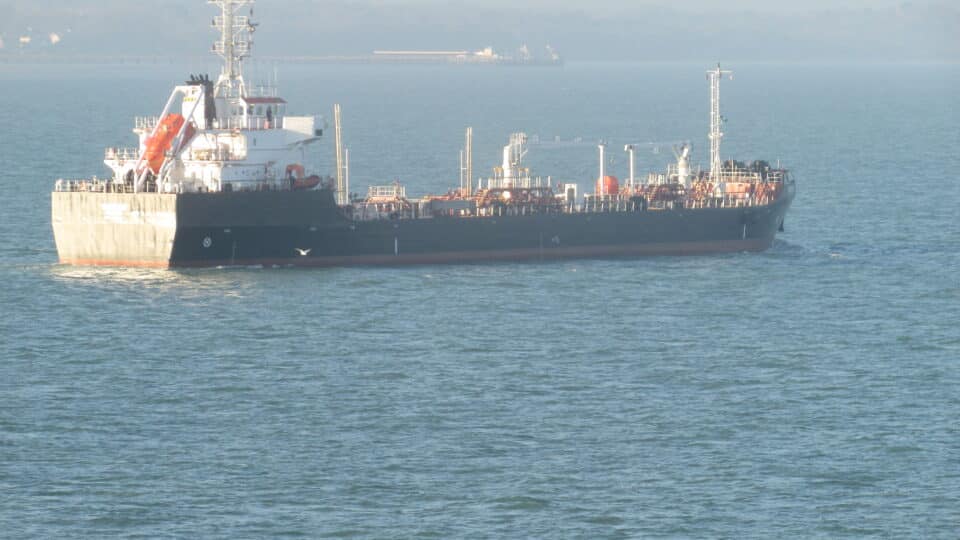
Photo: Kolforn / Wikimedia Commons, CC BY-SA. An oil tanker photographed in 2016. The image is strictly illustrative and does not show a shipment from Russia to the US.
InfoBuz reporting: 9 October 2026. Situation developing; this article distinguishes official documents from announced volumes and from economic effects that have yet to be confirmed.


Discuția cititorilor
Ai o opinie sau o întrebare despre acest articol? Spune-ne ce crezi.
Fii primul care deschide discuția.
Te rugăm să păstrezi un limbaj civilizat și să discuți la subiect. Comentariile spam sunt filtrate automat.