
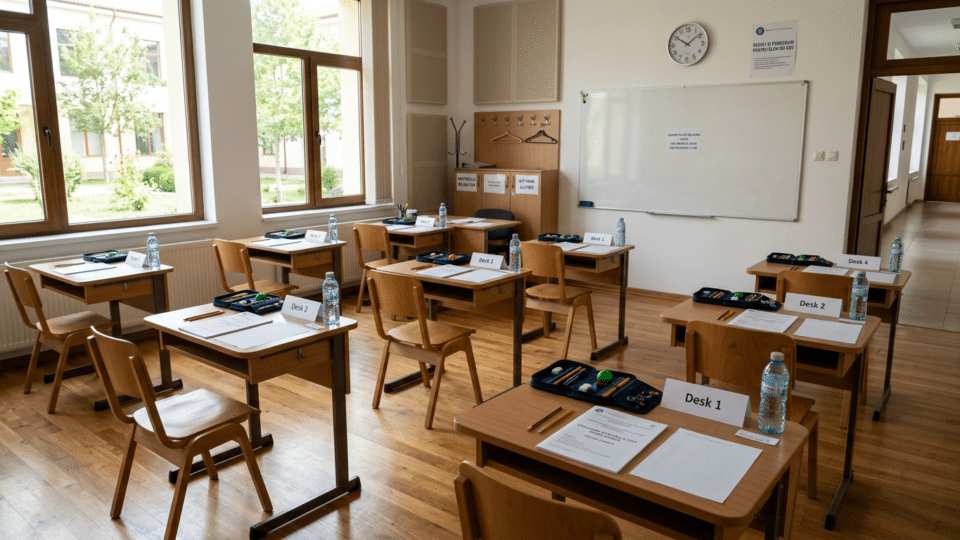
In Romania’s 2026 National Assessment and Baccalaureate, a student with special educational needs could receive adapted conditions for taking an exam. Extra time, a separate room, having instructions read aloud, Braille, a computer or dictating answers were possible in certain circumstances, but they were not granted automatically and did not mean easier exam papers.
The Ministry of Education’s procedure set out a clear route: a written application, supporting documents, submission of the file through the school, and a decision by the county examination organising committee or the Bucharest Municipality Committee. For the 2026 National Assessment, the deadline specified in the procedure was 12 June 2026. For the Baccalaureate, the application had to be submitted no later than the examination registration period.
Important for families looking for this information now: these deadlines have passed, and the rules below describe the procedure applied to the 2026 sessions. On 12 November 2026, the Ministry of Education published a draft procedure for future sessions for public consultation. It cannot be treated as a final rule until it is officially adopted.
What the 2026 procedure for exam accommodations sought to achieve
The purpose of the procedure was not to alter the examination standard, but to remove a barrier that prevented a candidate from showing what they knew. The exam papers remained the same. Depending on the student’s circumstances, the way in which instructions were received or answers recorded could be adapted.
The official procedure applied to students with visual impairments, hearing impairments and neurodevelopmental disorders. The category included, among others, autism spectrum disorder, specific learning disorders, ADHD, intellectual developmental disorders and other neurodevelopmental disorders, provided these were documented through medical or educational and vocational records.
Pre-university Education Law No. 198/2023 provides the broader framework for special education and support for students with special educational needs. For a national examination, however, the specific measure was not determined solely by the existence of a diagnosis or certificate. It was assessed under the examination procedure and individually approved by the competent committee.
The application route: from the family to the decision-making committee
In 2026, the parent, legal representative or adult student had to submit a written application to the management of the educational institution. An informal discussion with the form teacher, support teacher or school principal was not enough.
- The family or adult student submitted the application to the school. The application had to specify the adapted conditions requested in relation to the student’s specific needs.
- Supporting documents were attached. These substantiated the circumstances making the accommodation necessary.
- The school forwarded the request. The decision did not rest solely with the school, but with the county examination organising committee or the Bucharest Municipality Committee.
- The committee could approve or issue a reasoned rejection of the application. Approval concerned the measures needed by that particular candidate, rather than an identical package for every student in the same category.
- Arrangements had to be made before the exam. If an interpreter, assistant teacher, separate room or special equipment was approved, the examination centre had to be able to implement the measure decided upon.
The Timiș County School Inspectorate separately published the methodological framework and an application template for the 2026 National Assessment. This local publication shows that the central procedure was operationally passed on to local authorities, but it does not demonstrate that every county had the same human and technical resources.
Documents that could support an application
According to the Ministry of Education’s procedure for the 2026 national examinations, the file could include one of the prescribed supporting documents:
- a school and vocational guidance certificate;
- a disability classification certificate;
- an A5 certificate issued by a specialist doctor;
- a medical certificate issued by a specialist doctor on the county or Bucharest Municipality medical committee for school and vocational guidance.
The document did not replace the application, nor did it turn every accommodation into an automatic entitlement. Its role was to provide a basis for assessing the individual need. This is why it was useful for the request to be specific: not simply “exam accommodation”, but the measure needed for the student to receive the instructions and express their answer.
Measures that could be approved and the barriers they addressed
The table below summarises examples from the procedure applied in 2026. The measure depended on the student’s individual circumstances and the committee’s approval; not every option was suitable in every case.
| Barrier during the exam | Examples of possible accommodations | Limit that kept the assessment comparable |
|---|---|---|
| Reading or following the instructions | Reading or sequential repetition of instructions, enlarged print, Braille, adapted technical aids | The instruction was made accessible, not explained in a way that supplied the method for solving it. |
| Communication for candidates with hearing impairments | A sign-language interpreter, including an appointed authorised interpreter where necessary | The interpreter facilitated communication without introducing hints or answers. |
| Handwriting | Writing on a computer or dictating the answer to an assistant teacher | The teacher recorded exactly what the student dictated; they did not correct or complete the answer. |
| Time and self-regulation during the exam | Up to two additional hours, breaks on request, a separate room | The measure compensated for difficulty in access or working, without reducing the required content. |
| Compensatory tools for specific learning disorders | A pocket calculator, multiplication table, formula tables, mind maps or concept maps, if approved | The tools could not provide the answer or the reasoning required by the question. |
For a student with dyslexia, having the instruction read aloud could remove the barrier of decoding text. For a student with dysgraphia or dysorthographia, the difficulty could lie in the physical act of writing rather than knowledge of the answer; in that case, dictating to an assistant teacher could be relevant. For a candidate with a visual impairment, access to the text could require Braille, enlarged print or assistive technology.
These examples show why the phrase “extra time for students with special educational needs” is incomplete. Time can matter, but it does not automatically address every type of barrier.
Where accommodation ended and an impermissible advantage began
The distinction is simple in principle, although it can be difficult in practice: an accommodation changes the channel through which a candidate receives the instruction or communicates their answer; it does not change the skill being tested.
An assistant teacher could write down what a student dictated, but could not rephrase the answer, correct errors or suggest ideas. An interpreter could enable communication, but could not explain how to solve the task. Reading instructions sequentially could help a candidate access the text, but could not turn the question into guidance on how to answer it.
By the same logic, compensatory materials should not be described as “help during the exam”. They could be allowed only with approval and only where they reduced the effects of the disorder or impairment without supplying the answer being assessed.
Mock exams: a useful test for organisation
The 2026 procedure provided for the application to be used both for the mock exam and for the examination itself. That made the mock exam more than an academic practice run: it was also an opportunity to check whether the approved measure could work in real conditions.
Where an interpreter, assistant teacher, computer, Braille or a separate room was involved, the family and school had a legitimate interest in checking that roles were clear and the planned resource was available. A new application could be submitted if circumstances had changed, subject to the applicable deadlines.
Local data indicate that the procedure was used before the mock exams. According to information provided by the Iași County School Inspectorate to Ziarul de Iași, 95 students with special educational needs were registered for the National Assessment mock exam and 40 for the Baccalaureate mock exam at the time of the report. The figures are useful as an indication of local implementation, but they do not represent the final number of candidates for the summer examinations and cannot be extrapolated nationally.
What remains to be checked for future sessions
After the 2026 examinations, families should begin not with an old list of accommodations shared online, but with the official procedure published for the session for which the student is registering. Deadlines, application templates and wording may be updated.
The draft placed under public consultation by the Ministry of Education in November 2026 indicates that future rules were under review. Until the final version is published, it would be prudent not to assume that every detail of the 2026 procedure will remain unchanged.
Implementation remains an important limitation. A national rule may provide for an interpreter, assistant, separate room or equipment, but the documents consulted do not provide consolidated national data on the availability of these resources at every examination centre. If an application is rejected, the family may request a reasoned decision and clarification from the school and inspectorate; however, the materials reviewed do not set out a single, explicit appeal route that can be presented as a general rule.
Beyond the paperwork, the practical issue is whether the approved accommodation is prepared before the day of the exam. That is where the difference lies between a facility mentioned in a procedure and a student’s actual access to the examination.
Frequently asked questions
Did students with special educational needs receive easier exam papers in 2026?
No. The procedure aimed to adapt the conditions in which the exam was taken, not to reduce the skills assessed. The papers remained the same, and support could not provide answers or methods for solving tasks.
Who submitted the application for adapted conditions in the National Assessment or Baccalaureate?
Under the 2026 procedure, the application was made by the parent, legal representative or adult student and addressed to the management of the educational institution.
Who approved the requested accommodations?
The school forwarded the request, and the county examination organising committee or the Bucharest Municipality Committee could approve it or issue a reasoned rejection.
Was extra time granted automatically?
No. Extra time, of up to two hours under the 2026 procedure, was one of the possible measures and depended on an assessment of the case and the committee’s approval.
Could an assistant teacher correct an answer dictated by the student?
No. The assistant teacher’s role was to record the dictation under the approved conditions, without correcting, completing or suggesting answers.
Sources consulted
- Ministry of Education and Research — Procedure on ensuring equal-opportunity conditions in the 2026 national examinations
- Legislative Portal — Pre-university Education Law No. 198/2023
- Timiș County School Inspectorate — Methodological framework for the 2026 Grade 8 National Assessment
- Ministry of Education and Research — Public consultation on the draft procedure for equal opportunities in national examinations
- Ziarul de Iași — Students with special educational needs can receive adapted conditions in the National Assessment and Baccalaureate


Discuția cititorilor
Ai o opinie sau o întrebare despre acest articol? Spune-ne ce crezi.
Fii primul care deschide discuția.
Te rugăm să păstrezi un limbaj civilizat și să discuți la subiect. Comentariile spam sunt filtrate automat.