
Updated: 10 October 2026 la 22:41. Articolul a fost revizuit pentru a reflecta informațiile disponibile la această dată.
IPCC climate reports and the future assessment timetable—the world’s leading international scientific assessment of climate change—are at the centre of a diplomatic dispute in October 2026. The European Union and a group of more than 30 countries support publishing the main scientific contributions in time for the 2028 global assessment of climate progress. Other countries, including Saudi Arabia, China, India and Russia, are calling for a longer timetable, citing, among other things, the need for fair participation and representation of researchers.
The dispute is due to be discussed at the 65th IPCC session, held in Addis Ababa, Ethiopia, from 12 to 15 October 2026. Before the meeting, there is no new final decision that can be described as “the reports have officially been postponed until 2029”. A key distinction is needed: the AR7 synthesis report was already scheduled for late 2029; the current negotiations chiefly concern the deadlines for the contributions of the three working groups that precede it.
What is the IPCC and why its reports matter
The Intergovernmental Panel on Climate Change is the intergovernmental body established under the auspices of the United Nations to assess scientific literature on climate change. The IPCC does not primarily conduct its own climate experiments, nor is it a world government imposing taxes. Its role is to synthesise the available evidence, assess uncertainties and present options relevant to public policy.
Its assessments are written by international teams of experts, subjected to several rounds of review and discussed through IPCC procedures. The scientific documents are distinct from the summaries for policymakers, whose approval also involves government representatives. It is this combination of independent expertise and an intergovernmental mandate that makes the timetable sensitive.
An IPCC assessment is not a single prediction of the future. It presents scenarios, risks, confidence levels and the limits of available information. Used properly, it can help countries plan infrastructure, agriculture, flood protection and energy policy, without replacing governments’ democratic decision-making.

Where the dispute over 2028 began
At the end of 2028, the international process coordinated through the UN Framework Convention on Climate Change is expected to assess countries’ progress towards the goals of the Paris Agreement once again. For negotiators, an updated scientific assessment before then could provide a stronger basis for discussing emissions-cutting policies, adaptation and finance.
According to reporting by the Financial Times and other international outlets on 10 October 2026, the EU and allied countries are trying to prevent the main working groups’ reports from being pushed beyond this stage. A delay would mean that the global assessment could rely more heavily on older scientific documents and scattered studies rather than a new, integrated set of reports.
On the other hand, rapid publication does not automatically guarantee quality if authors and reviewers are not given the necessary time and resources. That is the underlying tension: how can a report be rigorous, representative and available at a moment relevant to political decisions?
Who supports faster publication
According to reporting published before the meeting, the European Union and more than 30 countries have expressed support for completing the IPCC contributions in time for the 2028 assessment process. European representatives, including Climate Commissioner Wopke Hoekstra, have argued that international decisions need the most up-to-date assessments of risks and emissions-reduction options.
From this perspective, a delay would postpone the conversion of a vast body of research into comparable, reviewed conclusions that governments can readily use. The effect could matter in negotiations where countries dispute not only how costs should be shared, but also the severity of risks and the speed required for the energy transition.
It would nevertheless be inaccurate to portray the European position as identical to the preferences of all researchers or all vulnerable countries. There are legitimate debates within the scientific community about timing, methods and working capacity.
Why other countries want more time
Countries including India, China, Russia and Saudi Arabia are cited in reporting as supporting a longer timetable. Some have major emissions or fossil-fuel industries; others also point to resource and representation challenges. It would be simplistic to assign precisely the same motivation to every country.
One explanation raised in the debate concerns the participation of researchers from countries with fewer resources. Writing an IPCC report is complex: authors must assess thousands of studies and respond to comments during the review process. For researchers without stable institutional support, these responsibilities can be difficult to meet alongside other professional duties.
For further information, readers can also consult The ban on sheep and goat exports until 31 December 2026: what remains possible for farmers and which products are not blocked, an article that develops an aspect directly related to this subject.
Critics of a delay, meanwhile, believe some countries could benefit politically from the absence of a new report before the 2028 negotiations. This is an interpretation of the geopolitical stakes, not evidence that every delegate seeking additional time intends to conceal climate findings.
Which reports are in the AR7 cycle
The IPCC’s seventh assessment cycle includes contributions from three main working groups. Working Group I assesses the physical science basis of climate change, including temperatures, oceans, the carbon cycle and other mechanisms. Working Group II examines impacts, vulnerabilities and adaptation. Working Group III considers options for cutting emissions and changing economic and energy systems.
Those contributions are followed by a synthesis report, intended to bring together the main findings. The IPCC had already stated in official documents that the AR7 synthesis report was planned for late 2029. This is the existing timetable and should not be confused with a last-minute decision by countries seeking to delay the other reports.
The cycle also includes planned thematic or methodological products, including a report on cities and climate change and assessments connected to inventories of certain pollutants. The deadlines for these products may differ, and not all are part of the October dispute.
Why the timetable could influence climate negotiations
The Paris Agreement provides for periodic assessments of collective progress and adjustments to national ambition. In these processes, countries use scientific reports, emissions statistics, economic models and risk assessments. A new IPCC document can clarify what has changed since earlier assessments, including trends in temperatures and global emissions.
If assessments are published after a key negotiating moment, policymakers can use other sources of evidence, but may lose the benefit of a recently reviewed international synthesis. Conversely, a report published before it can incorporate important research would have limitations of its own.
It should not, however, be claimed that an IPCC delay would automatically halt implementation of the Paris Agreement or legally prevent countries from acting. National policies and commitments can continue, and scientific literature remains available before a synthesis is published.
The role of politics in approving IPCC reports
The IPCC is an intergovernmental body with procedural rules. Governments take part in approving certain documents and in decisions on the work programme, while the content of assessments is based on scientific literature. Countries’ participation creates legitimacy and political accountability, but can make negotiations over timing and wording more fraught.
It is essential to separate three things: the facts investigated, how specialists assess them, and political decisions about how to use them. A country may accept the conclusions of climate physics yet dispute the pace of action or the distribution of costs for emissions-reduction measures. That does not automatically turn a procedural disagreement into a new scientific finding.
Authors must also be able to report uncertainties without pressure for more alarming or more reassuring outcomes. Protecting the integrity of an assessment requires transparent review rules and justification for significant changes.
Climate change and finance: a new point of conflict
New assessments increasingly discuss adaptation, loss and damage, and climate-response finance. For lower-income countries at high risk from floods, drought or sea-level rise, the central issue is not only the volume of emissions, but also the cost of protecting their populations.
Some economies fear that future reports could increase international pressure for rapid changes to their energy mix or financing. Others believe delaying the evidence would undermine the measures needed to protect those most vulnerable.
A balanced account must include these perspectives without suggesting that all views on the mechanisms of global warming carry equal scientific weight. There is a strong scientific consensus that human activity has influenced recent warming, while specific policies and the distribution of costs are legitimate subjects of debate.
What a later report would mean for Romania
Romania faces a range of climate risks, from periods of extreme heat and drought to intense rainfall and flooding. Regional and local data—not only a global average temperature—are relevant to adaptation. IPCC reports provide an international framework for understanding risks and comparing measures, but local projects require their own studies.
A delayed timetable would not prevent authorities from updating risk maps, building regulations, water management or agricultural strategies. Even so, a recent global assessment can help calibrate scenarios and justify investment. For credible decisions, Romanian institutions should use both IPCC sources and verified national data.
InfoBuz previously explained how climate change is already being felt and how scenarios should be interpreted. The new international dispute concerns the timetable for assessments, not the emergence or disappearance of the phenomenon.
What will be decided in Addis Ababa, from 12 to 15 October
At the 65th IPCC session, delegates are expected to consider the budget and timetable for the three working groups’ contributions to AR7. Before the meeting, the outcome cannot be presented as a foregone conclusion. Compromise options, intermediate stages or deadlines tailored to review needs may be discussed.
A credible decision should specify which reports are affected, the drafting and review stages, how researchers from all regions will be supported, and what the agreed deadline means for the 2028 assessment. Without such detail, a generic headline about an “IPCC delay” risks conflating different reports.
How to check a report on IPCC negotiations
Before sharing information, look for the date of the meeting and the official document published by the IPCC; identify the report being discussed; and check whether the matter is a proposal, an agreement or an adopted decision. Compare deadlines with those set previously. Do not confuse the AR7 synthesis report, already planned for 2029, with an alleged new postponement of every component.
Also ask whether the source quotes a named official or provides only anonymous information from the negotiations. News reports may highlight genuine tensions before a plenary session, but procedural confirmation comes from subsequent statements and adopted decisions.
Frequently asked questions
Has the IPCC already postponed all reports until 2029?
No such new decision had been confirmed before the 12–15 October 2026 meeting. The AR7 synthesis report was already scheduled for late 2029.
Why does the EU want the main contributions before 2028?
The supporting countries believe the international assessment of climate progress needs an up-to-date scientific synthesis.
What arguments do countries seeking more time make?
The arguments put forward include time for review, capacity to participate and representation of researchers from countries with different levels of resources; motivations may vary between delegations.
Does the IPCC set Romania’s taxes and energy policy on its own?
No. The IPCC assesses scientific literature; public-policy decisions belong to the competent institutions.
Sources and editorial transparency
- IPCC — official communication on the AR7 cycle and the 2029 synthesis report.
- IPCC — information document on the timetable and products of the seventh assessment cycle.
- ITTO — agenda for the IPCC-65 session, Addis Ababa, 12–15 October 2026.
- Financial Times — reporting on countries’ positions in the timetable negotiations, 10 October 2026.
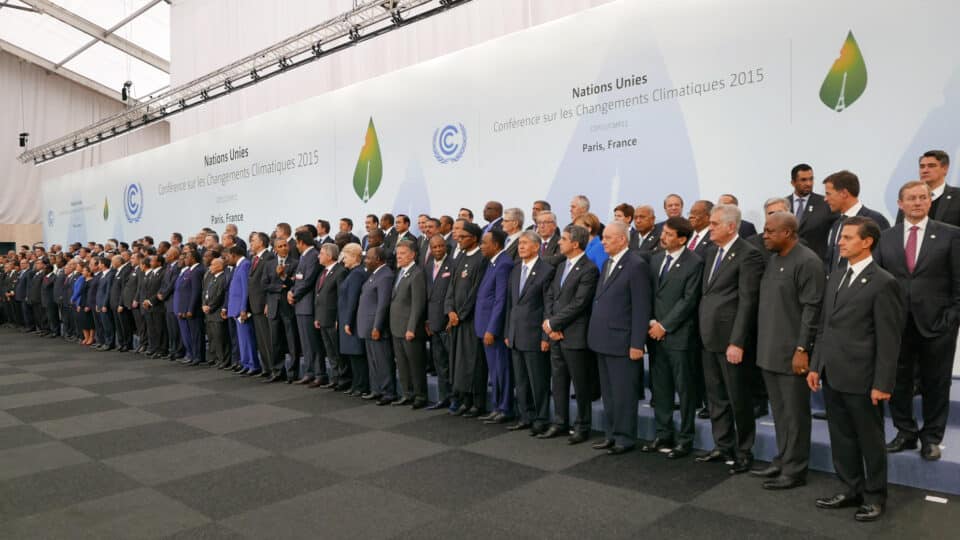
InfoBuz, 10 October 2026. This article was researched before the IPCC-65 meeting; the positions described remain under negotiation, not adopted decisions. The photograph is from the COP21 archive, not the 2026 meeting.









Discuția cititorilor
Ai o opinie sau o întrebare despre acest articol? Spune-ne ce crezi.
Fii primul care deschide discuția.
Te rugăm să păstrezi un limbaj civilizat și să discuți la subiect. Comentariile spam sunt filtrate automat.