
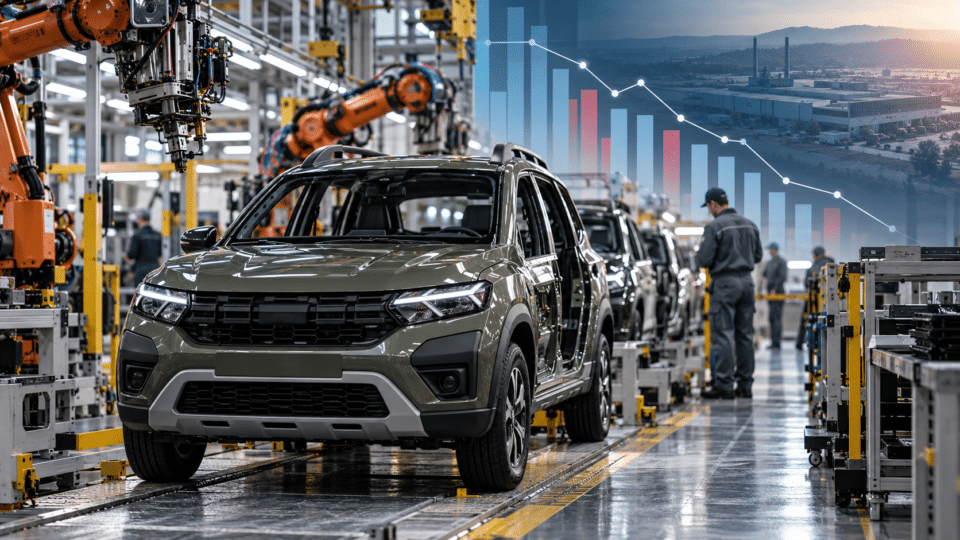
Dacia’s Vehicle Plant in Mioveni is scheduled to halt car production on 9 and 12 October 2026. The company said the measure was needed to align output with market orders, according to an internal note from Renault Group Romania’s Communications Directorate, made public by the business press and confirmed to Economedia. For employees not scheduled to work, the document refers to pay entitlements under the collective bargaining agreement.
A two-day stoppage does not amount to the closure of the plant. It is, however, a signal worth examining in the context of international competition, the allocation of new models to other factories and Renault Group’s stated cost-cutting targets. The real issue is not whether Dacia will disappear tomorrow, but which industrial advantages can keep Mioveni relevant in the next model cycle.
What was announced — and what should not be overstated
According to the note sent to employees, vehicle production was due to stop on Friday, 9 October, and Monday, 12 October. Some essential activities — touch-up work, spare parts, logistics, maintenance and production-flow preparation — could continue. The measure was communicated as an adjustment to the order book, not as an announcement of a permanent end to operations.
Union leader Viorel Ungureanu told HotNews that current output stood at around 1,060 cars a day, compared with roughly 1,160 in July. These figures are statements by the union representative, not newly published annual company statistics. They point to a temporary reduction in pace, but do not in themselves describe orders, inventories or the profitability of each model.
Mioveni in figures: why the plant matters beyond two days
Renault Group’s official plant profile states that Mioveni employed 6,096 people as of 31 December 2025, and that more than 88% of vehicles made there were exported. The plant therefore operates as an industrial hub directly tied to international demand; sales trends outside Romania may matter more than the domestic market.
| Official Mioveni indicator | Figure / status |
|---|---|
| Employees as of 31 December 2025 | 6,096 |
| Vehicles exported | More than 88% of output |
| Duster 3 produced in 2025 | 175,318 |
| Bigster produced in 2025 | 100,375 |
| Other models produced in 2025 | Sandero 5,022; Logan 6,769; Jogger 9,698 |
| Models currently presented as the main ones | Duster and Bigster |
The figures come from Renault Group’s official profile of the Mioveni plant. Adding the listed models for 2025 produces a total of 297,182 vehicles; this is an arithmetic calculation based on the company’s table. Historical data should not be confused with a forecast for 2026.
Why a successful brand may still pause a factory
There is no automatic contradiction between a brand’s commercial success and a temporary adjustment at one of its factories. Carmakers plan volumes for each plant and model according to orders, delivery times, component availability, powertrain mix and total production costs. Strong demand for a model made in one country does not necessarily mean equal orders for every factory in the group.
Renault Group reported consolidated revenue of €30.3 billion for the first half of 2026, up 9.5% on the first half of 2025. At the same time, it cited pressure from regulatory costs, commercial competition and raw materials. These are results for the group as a whole; they do not provide an individual profit or loss figure for Mioveni.
For related context, see State pensions will not be enough: why Romanians need to consider additional retirement income early, which presents further relevant information.
Competition between plants: when a new model goes to another country
In 2026, Dacia is expanding its range, including with the Striker and a new generation of the Spring. According to published information about the industrial programme, the Striker has been allocated to production in Turkey, while the new Spring is assigned to Slovenia. The launch of a Dacia model does not guarantee that it will be built in Romania.
The choice of factory depends on investment already made, the technical platform, available lines, supplier capacity, proximity to particular markets, logistics and costs over the full life cycle. Put simply, competition is not only between Dacia and other brands, but also between the plants that could build the next generation of cars.
At Mioveni, the Duster and Bigster are important industrial assets. Keeping them over the medium term, however, requires productivity, quality and the ability to adapt the plant to new technologies. The risk to watch is not an isolated stoppage, but a succession of decisions through which future investment and models are systematically directed to other locations.
Costs matter, but wages are not the only indicator
Renault Group’s “futuREady” strategy emphasises cutting variable vehicle costs. In its July 2026 reporting, the group reiterated its medium-term target of an average reduction of around €400 per vehicle per year. This is a group-level target, not an instruction to cut wages by €400 or a measure specific to Mioveni.
The cost of a car includes materials, components, energy, transport, production losses, quality, warranties and logistics. A plant can remain competitive even with higher wages when productivity is strong, defects are few and the supply chain works efficiently. Conversely, savings on wages do not necessarily offset delays, technical stoppages or a lack of investment.
What the stoppage means for workers and suppliers
For employees who do not work on the two days, the internal note cited by the press says that pay entitlements set out in the collective bargaining agreement will apply. This does not establish an identical arrangement for every category of worker; the practical details depend on scheduling and the applicable provisions.
The press has also reported a voluntary departure programme. Such a programme should be distinguished from collective redundancies that have already taken place. Eligibility, financial packages and effects on headcount can be properly discussed only on the basis of company documents and union confirmation. A two-day stoppage provides no basis for stating a definite number of jobs lost.
For industrial suppliers, fluctuations in orders can matter even when stoppages are short: parts volumes, transport schedules and shift planning may all be adjusted. The real impact, however, varies between companies that supply the plant directly and those with a more diversified customer base.
What to watch until the end of the year
- Production pace: whether daily output returns towards earlier levels or further non-production days emerge.
- Duster and Bigster orders: actual demand for the models allocated to Mioveni and any changes in the powertrain mix.
- Investment in automation and platforms: which projects are actually assigned to the plant in Argeș County.
- Decisions on future models: official announcements on the country of manufacture, rather than simply where cars are sold.
- Workforce and suppliers: verifiable assessments, social agreements and orders across the local components supply chain.
Mioveni remains a major industrial base, but competitiveness must be proven
The available information describes a scheduled production adjustment and increasingly intense competition for future orders and investment. Renault’s official profile confirms the plant’s importance and export capacity; the company’s own sources also show that efficiency and cost reduction are strategic priorities. The key question for Mioveni is whether it can secure enough new projects, not whether two stoppage days amount to the end of Romania’s automotive industry.
Sources and documents
- Renault Group — Mioveni plant profile, 2025 production and employee numbers.
- Renault Group — first-half 2026 results and the futuREady strategy.
- HotNews, 5 October 2026 — internal note and union statements on the scheduled stoppages.
- Economedia — Dacia’s confirmation of the scheduled stoppage.
- InfoBuz — context on Dacia’s new models in 2026.







Discuția cititorilor
Ai o opinie sau o întrebare despre acest articol? Spune-ne ce crezi.
Fii primul care deschide discuția.
Te rugăm să păstrezi un limbaj civilizat și să discuți la subiect. Comentariile spam sunt filtrate automat.