
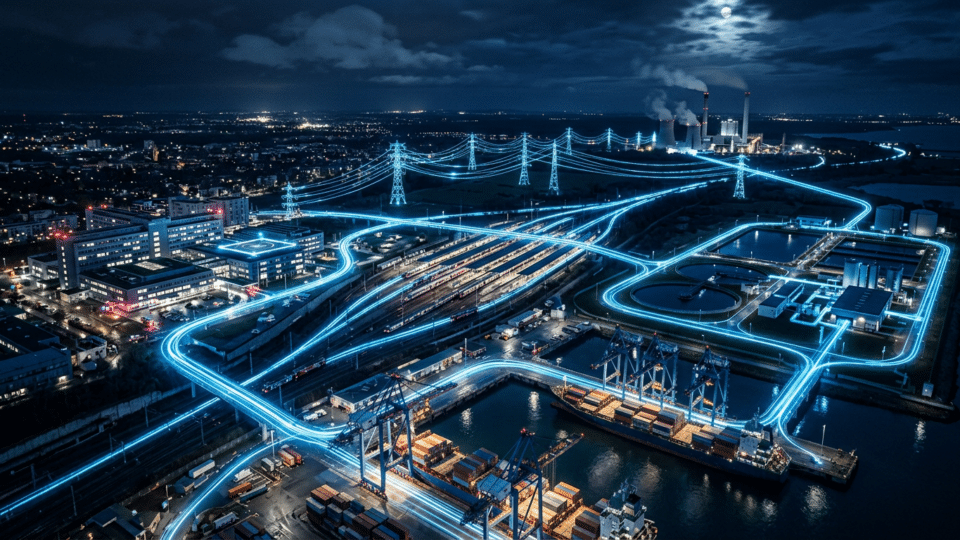
2027 could become a critical year for the security of essential infrastructure. Energy, hospitals, water, transport, public administration and digital services are becoming ever more connected. That connectivity improves efficiency, but it also expands the attack surface.
The ENISA Threat Landscape 2026 report says ransomware remains the type of incident with the greatest short-term impact, while 73% of the organisations targeted in the incidents analysed are essential or important entities under NIS2. Transport, healthcare, public administration, water and digital services are among the sectors where criticality is high and security maturity remains uneven.
Why critical infrastructure is becoming a more attractive target
Critical infrastructure has three characteristics that make it attractive to attackers: high impact, immense pressure on the victim and little tolerance for disruption.
For more on critical infrastructure, see How prepared is Romania for the next major crisis: energy, water, food and infrastructure, which provides further context on the issue.
- a hospital cannot suspend operations for days on end;
- a water company cannot leave the population without service;
- an energy operator cannot afford to lose visibility over its systems;
- a disrupted port or railway can block entire logistics chains.
Ransomware remains the most immediate threat
ENISA confirms that ransomware remains the incident type with the greatest immediate impact. The motive is straightforward: attackers encrypt systems, steal data and create operational pressure until an organisation is willing to pay.
In critical infrastructure, that pressure is even greater because a service outage directly affects the public.
The central issue: IT and OT convergence
IT networks manage data, applications and communications. OT, or operational technology, systems control physical processes: pumps, turbines, valves, industrial installations, railway signalling, air-conditioning and refrigeration systems.
As these two worlds are connected for monitoring and automation, a digital incident can produce physical consequences.
2026 attacks on refrigeration systems point to the direction of travel
On 4 November 2026, ENISA and the European Commission officially announced cyber incidents affecting commercial refrigeration systems in several EU member states. In France, an attack targeted cooling equipment used at blood-plasma storage sites.
In the French case, monitoring systems detected the attempt and the products were protected. The incident remains significant because it shows how a vulnerability in connected equipment can become a direct threat to medical services.
Healthcare: a sector with disproportionate risk
Hospitals and medical services are attractive targets because they hold sensitive data and cannot tolerate long periods of unavailability.
- unavailable IT systems;
- postponed appointments and procedures;
- blocked access to medical records;
- disruption to laboratories and pharmacies;
- greater risk if connected equipment is targeted.
Energy: the impact can extend far beyond the company attacked
The energy sector is interdependent with almost all other infrastructure. A major outage can affect communications, transport, healthcare, water and industry.
ENISA says significant energy incidents can have social consequences within just a few hours. Attacks on suppliers and third parties can also become entry vectors into critical organisations.
Water and wastewater: high risk, limited public visibility
Treatment and pumping plants use industrial systems that may have long life cycles and ageing equipment. Some are connected to modern IT networks but retain OT components that are difficult to update.
A successful attack can disrupt distribution, quality monitoring or treatment processes. This is why NIS2 explicitly includes the drinking-water and wastewater sectors among critical sectors.
Transport is already in the risk zone
ENISA used the Cyber Europe 2026 exercise to simulate coordinated attacks on rail and maritime infrastructure. The scenario included logistics bottlenecks, disrupted navigation, halted trains and ransomware targeting administrative and ticketing services.
Transport is a sector with many legacy systems, many suppliers and a high reliance on interoperability, making it difficult to secure consistently.
Why 2027 could be more difficult than 2026
There is no certainty that 2027 will bring the “largest wave” of attacks, but several trends are increasing the risk:
- more connected devices;
- attack surfaces expanded through third-party suppliers;
- more mature and industrialised ransomware;
- attackers’ use of AI for automation and social engineering;
- geopolitical tensions and hacktivism;
- legacy infrastructure that is difficult to update.
AI could accelerate attacks
ENISA warns that AI models will be used increasingly in malicious operations. AI can help attackers produce more convincing phishing messages, automate infrastructure reconnaissance and rapidly adapt attacks.
At the same time, AI can help defenders by detecting anomalies, correlating alerts and speeding up incident response.
Supply chains: attackers do not need to enter a critical company directly
One of the most difficult risks is an attack through suppliers. A critical company may have very strong security but still depend on software, sensors, maintenance providers, cloud services or equipment managed by third parties.
An attack on one supplier can become a gateway to dozens or hundreds of organisations.
NIS2 changes the EU’s minimum security standard
NIS2 significantly expands the number of entities required to implement security measures and report incidents. It covers energy, transport, healthcare, water, public administration, digital infrastructure and other essential sectors.
The directive focuses on risk management, continuity, supply-chain security, incident response and management accountability.
The Cyber Resilience Act adds pressure on manufacturers
From 2026, Cyber Resilience Act obligations become increasingly relevant for hardware and software manufacturers. ENISA has stressed that, from September 2026, severe incidents and actively exploited vulnerabilities must be reported through the prescribed European mechanisms.
What a major attack on critical infrastructure could mean
| Sector | Possible impact |
|---|---|
| Energy | Outages, loss of control, cascading effects |
| Healthcare | Delayed services, unavailable systems, clinical risk |
| Water | Disrupted distribution or treatment |
| Transport | Delays, logistics bottlenecks, unavailable ticketing |
| Public administration | Unavailable public services, compromised data |
| Digital | Spillover effects across many other organisations |
Romania is not isolated from this risk
Romania is integrated into European energy, logistics, telecommunications and financial networks. A major incident in a neighbouring country or at a shared supplier could also have indirect effects on Romanian organisations.
ENISA has included incidents from Romania in previous reports, including attacks on energy companies. This shows that the risk is already present, rather than merely theoretical.
What critical operators should do
- strictly segment IT and OT networks;
- reduce unnecessary remote access;
- implement multi-factor authentication;
- maintain offline, tested backups;
- monitor suppliers and privileged accounts;
- regularly test incident scenarios;
- maintain manual procedures for essential operations;
- report relevant incidents promptly.
Why backups are not enough
A backup can restore data, but it does not automatically resolve an infrastructure compromise. If attackers have gained persistent access, stolen passwords or compromised OT equipment, simply restoring systems can reintroduce the problem.
Resilience means detection, isolation, continuity, recovery and verification of system integrity.
Crisis exercises are becoming as important as technology
Cyber Europe 2026 was designed specifically to test not only technology, but also coordination between authorities, operators and European crisis-response structures.
In a real incident, the questions are operational: who decides to shut down a system, who communicates publicly, who prioritises recovery, and how are essential services maintained?
What to watch in 2027
- attacks on suppliers of industrial equipment;
- ransomware combining encryption with operational sabotage;
- state-backed attacks on energy and transport;
- AI used for phishing and automated reconnaissance;
- DDoS campaigns linked to geopolitical conflicts;
- exploitation of internet-exposed IoT and OT equipment.
Conclusion: 2027 could be riskier, but not inevitably more dangerous
There are sufficient warning signs to regard 2027 as a high-risk year for critical infrastructure. Ransomware, geopolitics, AI and reliance on suppliers create a dangerous combination.
Still, the outcome is not predetermined. NIS2, the Cyber Resilience Act, European exercises and investment in IT/OT segmentation, backups, monitoring and response can significantly reduce the impact.
Frequently asked questions about attacks on critical infrastructure
What is the biggest immediate threat?
ENISA considers ransomware the incident type with the greatest short-term impact.
Which sectors are most exposed?
Energy, healthcare, transport, water, public administration and digital infrastructure are among the most important sectors covered by NIS2.
Can a cyberattack cause physical effects?
Yes. It can do so if OT systems controlling industrial processes, refrigeration, pumps, transport or other equipment are compromised.
Why do third-party suppliers matter?
Because a vulnerability at a shared supplier can open access to many organisations at the same time.
Is Romania exposed?
Yes. Romania is integrated into European infrastructure networks and has already had reported incidents in critical sectors.








Discuția cititorilor
Ai o opinie sau o întrebare despre acest articol? Spune-ne ce crezi.
Fii primul care deschide discuția.
Te rugăm să păstrezi un limbaj civilizat și să discuți la subiect. Comentariile spam sunt filtrate automat.