
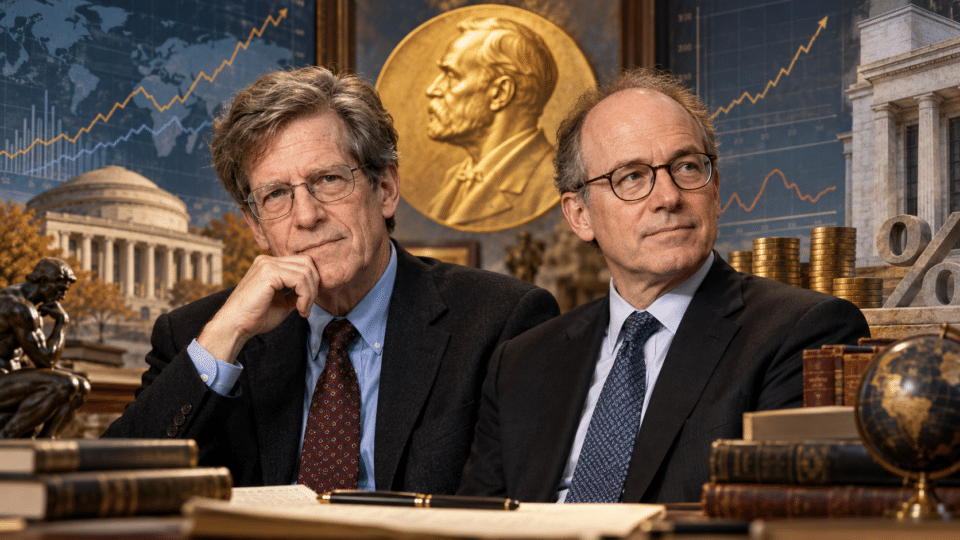
On 12 October 2026, Robert E. Hall and Michael Woodford received the Sveriges Riksbank Prize in Economic Sciences in Memory of Alfred Nobel for their contributions to the microeconomic foundations of economic stabilisation. Beyond the academic terminology, the central idea matters to every household: today’s decisions on consumption, wages, investment and prices also depend on what people believe will happen tomorrow.
The award recognises research that has influenced how central banks and governments build models of inflation, recessions and economic shocks. It does not mean that two economists have found a formula that eliminates crises. Rather, it places the behaviour of individuals and firms at the centre of analysis, instead of mechanical statistical relationships between broad economic aggregates.
Who are the laureates, and what were they recognised for?
Robert E. Hall is an economist affiliated with Stanford University and the Hoover Institution. His research covers consumption decisions, the labour market, business cycles and economic policy. One key contribution was the use of household behaviour to understand how spending changes in relation to current income and expectations of future income.
Michael Woodford, a professor at Columbia University, is known for his work on monetary policy, price-setting and the role of expectations. His book Interest and Prices (2003) became a reference point for analysing how central-bank decisions are transmitted through interest rates, firms’ behaviour and public expectations.
Sweden’s central bank, the American Economic Association and the laureates’ universities confirmed the two names and the subject of the award. The Prize in Economic Sciences is awarded by the Royal Swedish Academy of Sciences and financed through the mechanism established by Sveriges Riksbank; historically, it was not among the original prize categories set out in Alfred Nobel’s will.
What “microfoundations” are, and why they change how we view the economy
A traditional macroeconomic model may observe, for example, that when interest rates rise, consumption slows. A model built on microfoundations seeks to explain why: what a consumer with a variable-rate loan decides, how a company weighs the cost of borrowing against expected profit, and why a worker asks for a higher wage when they expect prices to rise.
| Individual decision | How it spreads through the economy |
|---|---|
| A family postpones a major purchase | Demand for certain products may slow. |
| A company raises prices because it expects future costs | Expectations can influence inflation before all costs have changed. |
| A central bank announces a credible interest-rate stance | Households and companies may alter their plans for the coming months or years. |
| An investor expects weaker demand | New projects may be postponed, with effects on employment. |
The examples in the table describe possible mechanisms, not forecasts for Romania in October 2026. In reality, the same shock can produce different reactions, and some households cannot substantially change their consumption because they spend almost all their income on necessities.
First lesson: expectations about the future change today’s consumption
Imagine a family learns that its income could fall in six months. Even before losing a single leu, it may forgo a holiday or postpone buying a car. Conversely, the prospect of a more secure income may encourage some spending and investment. In both cases, the economy responds to expectations, not only to money already received or lost.
In the same context, see also State pensions will not be enough: why Romanians need to consider additional retirement income early, which offers further relevant information.
This does not apply uniformly to everyone. A family with savings can plan over the long term, while another on a low income is constrained by current expenses. These differences between households are precisely what make modern models more complex than a simple relationship between “average wage” and “average consumption”.
Second lesson: the central bank also influences the economy through what it says
Monetary policy is not limited to announcing an interest rate for the current day. Credibility and communication about the future direction of policy can affect market rates, borrowing and saving. The concept known as forward guidance means that a central bank tries to provide signals about its future conduct, with the aim of guiding expectations in a way compatible with price stability.
Suppose, purely as an illustration, that a central bank signals that interest rates will remain high until inflation slows on a lasting basis. Some firms will reassess financing for new investments; some households will be more cautious about borrowing. The effects depend on how credible the message is, market conditions and each person’s practical constraints.
Communication alone cannot reduce every price increase. If an economy faces a physical energy shortage, war or a supply disruption, interest rates and public messages cannot immediately produce more oil, gas or grain. Models are tools for analysis, not devices for cancelling reality.
From oil shocks to financial crises and the pandemic
The research that led to modern macroeconomic models gained relevance at a time when older approaches were confronting difficult combinations of high inflation and weak economic activity. It later became useful in analysing financial crises, when traditional monetary policy met its limits, and at times when the public needed to understand not only the immediate decision but also the likely course of economic policy.
In 2008–2009, and later during the pandemic and price shocks, policymakers used a range of monetary and fiscal instruments. Models inspired by the laureates’ research contributed to the analytical framework, but the two economists should not be credited with every decision made by governments or central banks, nor with every favourable economic outcome.
What the 2026 prize has to do with Romania
For Romania, an economy in which inflation, interest rates, energy and the external deficit remain major concerns, the important lesson is the quality of expectations. A company that does not know what level borrowing costs or taxes will reach may delay investment. A family worried about price rises may change how it saves and spends. A central bank must understand such reactions when assessing how its decisions are transmitted.
This does not make it possible to automatically infer the future level of the National Bank of Romania’s policy rate or the euro-leu exchange rate from the Nobel Prize awarded today. An economic model explains mechanisms, but forecasts require up-to-date data, assumptions and separate analysis. Moreover, the effectiveness of policy depends on trust in institutions, fiscal discipline and external conditions.
The impact on purchasing power should not be described solely through the official inflation rate. For readers interested in the difference between indicators and personal experience, InfoBuz’s analysis of the average pension and the cost of living is also relevant.
What even the most sophisticated economic model cannot promise
- It cannot predict unexpected events with certainty, such as military conflicts or natural disasters.
- It does not eliminate differences between people: two households with the same income may react differently to the same interest rate.
- It does not replace accurate measurement of prices, employment, productivity and investment.
- It does not guarantee that political decisions will follow technical recommendations, or that all institutions will communicate with sufficient credibility.
- It should not be confused with investment advice or a promise of a fixed inflation rate in a given year.
Three useful questions the laureates teach us to ask
- What do people and companies think will happen next? Expectations can change behaviour before official indicators do.
- What real options do they have? A family without savings and one with reserves do not react identically to the same news.
- How credible is the announced policy? Measures whose effects are delayed need consistency and understandable explanations.
Conclusion: the Nobel recognises a more precise way of asking questions about crises
The 2026 prize is not about a miracle formula against inflation. It represents a shift in perspective: the larger economy is built from small decisions, and those decisions are shaped by expectations, constraints and the credibility of institutions. Hall and Woodford contributed to the framework through which central banks and governments can better analyse crises, without analysis eliminating uncertainty.
Primary sources and verification of the prize
- Sveriges Riksbank — official announcement of the 2026 laureates.
- Stanford University — confirmation of Robert E. Hall’s award.
- Columbia University — confirmation of Michael Woodford’s award.
- American Economic Association — information on the laureates and their contributions.
- NobelPrize.org — the 2026 prize page.









Discuția cititorilor
Ai o opinie sau o întrebare despre acest articol? Spune-ne ce crezi.
Fii primul care deschide discuția.
Te rugăm să păstrezi un limbaj civilizat și să discuți la subiect. Comentariile spam sunt filtrate automat.