
Hot water sometimes takes 30, 60 or even 90 seconds to reach the tap. Until then, cold or lukewarm water runs from the faucet, and many people let it go down the drain. How much water is lost in a year, why the wait is longer at some sinks, and whether a recirculation pump is worth it? This InfoBuz guide explains what happens inside the plumbing system, provides formulas and calculation examples in litres and lei, compares solutions and sets out what should not be changed at the expense of safety.
Why hot water is delayed at the tap
When you turn the handle to the hot-water position, you do not instantly receive water from the boiler or the heating system’s heat exchanger. The pipe between the source and the tap already contains a volume of water that cooled while the system was not in use. This water is pushed towards the tap by newly arriving water, which may already be heated or may itself need time for the source to start.
In a house with long pipe runs, this volume can be substantial. With an instantaneous water heater, there is also a delay while flow is detected and the water is heated; in an apartment block with a centralised system, the building’s temperature and recirculation performance may matter. That is why the same 45-second wait does not necessarily have the same cause, and cannot be fixed simply by replacing a tap at random.
Why this can waste water, time and energy
If you let water run into the drain until it reaches a comfortable temperature, you pay for the discharged volume according to the way you are billed, even if you did not use it for washing. Separately, long, uninsulated runs lose heat between uses. The losses may look minor over a day, but a habit repeated several times can add up over a year.
Not all of these losses automatically become money saved after an intervention. A recirculation pump can reduce the amount of water discharged, but it may consume electricity and keep pipes warm, increasing heat losses. ENERGY STAR explicitly warns of this trade-off in continuously circulating systems.
A simple, safe test: seconds waited and litres run
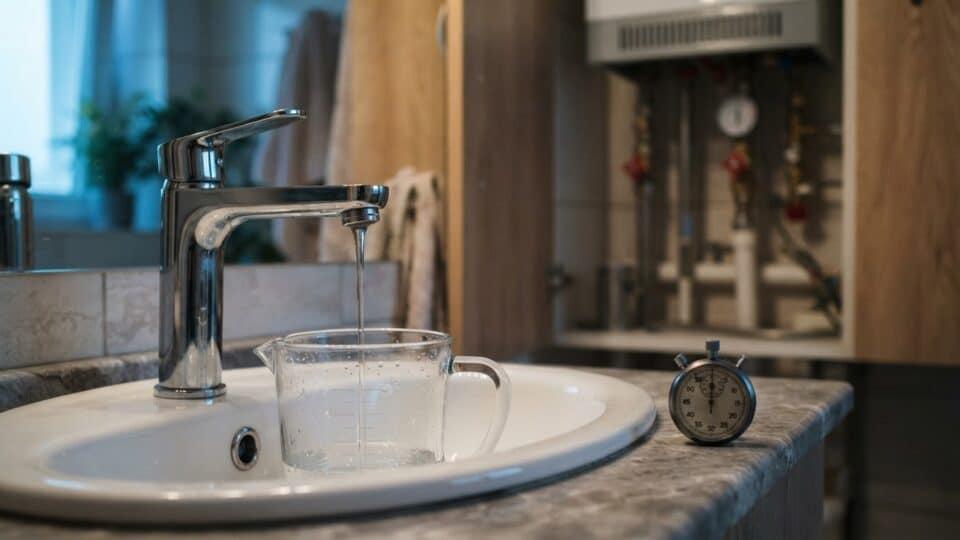
You can carry out an indicative check without taking the plumbing apart. Choose a tap where you can collect water in a suitably sized container that will not overflow. After several hours with no use on that branch, set the tap to its usual hot-water position, start a timer and note how many seconds pass before the temperature becomes stable and suitable for use. Do not use your hand as a measuring tool for water that may be hot.
Measure the flow rate separately: if you fill a graduated 1-litre container in 9 seconds, the approximate flow rate is 60 ÷ 9 = 6.67 litres per minute. To measure the waiting volume, safely collect as much of the initial water as possible, or estimate it using the flow rate and time. Repeat the test on three mornings or after comparable periods of non-use. If the water becomes very hot, there is a scalding risk, or the equipment shows errors, stop the test and seek qualified assistance.
Formula for the amount of water going down the drain
The estimated volume is litres = flow rate (litres/minute) × time (seconds) ÷ 60. For example, at a measured flow rate of 7 litres/minute and a wait of 45 seconds, the volume is 7 × 45 ÷ 60 = 5.25 litres. This is the amount that actually leaves the tap during the period considered, provided the flow rate remains approximately constant.
For an annual estimate, multiply the volume per event by the number of daily uses during which you let water run without using it, then by 365 days, and divide by 1,000 to obtain cubic metres. Use your own routine: a household does not necessarily wait three times a day after a break long enough for the pipe to cool completely. The figures in the example below are explicit assumptions, not observations by InfoBuz in a real home.
Table: 30, 45, 60 or 90 seconds — illustrative annual cost
We compare four waiting scenarios, each involving three uses per day in which the initial volume is entirely allowed to run down the drain. To convert this into money, we use only a hypothetical price of 17 lei/m³ for variable costs associated with water and sewerage. This is not presented as the tariff of a utility company in Constanța, Bucharest or elsewhere in Romania.
This table does not separately calculate heating costs, fixed charges or the specific billing method for centrally supplied hot water. If the water is collected and reused under suitable conditions, the discharged volume is no longer equal to the volume that initially ran. Read the figure that fits your situation, not as a statistical average for homes.
| Wait | Assumed flow rate | Volume/event | Volume/year, at 3 uses/day | Cost/year at 17 lei/m³ (hypothetical) |
|---|---|---|---|---|
| 30 sec. | 6 L/min | 3.00 L | 3.29 m³ | 55.85 lei |
| 45 sec. | 7 L/min | 5.25 L | 5.75 m³ | 97.73 lei |
| 60 sec. | 7 L/min | 7.00 L | 7.67 m³ | 130.31 lei |
| 90 sec. | 8 L/min | 12.00 L | 13.14 m³ | 223.38 lei |
Why pipe diameter changes the waiting time
The volume of a circular pipe rises with the square of its internal diameter. The practical formula is litres = 3.1416 × internal diameter (mm)² × length (m) ÷ 4,000. For example, a 10-metre pipe with an internal diameter of 12 mm holds about 1.13 litres; at 16 mm, about 2.01 litres; and at 20 mm, about 3.14 litres.
In a real installation, the volume of fittings, connections and other branches, as well as the behaviour of the heat source, must be added. The nominal or external diameter of a PPR pipe is not the same as its internal diameter, which depends on wall thickness. Do not replace pipe based on this formula without a design: too small a diameter can reduce flow and create problems when other taps are open at the same time.
| Internal diameter | Volume in 10 m of pipe | Interpretation |
|---|---|---|
| 12 mm | 1.13 litres | Low-volume pipe, if flow is adequate |
| 16 mm | 2.01 litres | Example of a moderate-volume run |
| 20 mm | 3.14 litres | Greater volume of water cooled after a break |
A 10-metre pipe example: why 5 litres can mean more than the water in the pipe
Suppose the 10 metres of pipe have an internal diameter of 16 mm and therefore hold around 2 litres. If the tap discharges 5.25 litres before water reaches the desired temperature, the difference does not necessarily indicate a leak inside a wall. Heated water may need time to start flowing from the boiler, while the pipe material, the tap and the remaining cold water absorb some of the heat.
The static volume of the pipe is a useful indicator, but it does not predict the waiting volume exactly. If water cools gradually along the run, the temperature at the tap rises gradually rather than at a perfect boundary between cold and hot water. For fair comparisons, measure to the same target temperature and after the same period without use.
Storage boiler versus instantaneous water heater: different causes
A storage boiler has water already heated in its tank, but that water must still travel through the pipe to the tap. If the run is long, the wait can remain substantial even when the tank is working normally. With a heating system that produces hot water on demand, there is also the time needed to detect flow, ignite or start the heating process, and transfer heat.
An instantaneous appliance may also have a minimum flow requirement for activation. If water stays cold at just one low-flow tap, a clogged aerator, a tap cartridge or a local restriction may be relevant; if the problem occurs at every outlet, the source or the shared distribution system is worth checking. Do not dismantle the boiler, burner, gas equipment or electrical part of a water heater to look for the cause yourself.
Apartment buildings: why metered hot water may run cold at first
In buildings with centralised hot-water production or distribution, the performance of supply and recirculation circuits, the building settings and the actual temperature at outlets all matter. A water meter installed on the hot-water branch generally measures the volume passing through it; it does not automatically mean that this volume is checked according to the temperature of every litre.
For billing questions, record dates and times, the temperature measured safely and the duration of the wait, then ask the building administrator or utility operator for information about the contractual parameters and calculation method. We do not promise a universal refund: rights depend on the contract, the metering system and the applicable regulations. See also InfoBuz’s analysis of the differences between the main meter and apartment water meters.
If hot water is slow at one tap, do not automatically blame the boiler
Compare the time and flow rate at two outlets. If hot water arrives normally at the shower but not at a sink close to the boiler, there may be differences in the branch, restrictions or tap faults. Aerators clogged with deposits, a local filter and a faulty cartridge can alter flow and influence how an instantaneous water heater detects demand.
Do not inspect a tap by dismantling it while the plumbing is under pressure. If there is very hot water, sudden temperature fluctuations or signs of leaks, stop using it and call a plumber. A diagram of the pipe runs, if available, may immediately show why two apparently nearby taps have different waiting times.
When all taps have problems: what a specialist can investigate
If delays occur at every outlet, possible causes include the heat source, system filtration or settings, recirculation, or the main distribution system. For a boiler, heating performance and safety settings can be checked; for an instantaneous heating system, its ability to start and maintain temperature under the flow conditions specified by the manufacturer can be assessed.
In an apartment block, the problem may concern the shared distribution system rather than a component inside the apartment. It is preferable to start with non-invasive measurements, the system manual and a documented report, rather than successive adjustments without diagnosis. Work on boilers, gas systems, electrical equipment and shared networks should be carried out by competent people and, where the law requires it, authorised ones.
Short, insulated pipes: savings from the design stage
EPA WaterSense recommends efficient distribution systems that limit the volume between the hot-water source and each point of use; its criteria for high-performance homes use a benchmark of about 0.5 gallon, or 1.9 litres. This is a benchmark of the US programme, not a general legal requirement in Romania.
During a renovation, it may be possible to consider shorter runs, placing bathrooms and kitchens closer together and nearer the source, and insulating pipes to reduce heat losses. Changes to pipe diameters, layouts or hydraulics should be designed with a plumber, taking account of simultaneous flow, pressure, maintenance access and stagnation risks. A very short pipe installed incorrectly is not a good solution.
On-demand hot-water recirculation: how it works
An on-demand recirculation system uses a pump and a return line or, in some configurations, a controlled transfer arrangement to bring hot water closer to the tap before the user opens it. It may be activated with a button or another control mechanism, and may stop according to the temperature detected. In an appropriate installation, cooled water is returned to the system instead of being discharged to the drain.
ENERGY STAR describes the benefits of on-demand systems and the limits of permanent systems. Some systems have a dedicated return pipe, while other configurations temporarily use the cold-water line; the latter can result in lukewarm water from the cold tap for a short time. Not every solution is compatible with every building and heat source.
Why a continuously running recirculation pump can increase bills
A recirculation loop keeps water moving and, in some systems, warm almost continuously. This can reduce the wait, but creates heat losses along pipe runs and uses electricity for the pump. Less water going down the drain does not automatically mean lower total energy use.
A simplified example: a pump using 8 W continuously consumes 8 × 8,760 ÷ 1,000 = 70.08 kWh of electricity per year, without including the additional energy needed to heat the pipes. The 8 W figure is chosen for demonstration, not as a guaranteed consumption figure for all pumps. A system that runs only when needed may have a better balance, but performance depends on the installation and control method.
How much heat remains in pipes that cool between uses
To understand the order of magnitude, the thermal energy needed to heat water can be estimated as energy (kWh) ≈ 0.001163 × litres × temperature difference (°C). If a run contains 2 litres and the water is heated by 35°C, the result is around 0.081 thermal kWh.
If, hypothetically, the same amount cooled completely and was reheated three times a day, it would represent approximately 89 thermal kWh/year. This is not automatically the actual loss in every household: the temperature of the water left in the pipe, the interval between uses, pipe insulation and the energy actually supplied by the equipment all matter. Do not confuse thermal kWh with purchased electrical kWh or gas energy without taking the source’s efficiency into account.
Safe water temperature: energy savings, scalding and Legionella
Drastically reducing storage temperature simply to save energy is not universally safe advice. The CDC states that high boiler-water temperatures can limit certain microorganisms, including Legionella, but increase scalding risk. For homes, the CDC discusses a range of about 54–60°C in the tank and the use of thermostatic mixing valves at outlets where protection from burns is needed.
Do not turn these figures into instructions to adjust any appliance thermostat yourself. The type of installation, vulnerable people, local rules and the manufacturer’s instructions are relevant. In multi-unit buildings or complex systems, separate water-management programmes and requirements may apply; the CDC guide for building systems is more stringent and should not be mechanically applied to every apartment boiler.
Why unused pipes and stagnant water matter for hygiene
In a rarely used installation, water can remain for long periods in secondary branches or dead-end runs. At certain temperatures, stagnant water encourages microbiological risks, while the loss of residual disinfectant can worsen the problem. For buildings, the CDC recommends identifying low-flow areas and monitoring temperatures.
Do not attempt to address a stagnation risk by improvising a recirculation loop or incorrectly connecting hot- and cold-water pipes. Changes can affect temperatures, pressure and water quality. If a tap or bathroom has not been used for a long time, follow the advice of the building administrator, operator or a specialist on returning it to service.
Does reducing tap flow automatically reduce waiting time?
Not necessarily. An aerator that limits flow can reduce litres per minute, but if the volume of cooled water in the pipe remains approximately the same, the time until hot water arrives may increase. In other installations, very low flow may delay activation of an instantaneous heating system. A water-saving device should therefore be assessed by total volume per use, not only the displayed speed of the water stream.
A tap used for handwashing may work efficiently at a low flow rate, but the same saving cannot automatically be applied to filling a bath or to a heating system with a minimum activation flow. Take measurements before and after, at the same target temperature and under conditions that are as similar as possible. Equipment that causes sudden temperature swings should be inspected.
What to do first: comparing six solutions
Before buying a pump or changing pipe runs inside walls, identify where the delay occurs: at the source, in distribution, in the tap or in the recirculation function. Simple solutions may include repairing a faulty aerator or adjusting settings permitted by the manufacturer, while structural solutions may involve replacing pipework. Insulation can reduce lost energy, but does not necessarily eliminate all the volume of cooled water.
The order of investment matters. A pump installed on an unsuitable run can create new costs; a pipe reduced too far can lower pressure; moving a boiler next to one tap may be unsuitable if it serves other outlets at the same time. Prioritise a documented diagnosis and a calculation of net savings, rather than a single technical claim in an advertisement.
| Solution | Possible advantage | Trade-off or limitation |
|---|---|---|
| Diagnosing the source and tap | Identifies faults without major work | Does not itself shorten a long pipe run |
| Shortening the run during renovation | Less water between source and tap | Requires design and construction work |
| Insulating pipes | Reduces heat loss | Does not remove the volume of stagnant water |
| On-demand recirculation | May reduce water discharged before use | Uses energy; compatibility must be checked |
| Continuous recirculation | Convenience and rapid availability | May substantially increase heat losses and pump use |
| Collecting the initial water | May prevent the entire volume being discharged | Requires a container and an appropriate use; not automatically suitable for drinking |
How to check whether an intervention worked, rather than merely seeming faster
Repeat the same measurement after the work: use the same tap, the same setting, a similar period without hot-water use, a similar target temperature and a measured flow rate. Record the waiting time, discharged volume and, if there is a pump, the system’s electricity use over a representative period. The real financial difference also depends on the cost of heating, not only on the litres saved.
In an apartment with centralised hot water, keep a log of the days and times when the problem persists and ask the building administrator or supplier for information. In a house, a plumber can relate the observations to the configuration of the pipes and heat source. Do not accept a claim of “70% savings” merely because water arrived faster in one test.
Three myths that lead to unnecessary investment
“If hot water takes a long time to arrive, the boiler must be faulty.” False: the run to the tap may be long and filled with cooled water. “A recirculation pump always saves energy.” False: if it runs continuously, it can increase heat losses and electricity use. “Smaller pipe always means a better system.” False: sizing must ensure the necessary flow and operating conditions.
Another common myth is that every litre discharged before hot water arrives is already heated and represents a full thermal loss. Some of it may be cooled water from the pipe; energy loss must be calculated according to temperature and the source’s operation, not by mechanically multiplying all litres by heating energy.
Frequently asked questions about hot water that takes too long to reach the tap
How many litres do I lose in 45 seconds? At a flow rate of 7 L/min, around 5.25 litres. Why does hot water arrive quickly in the bathroom but late in the kitchen? The runs and diameters may differ, or there may be local restrictions. Would a larger boiler solve it? Not if the delay is caused by a long pipe and water cooling inside it. Is a recirculation pump worth it? Sometimes, especially when it is controlled on demand and installed correctly; total losses must be compared.
Should I lower the boiler temperature to save money? Not without assessing hygiene and scalding risks, the manual and the system configuration. Can the initial cold water be used for something else? It can sometimes be collected for cleaning or a toilet cistern, if it is safe for the intended use; do not automatically assume that stagnant water from the hot-water run is suitable for drinking. Can I complain about the delay in an apartment block? Yes. You can document it and request explanations about service parameters and billing, according to your contractual situation.
Other InfoBuz guides on water, energy and home maintenance
For a broader look at energy use, read Energy losses at home: 15 things you can fix. For preventive checks of household systems, see 25 checks that uncover hidden deterioration. If you are also interested in the real cost of heating, we have a comparison of gas, heat pumps and electric heating.
This article deals specifically with the distribution of hot water to the tap, not the overall thermal performance of a home. For a diagnosis, measurements taken on the actual installation are relevant, rather than experiences from other homes with different equipment.
Sources and methodology: what is measured and what is a demonstration calculation
Main sources: US EPA WaterSense — efficient hot-water distribution solutions; ENERGY STAR — on-demand recirculation and the limits of continuous circulation; CDC — hot water, preventing microorganisms and scalding risk; CDC — monitoring temperature and stagnation in buildings.
The formulas presented are physical relationships between flow rate, time, volume and thermal energy. The examples use 17 lei/m³ solely as a hypothetical tariff, not a verified price from a Romanian supplier, and assume repeated uses as set out in the tables. We did not conduct a test in a real home; energy costs, pump power and system configurations are illustrations. This article was researched and written on 22 November 2026. For changes to plumbing installations, consult a competent plumber and the equipment documentation.


Discuția cititorilor
Ai o opinie sau o întrebare despre acest articol? Spune-ne ce crezi.
Fii primul care deschide discuția.
Te rugăm să păstrezi un limbaj civilizat și să discuți la subiect. Comentariile spam sunt filtrate automat.