
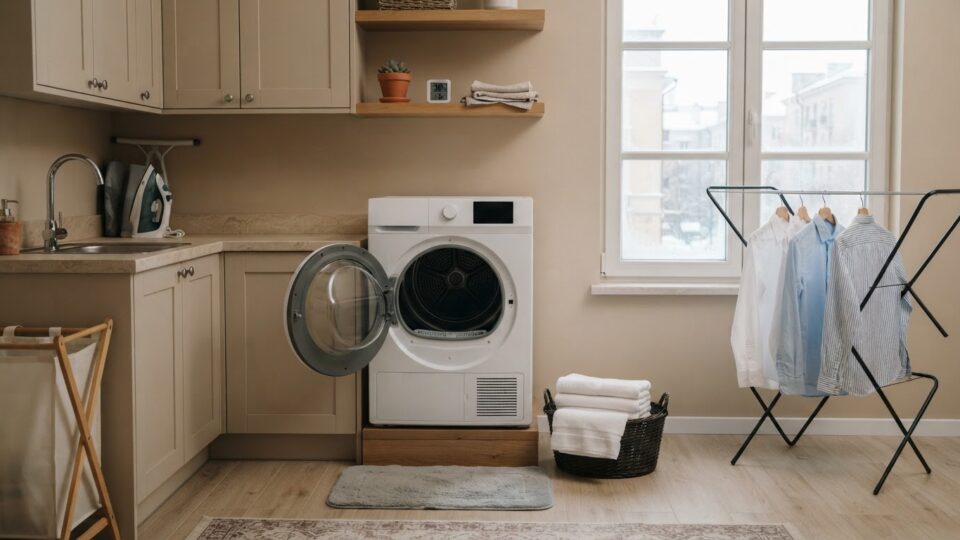
Drying laundry in winter involves more than choosing between a heat-pump tumble dryer and a clothes rack in a flat. Energy used per cycle, water released into the air, the risk of condensation and how long clothes take up living space all matter. Since July 2025, dryers have also carried a new EU A–G energy label, with consumption stated in kWh per 100 cycles. We have calculated illustrative costs in Romanian lei and explain when one option may be more suitable than the other.
Why drying laundry in winter is a comfort, energy and health decision
In the cold season, a load of laundry can dry slowly in a poorly ventilated room. For a family, the issue is not just energy use but also the space occupied, drying time, humidity in the air and whether clothes will be ready to wear the next day. A heat-pump appliance can simplify the routine, but it is an investment and uses electricity.
A clothes rack has no motor, but water left in the fabrics gradually enters the air. If extra ventilation in winter or a dehumidifier is needed, there is an indirect cost. A fair comparison includes all of these factors, without assuming that every room or dryer model behaves in the same way.
Four drying methods that should not be confused
A vented dryer expels humid air outside through a dedicated duct. A conventional condenser dryer uses electric heating and collects water, but generally consumes more than an efficient heat-pump model. A heat-pump dryer recovers some of the heat from its circuit and reheats recirculated air.
Drying on a rack indoors does not require an electric dryer, but the vapour must be managed through ventilation and temperature control. Outdoor drying, when the weather permits, avoids introducing water indoors. Note that a heat-pump appliance is also a type of condenser dryer; it is not accurate to compare products solely by the word “condenser” in their description.
Table: a full comparison of dryers and clothes racks
A technical advantage can come with an operational trade-off. For example, a heat-pump dryer uses energy, but water is collected in a reservoir or discharged through a drain; a clothes rack uses no electricity directly, but may raise room humidity. Actual values are specific to the model and the home.
The following table is indicative, not a comparison of products tested by InfoBuz. A decision should take account of washing frequency, home temperature, condensation risk, available space and the electricity price in the reader’s own contract.
| Method | Direct consumption / trade-off | Humidity and installation |
|---|---|---|
| Heat pump | Electricity; generally more efficient than resistance heating | Water is condensed; requires space in line with the manual |
| Resistance-heated condenser dryer | Generally higher consumption for comparable loads | Reservoir or drainage; some older appliances remain in use |
| External venting | Energy for heating and air circulation; expels warm air | Requires a correctly installed duct to the outside |
| Indoor clothes rack | No motor; possible indirect heating and ventilation cost | Water from clothes becomes vapour indoors |
| Outdoor clothes rack | No electricity used for drying | Moisture goes into outdoor air; weather-dependent |
What changed for new EU dryers from July 2025
From 1 July 2025, the new ecodesign requirements for household tumble dryers under Regulation (EU) 2023/2533 apply. For standard dryers newly placed on the EU market, the efficiency thresholds have made heat-pump technology predominant and necessary to meet the applicable requirements, subject to the exceptions and conditions in the regulation.
This does not mean that an older resistance-heated dryer already in a home becomes illegal. Transitional rules also apply to some stock lawfully placed on the market earlier. The European Commission explains the distinction between placing a product on the market and subsequently selling a product from stock. The 2025 date should not be treated as a compulsory replacement order for households.
The A–G energy label: why the new letter is not the old A+++
Since July 2025, the EU dryer label has used A–G classes. It shows weighted average consumption in kWh per 100 cycles, as well as eco-programme capacity, full-load duration, noise and, where relevant, condensation efficiency. The new scale cannot be translated directly from the former A+, A++ or A+++ ratings.
When comparing two models, first look at kWh consumption under the same standard and the test load, rather than the letter alone. Official documentation can be checked in EPREL, the European database of energy-labelled products. Quick programmes or programmes for special fabrics may consume differently from the eco programme.
| Item on the EU label | Correct interpretation | Limitation |
|---|---|---|
| A–G class | Efficiency class under the new method | Cannot be directly converted from A+++ |
| kWh / 100 cycles | Weighted consumption for the eco programme | Does not guarantee consumption for every programme |
| Capacity, kg | Rated eco-programme load | Does not authorise every bulky item |
| Eco duration | Time at full load | Is not the duration of every cycle |
| Condensation | Share of moisture collected in the test | Does not rule out condensation in a cold room |
| Noise | Emission under test conditions | Perception also depends on placement |
| Repairability, from 2027 | A–E class for covered models | Is not a guarantee of service life |
What 130 kWh/100 cycles means and how to calculate the cost
An appliance with weighted consumption of 130 kWh/100 cycles has a reference figure of 1.3 kWh per cycle, calculated by dividing by 100. Assuming 180 cycles a year, the mathematical result is 234 kWh/year. At a strictly hypothetical price of 1.10 lei/kWh, the cost would be 257.40 lei/year.
The formula is straightforward: cost = (kWh/100 cycles ÷ 100) × number of cycles × electricity price. The price of 1.10 lei is not presented as a current national tariff, and 180 cycles is not an official Romanian average. Make your own calculation using your bill and number of uses, bearing in mind that real programmes are not always identical to the eco test.
Four annual cost scenarios at 180 drying cycles
The difference between weighted consumption of 120 and 300 kWh/100 cycles may seem abstract. Once multiplied by frequency of use, it becomes a measurable expense. The table deliberately uses mathematical scenarios, including figures that may correspond to different technologies and generations.
Do not infer that every value in the table describes new dryers on the EU market in 2026. When buying, look for the specification sheet for the exact model; for an older appliance, measure actual energy use or use the original documentation, if it is comparable.
| Hypothetical label consumption | Energy at 180 cycles/year | Cost at 1.10 lei/kWh (hypothetical) |
|---|---|---|
| 120 kWh/100 cycles | 216 kWh | 237.60 lei |
| 130 kWh/100 cycles | 234 kWh | 257.40 lei |
| 200 kWh/100 cycles | 360 kWh | 396.00 lei |
| 300 kWh/100 cycles | 540 kWh | 594.00 lei |
When the price difference for efficient technology pays back
Consider two hypothetical appliances: one consumes 3.0 kWh/cycle, the other 1.3 kWh/cycle. At 180 uses a year and 1.10 lei/kWh, the first would cost 594 lei/year and the second 257.40 lei/year. The difference would be 336.60 lei/year. If the efficient appliance cost 1,200 lei more, simple energy payback would be around 3.6 years.
The prices and consumption figures in this example are assumptions, not commercial offers. The calculation does not include repairs, changes in tariffs, standby use, differences in load size or resale value. With only a few dozen cycles a year, recovering an investment through electricity savings may be much slower; with frequent use, the energy difference becomes more significant.
How a heat-pump dryer works
In a closed circuit, air passes through the clothes and takes up moisture, is cooled to condense the vapour, then reheated for another pass through the drum. The heat pump transfers thermal energy and can reduce electricity use compared with resistance-only heating in many situations. The resulting water is collected in a reservoir or sent to a drain, depending on the installation.
ENERGY STAR describes the principle and notes that these appliances can operate at lower temperatures. That benefit does not mean zero consumption or invariably faster drying. Appliances must be installed within the ambient conditions recommended by the manufacturer and need adequate air circulation around them.
The eco programme may take longer but use fewer kWh
Cycle duration is not the same as energy used. Equipment running at moderate power for longer can consume less than an appliance with a powerful heating element running for less time. The EU label displays the duration of the eco programme at full load, allowing waiting time to be compared across models.
If work clothes or uniforms are needed quickly, check the additional programmes as well. A “quick” drying cycle may have different consumption, a different load limit and a different final moisture level. Do not turn a single programme into a claim that a dryer is always better or worse than air drying.
Condensation efficiency matters in small rooms
A condenser dryer can collect most of the extracted moisture, but performance depends on the technology and model. The condensation efficiency class on the new EU label indicates the appliance’s ability to retain water under test conditions. It is a different indicator from the energy class.
Even an efficient appliance releases heat into the room and may require ventilation in accordance with the manual. If it runs in a small bathroom, watch the hygrometer and windows. A good condensation class does not guarantee that there will never be droplets on windows or problems where a space has very cold walls and insufficient ventilation.
How much water remains in clothes after spinning
An example using scales explains the issue better than broad estimates: a load weighing 4.0 kg completely dry and 5.6 kg after spinning retains around 1.6 kg of water, or approximately 1.6 litres. That amount must be removed during drying, through vapour, condensation or other mechanisms. This is a constructed example, not a measurement of a real model.
Some textiles retain far more water than others, and spin performance varies by programme. For that reason, 1.6 litres is not a fixed rule for every load. If laundry is hung in a room, the vapour initially enters the air, although some may be removed through ventilation or condense on cold surfaces.
Does drying laundry indoors automatically cause mould? No
The risk arises when moisture accumulates, when surfaces are cold enough for condensation, and when drying or ventilation is inadequate. A clothes rack does not automatically produce mould in a well-ventilated room without significant thermal bridges. Repeated loads in a small bedroom can, however, worsen an existing humidity problem.
According to the EPA, indoor relative humidity should be kept below 60% where possible, ideally between 30 and 50%. This is not a guarantee that mould can never occur in a cold corner at 49%; local surface temperatures and any water ingress matter. An area that is already mouldy requires the underlying moisture cause to be addressed.
What a hygrometer shows before and after hanging laundry
Place a hygrometer away from a window, radiator or direct airflow, and record the temperature and humidity before hanging clothes. Check again after one to two hours and at the end of drying. If humidity remains high for a long time or condensation appears on windows, moisture removal needs to improve rather than simply moving the rack to a hidden corner.
Relative humidity depends on temperature, so a rise or fall in the reading alone does not reveal how many litres of water are in the air. For a proper assessment of a home, check ventilation, cold walls, water ingress and heating habits. See also InfoBuz’s analysis of mould in new homes.
Ventilation in winter is not energy-free
Ventilation removes humid air and introduces outdoor air, which can lower humidity, but in cold weather may require the incoming air to be reheated. The cost depends on temperatures, how long the window is open, wind, the building’s characteristics and its heating system. It cannot be calculated from a single universal figure in lei per load.
In a home with mechanical ventilation and heat recovery, the balance may differ from that in a flat ventilated only through windows. It is inaccurate to describe rack drying as “zero cost” in every season if additional heating and dehumidification are then used for comfort. Equally, it should not automatically be considered more expensive than an electric dryer without measurements.
Drying outdoors in winter: when it helps and when it takes longer
Low temperatures do not stop drying entirely: evaporation and, in certain conditions, sublimation are possible in winter. Wind and sufficiently dry air can help, while dense fog, rain and high humidity make drying much slower. If clothes freeze, the process can take a long time, and fabrics should be handled without tearing them.
An enclosed, unventilated balcony is not the same as being outside in the open; moisture can accumulate on window frames. Check that the clothes rack is secure, so clothes and pegs cannot fall into public space. Avoid using improvised electric heating appliances beneath laundry or near flammable materials.
Clothes rack plus dehumidifier: an alternative that needs measuring
A dehumidifier can collect moisture evaporating from laundry and help maintain an appropriate level in the room. Some appliances have a laundry-drying mode, but actual consumption depends on air temperature and humidity, the type of appliance, operating time and the amount of water extracted. There is no guaranteed kWh consumption for every load.
Compare the combined energy used for an entire session, not just the maximum power listed on the label. An appliance that extracts, for example, a certain number of litres a day in laboratory tests may remove less water in a cold room. Do not cover the dehumidifier’s grilles with laundry, do not place it where water could splash electrical sockets, and follow the safety instructions.
Better spinning can save energy before drying begins
If fabrics allow it, an appropriate spin speed removes more water from clothes before drying begins. Less water left behind means a smaller evaporation load, whether a drum or a rack is used. This is one of the simplest ways to avoid extra costs without buying another dryer.
ENERGY STAR recommends efficient spinning where fabrics permit it. Do not increase the speed beyond a fabric’s limits, do not force in bulky laundry that unbalances the machine, and do not assume cotton, wool and synthetic fabrics will retain the same moisture after washing.
Why moisture sensors and filter cleaning matter
A sensor-equipped dryer can stop the cycle once clothing reaches the selected dryness level, reducing unnecessary heating. Timed programmes may be appropriate in some situations, but risk continuing after some fabrics are already dry. Separate thick towels from thin tops if the programme does not handle the mix well.
ENERGY STAR recommends avoiding over-drying and cleaning the lint filter. A clogged filter reduces air circulation and can extend drying time. Check the manual for how often to clean the heat exchanger and other elements; do not dismantle refrigeration or electrical components.
Separate dryer versus a washer-dryer combo
In a very small flat, a combination appliance can save space, but its drying capacity may differ from its washing capacity. A wash-and-dry cycle may require different conditions and times from a separate dryer. Do not compare the consumption of a combined programme with the 100-cycle figure for a standalone dryer without checking.
EU Regulation 2023/2533 on tumble dryers does not include washer-dryers within its scope; they have their own rules and labels. It is therefore inaccurate to say that all combination appliances were required to become heat-pump models from July 2025. Check the exact documentation before choosing.
An A–E repairability class arrives in 2027
The European Commission has introduced a repairability index for dryers, and from 1 January 2027 displaying it will become mandatory on the labels of new models covered by the regulation. The A–E class assesses, among other things, access to components, fastening systems, required tools and repair information. Some products may already display the information before the mandatory date.
An older item from stock is not automatically non-compliant if it has an earlier version of the label, subject to the conditions set out in the regulation. The repairability class does not promise that an appliance will work for a set number of years and does not replace commercial warranty terms. Source: European Commission, 2025 announcement.
Installation and fire prevention: mistakes not worth making
A dryer should be installed in the location and temperature range recommended by the manufacturer, with suitable electrical supply and unobstructed air circulation. On vented appliances, the duct should be checked for restrictions and lint build-up. For heat-pump models, follow the instructions exactly for cleaning filters, emptying the tank and maintenance.
The U.S. Fire Administration warns of fire risks and recommends plugging large appliances directly into suitable wall sockets, without extension leads. Do not dry textiles with flammable residues against instructions, do not block ventilation, and do not leave the appliance running while asleep or away. If there is a burning smell or a warm socket, stop using it and arrange a technical inspection.
A practical seven-day test, without dangerous tools
Start by counting laundry loads over a week and the programmes used. Record the estimated weight or amount of clothing and, if possible, the dryer’s total energy use from a load-compatible meter. On another day, track the humidity and temperature in the room where laundry is hung, without deliberately reducing ventilation to an unsafe level.
Compare electricity use, duration, condensation and whether the room can be used separately over that period. Do not extrapolate an annual cost from a day with unusual temperatures or from one quick programme. If suitable measuring equipment is unavailable, the energy label and a routine log are enough for a preliminary estimate.
| Observed problem | What to check first | What not to do |
|---|---|---|
| Laundry still damp after a cycle | Load, filter, programme and manual | Do not force repeated cycles without diagnosing the issue |
| Steamed-up windows near the rack | Humidity, ventilation and thermal bridges | Do not cover mould without eliminating the cause |
| Consumption higher than estimated | Programme, spin, quantity and kWh meter | Do not compare a quick programme with eco |
| Dryer in a cupboard | Temperature and clearance in the manual | Do not block air grilles |
| Burning smell or warm socket | Condition of the cable and appliance | Do not use an improvised extension lead |
Which method makes sense in a studio flat, apartment or house
In a studio flat with persistent dampness, hanging laundry every day may be problematic; an efficient, correctly placed appliance or a dehumidification solution may help, but the cause of condensation should be checked. In a flat with an airy balcony, a mixed approach may be practical. In a house with outdoor space, natural drying is useful when weather permits.
For a household that uses a dryer rarely, the saving on each cycle may not justify replacing an appliance that still works. For a household with many loads, kWh/100 cycles becomes important. For context, see InfoBuz guides to condensation after insulated windows are installed and reducing household energy bills.
Frequently asked questions about drying laundry in winter
Is a heat-pump dryer worthwhile? If you use it frequently and have suitable space and budget, a total-cost comparison may be favourable, but it should be calculated. Can I dry laundry in the bedroom? Avoid this if humidity stays high or condensation appears; control the moisture source and ventilation. Is rack drying cheaper? It has zero direct electricity use, but not always zero indirect cost.
What does 150 kWh/100 cycles mean? A weighted reference of about 1.5 kWh per test cycle, not the annual cost for every family. Why are some eco programmes long? They may use lower power over a longer period. What changes in 2027? The repairability class becomes mandatory for new models covered by the regulation. Does drying laundry indoors necessarily cause mould? No, but it can worsen uncontrolled humidity.
Official sources and editorial methodology
Regulations and labels: European Commission – Tumble Dryers; Regulation (EU) 2023/2533; Commission Delegated Regulation (EU) 2023/2534; EPREL – official dryer database; European Commission – 2027 repairability class.
Humidity, efficiency and safety: EPA – Moisture and Mold; ENERGY STAR – Clothes Dryers; ENERGY STAR – Clothes Washers; U.S. Fire Administration – Electrical Fire Safety. Research date: 23 November 2026. The cost tables are illustrative calculations at 1.10 lei/kWh, while the consumption figures compared are not physical tests conducted by InfoBuz or national tariffs.


Discuția cititorilor
Ai o opinie sau o întrebare despre acest articol? Spune-ne ce crezi.
Fii primul care deschide discuția.
Te rugăm să păstrezi un limbaj civilizat și să discuți la subiect. Comentariile spam sunt filtrate automat.