
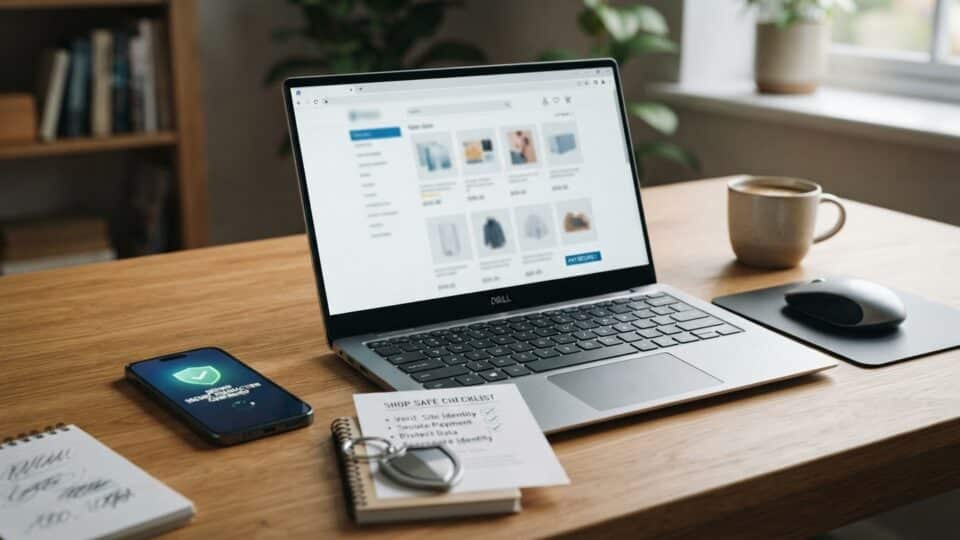
How do you check an online store before paying? Do not stop at the logo, design or padlock in your browser. A fake website can look flawless, use HTTPS and copy a genuine store almost perfectly. A proper check means confirming who the trader is, how long the domain has existed, what policies it has, how it requests payment and whether its price makes sense in relation to the market.
For more information about consumer rights, see How to cancel an online order effectively, which provides complementary details on the subject.
In 2026, the Romanian Police explicitly advise shoppers to check an online store’s authenticity, the company’s identification details, delivery and return terms, domain and payment methods. At the same time, EU rules give consumers clear rights when they buy from a trader: transparent information, a legal guarantee and, for most online purchases, a 14-day withdrawal period.
How to check an online store in five minutes
Before entering your card details, carry out these checks:
- Check the company name and contact details.
- Look closely at the website domain.
- Search for independent reviews.
- Read the returns and delivery policy.
- Compare the price with other stores.
- Check the payment method.
- Look for signs of phishing or imitation of a real brand.
If two or three of these points raise questions, do not complete the payment simply because the discount “expires in 10 minutes”.
1. Check who the trader is
A reputable online store should clearly tell you who is selling the product.
Look in the footer, on the Contact page, in the Terms and Conditions, or in the Returns Policy for:
- the company name;
- its registered-office address;
- contact details;
- a tax identification number or other business identification details;
- where applicable, its registration number;
- the return address.
If the only information is a contact form and a Gmail address, continue your checks with much greater care.
2. Company details should be consistent everywhere
It is not enough for a website to display a company name.
Check whether the same company appears in:
- the Terms and Conditions;
- the Privacy Policy;
- the Returns Policy;
- the invoice or invoice template;
- the Contact page.
If one page names “SC Example SRL” and the Terms refer to another company in another country, you need an explanation before paying.
3. Look very closely at the web address
Fake stores often copy the names of well-known brands.
The difference may be just one character:
- brand.ro → bramd.ro;
- magazin.com → magazin-shop.com;
- numeoficial.ro → numeoficial-romania.store.
The Romanian Police recommend checking the domain carefully, particularly when a website uses unusual extensions or names very close to those of a real brand.
4. HTTPS is necessary, but does not prove a store is legitimate
The padlock in your browser and an address beginning with HTTPS show that the connection between your browser and the website is encrypted.
They do not mean that the website owner is automatically trustworthy.
A fraudulent website can also obtain an HTTPS certificate.
Therefore:
HTTPS means an encrypted connection, not a certificate of good conduct.
5. Search the store name together with “scam”, “fraud” or “complaints”
A 30-second search can prevent a mistaken payment.
Search for phrases such as:
- “store name complaints”;
- “store name scam”;
- “store name fraud”;
- “store name returns”;
- “store name does not deliver”.
Do not treat every negative comment as proof of fraud. Any large trader may have dissatisfied customers.
Look for repeated patterns:
- products that are never delivered;
- money that cannot be recovered;
- a company that cannot be contacted;
- counterfeit products;
- returns that are systematically refused.
6. Perfect reviews can be as suspicious as no reviews
A new store with 300 five-star reviews posted within two weeks deserves closer scrutiny.
Signs of artificial reviews may include:
- very similar wording;
- the same writing mistakes;
- very short, generic reviews;
- waves of reviews over the same period;
- accounts with no other activity.
Look for reviews across several platforms, not only on the store’s website.
7. A price that is “too good to be true” is one of the clearest signals
The Romanian Police warn about unrealistically large discounts, particularly on branded goods and expensive electronics.
If a phone that normally costs 4,000 lei suddenly appears for 1,200 lei at an unknown store, the issue is not necessarily that you have found the deal of a lifetime.
Before paying:
- compare the price at at least 3–4 stores;
- check whether the product is new or refurbished;
- check whether the price includes VAT;
- check the delivery charge;
- check whether it is sold by the store or by a third party.
8. A countdown saying “the offer expires in 09:59” is not proof of real urgency
Many legitimate stores use countdowns for genuine campaigns.
But dubious websites use the same tactic to reduce the time you have to think.
A clear warning sign is when:
- the countdown returns to the same value after a refresh;
- the discount “ends today” every day;
- all products are reduced by 70–90%;
- stock is permanently shown as “last 2 items”.
9. Check the returns policy before, not after, buying
In the European Union, for most online purchases from a trader, consumers generally have the right to withdraw from the contract within 14 days without giving a reason.
In Romania, Emergency Ordinance No. 34/2014 regulates the withdrawal right for distance contracts and sets out the exceptions.
There are products and services for which the right of withdrawal does not apply or may be limited, for example:
- personalised products;
- certain services for a specific date;
- sealed products that cannot be returned after unsealing for reasons provided for by law;
- certain types of digital content after supply has begun with the consumer’s consent.
A store that simply says, “We do not accept returns for products purchased online,” should be examined very carefully.
10. Check who pays return shipping
The right of withdrawal does not automatically mean free returns in every situation.
Under EU rules, the buyer may bear the cost of returning goods if they were informed in advance, subject to legal exceptions or where the trader has agreed to bear the cost.
The store’s policy should explain clearly:
- where to send the product;
- within how many days;
- who pays the shipping cost;
- how you will receive the refund.
11. Check the difference between a trader and a private individual
This distinction is essential on marketplaces.
EU rules require platforms to indicate whether the seller is a trader or a private individual.
Standard consumer rights — including the 14-day withdrawal right — apply mainly to the relationship between a consumer and a trader.
If you buy from a private individual, the legal protection is different.
12. The legal guarantee is not the same as a “commercial warranty”
For goods bought from a trader in the EU, there is a minimum legal guarantee of conformity, generally 2 years for new goods.
A commercial warranty offered by the manufacturer or store is additional and does not replace statutory rights.
If a store says “30-day warranty only” for a new product, check the terms and legal framework carefully.
13. Look at the payment methods
The Romanian Police recommend using secure payment methods and exercising caution where an unfamiliar trader insists on a bank transfer.
Risk signals include:
- only a transfer to a personal account;
- payment in cryptocurrency;
- transfers through services that are difficult to reverse;
- sending card details by email or chat;
- a request for a photograph of your card.
For an unfamiliar store, a payment method that provides authentication and allows you to raise the transaction with your bank if fraud occurs is preferable.
14. A virtual card can limit exposure
If your bank offers virtual or single-use cards, they can be useful for online shopping.
The advantage is that you do not directly expose the details of your main card, or you can limit the available balance.
This does not make a fake store safe, but it reduces the consequences if payment details are compromised.
15. Never send a full photo of your card
A legitimate trader does not need:
- a front-and-back photograph of your card;
- your PIN;
- your internet-banking password;
- one-time passwords received by SMS;
- authorisation codes sent to your banking app.
If someone asks for this information, stop the transaction.
16. Check the payment page
When paying, pay attention to whether you are redirected to:
- a recognised payment processor;
- your bank’s 3D Secure page;
- a completely different and suspicious domain.
Do not continue if the page asks for unusual information or if the web address appears to be copied.
17. Do not open a store through an SMS link if you can go there directly
A common tactic is a message such as:
“Your parcel is held. Pay 4.99 lei here.”
The link may lead to a website imitating the courier or store.
The Romanian Police recommend manually opening the official website when you receive such messages.
InfoBuz also has a separate guide on how to recognise a phishing message and what to do if you have already clicked the link.
18. Check whether the site uses poor Romanian
Machine translation does not automatically mean fraud, but it can be a warning sign when combined with other problems.
Watch for:
- incoherent sentences;
- lei and euros mixed together;
- poorly translated returns policies;
- incorrect country names;
- contact details copied from another website.
19. Check the product images
A fake website may take photographs directly from the manufacturer or another store.
If you have doubts:
- search the image on Google Images or Lens;
- see whether the same photograph appears on dozens of websites;
- compare the description with the manufacturer’s official page.
If a store claims to sell an exclusive product but the photographs and description have been copied in full, caution is warranted.
20. Search for the store on maps and check the address
If the website displays a physical address, check it.
You may find that:
- the address is an empty plot of land;
- it is a building with no connection to the store;
- it is an address copied from another company.
An online company can legitimately operate without a showroom, but its registered address should still exist.
21. Check the age of the domain, but do not use it as the only verdict
A domain created last week and used for a “national store with 15 years of experience” is suspicious.
On the other hand, a new store may be entirely legitimate.
Domain age is an indication, not proof.
The combination matters:
a very new domain + huge discounts + unclear company details + bank transfer only = high risk.
22. A marketplace does not automatically guarantee every seller
Large platforms may have third-party sellers.
Check:
- who is actually selling the product;
- who issues the invoice;
- who handles the return;
- the seller’s rating;
- the age of the account;
- the marketplace’s policy for disputes.
23. Do not install apps sent by “store support”
If someone asks you to install AnyDesk, TeamViewer or another remote-control application to “confirm payment”, end the conversation.
A trader does not need to take control of your phone or computer to refund your money.
24. Do not pay “unblocking fees” after ordering
One fraud pattern is:
- you pay for the product;
- you receive a message saying that the parcel is held;
- you are asked for a small additional fee;
- the payment page steals your card details.
If there is a delivery problem, manually visit the courier’s website and check the AWB tracking number.
25. Keep all the evidence
After ordering, save:
- the order confirmation;
- the invoice;
- screenshots of the offer;
- the return terms;
- messages exchanged with the store;
- the order number;
- proof of payment.
If a dispute arises, these documents are essential.
What to do if the store does not deliver
Start by contacting the trader using the official details on the website.
If it does not respond and you have reason to believe it is fraud:
- contact your bank as soon as possible;
- ask for your card to be blocked if its details have been compromised;
- ask the bank what options are available to dispute the transaction;
- keep the evidence;
- report the matter to the relevant authorities.
InfoBuz has published a separate guide: Have you sent money to an online scammer? What to do in the first 60 minutes to try to recover it.
What to do if you entered your password on a fake site
Immediately change the password for the real account.
If you used the same password on other accounts, change it there too.
Enable two-factor authentication or passkeys where available.
If you want to move away from passwords gradually, InfoBuz also has the guide Passkeys in 2026: how to replace passwords without being locked out of your accounts.
A 60-second checklist before paying
| Question | If the answer is “no” |
|---|---|
| Is the company clearly identified? | Stop and check. |
| Is there a real address and contact information? | Higher risk. |
| Is the domain correct? | Do not enter any details. |
| Is there a returns policy? | Do not buy until it is clear. |
| Is the price realistic? | Compare it on other websites. |
| Is payment made by a secure method? | Do not transfer money at random. |
| Do the reviews appear genuine? | Look for external sources. |
How to check an online store: the three-signals rule
One unusual element does not necessarily prove fraud.
But if you see several of the following at the same time:
- an incredibly low price;
- a new or unusual domain;
- missing company details;
- an unclear returns policy;
- bank transfer only;
- pressuring messages;
- suspiciously perfect reviews;
then it is no longer a coincidence.
The more warning signs accumulate, the simpler the right decision becomes: do not pay.
Final thoughts
A trustworthy online store should not make you guess who the trader is, where to find it or how to return a product.
Before paying, check:
- the company’s identity;
- the domain;
- the reviews;
- the price;
- the return terms;
- the payment method;
- signs of phishing.
The best “antivirus” for online shopping remains a few minutes of checking before you enter your card details.
Frequently asked questions
Does HTTPS mean the store is safe?
No. HTTPS means the connection between your browser and the website is encrypted. A fraudulent website can also have an HTTPS certificate.
Can I return any product bought online within 14 days?
For most online purchases from traders, there is a 14-day right of withdrawal, but the law provides several exceptions, including for certain personalised products, services and digital content.
Is a store without cash on delivery automatically fraudulent?
No. Many legitimate stores accept online payment only. What matters is who the trader is, how payment is processed and what other signs of trustworthiness are present.
What should I do if I have already paid on a fake site?
Contact your bank immediately, keep the evidence, block the payment instrument if its details have been compromised and report the matter to the relevant authorities.
Can I trust reviews on the store’s website?
Do not rely on them alone. Compare them with independent reviews and look for patterns of complaints across several platforms.
Sources: Romanian Police – recommendations for preventing fraud in online shopping; ANPC – Emergency Ordinance No. 34/2014 on distance contracts; Your Europe – consumer rights when shopping; Council of the EU – legal guarantee and right of withdrawal.





Discuția cititorilor
Ai o opinie sau o întrebare despre acest articol? Spune-ne ce crezi.
Fii primul care deschide discuția.
Te rugăm să păstrezi un limbaj civilizat și să discuți la subiect. Comentariile spam sunt filtrate automat.