
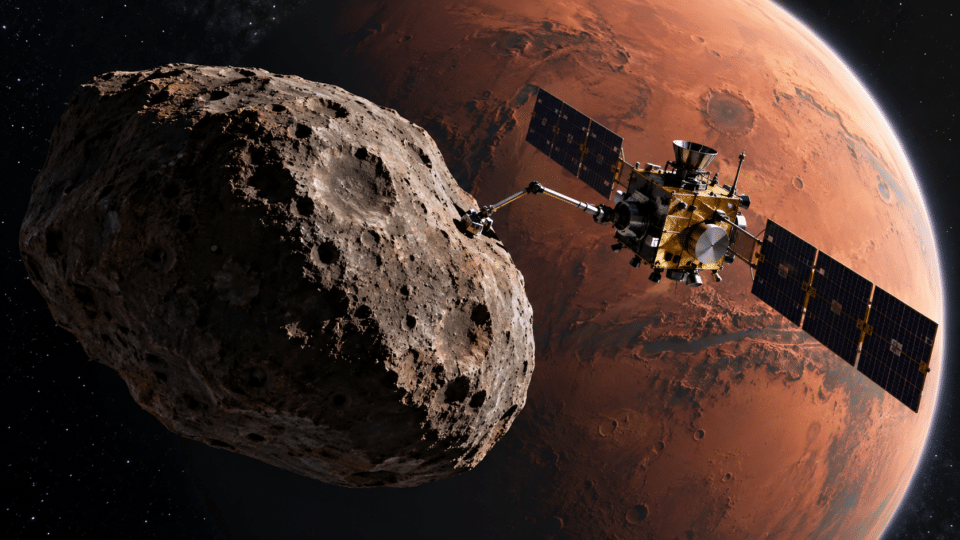
Ten grams of material may seem too little to justify a space mission lasting several years. In planetary science, however, a few grams analysed in laboratories on Earth can yield information that photographs or spectrometers operating millions of kilometres away cannot provide on their own.
Japan’s Martian Moons eXploration (MMX) mission is scheduled to launch on 20 October 2026, at 04:41 in Japan—the evening of 19 October in Europe. The plan is led by JAXA, with participation from NASA, ESA, CNES and DLR. As of 14 October, the launch remains a future event, rather than one that has already taken place.
Why Phobos?
Mars has two small natural satellites, Phobos and Deimos. Their origin remains an important scientific question: were they objects captured by the planet’s gravity, or did they form from material produced by violent events in the history of the Martian system?
For more on Mars, see also Curiosity found 21 organic molecules on Mars. Why “organic” does not automatically mean life, which provides complementary context on the subject.
Their shape, surface composition and orbits can offer clues, but remote observations do not rule out every hypothesis. A sample brought to Earth would allow chemical, mineralogical and isotopic analyses far more detailed than those possible in space.
That is why the mission’s success will not be measured by the weight of the material, but by the quality of the information it can provide.
Mission timeline: what is planned
According to the European Space Agency, the launch is planned from the Tanegashima Space Center aboard an H3 rocket. The spacecraft is expected to reach the Mars region in August 2027, then begin operations around Phobos in September 2027.
The programme includes mapping the surface, observing Mars and deploying a rover on the moon. In 2030, the mission is scheduled to collect at least 10 grams of material from two sites on Phobos.
The sample capsule is due to return to Earth in 2031, with a landing planned in a designated area of Australia. During its return journey, the mission module is also scheduled to observe Deimos.
This timeline reflects mission objectives communicated before launch, not guaranteed events. A complex space operation may face delays or technical adjustments.
What the samples could reveal
The samples could help establish whether material on Phobos more closely resembles certain small bodies in the Solar System or material formed near Mars. If differences are found between samples from the two sites, they could point to distinct processes at the surface.
Researchers may also examine the effects of prolonged exposure to radiation and micrometeorite impacts—factors that gradually alter layers of material on moons without a dense atmosphere.
MMX is not a mission to directly discover life on Mars. It may, however, contribute to understanding the evolution of the Martian environment and the conditions in which nearby bodies formed.
Why a rover is not enough
A rover can observe its immediate location and carry out a limited number of measurements. A laboratory on Earth has more sophisticated instruments, can repeat analyses and can preserve material for future technologies.
That is the strategic advantage of sample-return missions: the value of their discoveries does not end when the capsule lands. Samples can be reanalysed for decades.
The hardest part is not the journey
Before setting off for Earth, the spacecraft must navigate a difficult orbital environment, study suitable areas, deploy instruments and collect material from the surface of a moon with low gravity.
Success depends on a sequence of manoeuvres without which the sample cannot be obtained or transported safely. That is why the stages between 2027 and 2031 matter as much as the launch.
What to watch after 20 October
The first milestone will be confirmation of the launch and the spacecraft’s initial condition. Next will come its trajectory, communications with Earth and preparations for observations in 2027. Only after collection will it be possible to discuss the actual quantity of material recovered.
Ten grams may be little on a scale, but they could be enough to test theories about the origin of a world. That disparity is precisely what makes MMX one of the scientific missions to follow in the coming years.
Updated 14 October 2026. All future dates are plans announced by the space agencies, not results already achieved.


Discuția cititorilor
Ai o opinie sau o întrebare despre acest articol? Spune-ne ce crezi.
Fii primul care deschide discuția.
Te rugăm să păstrezi un limbaj civilizat și să discuți la subiect. Comentariile spam sunt filtrate automat.