
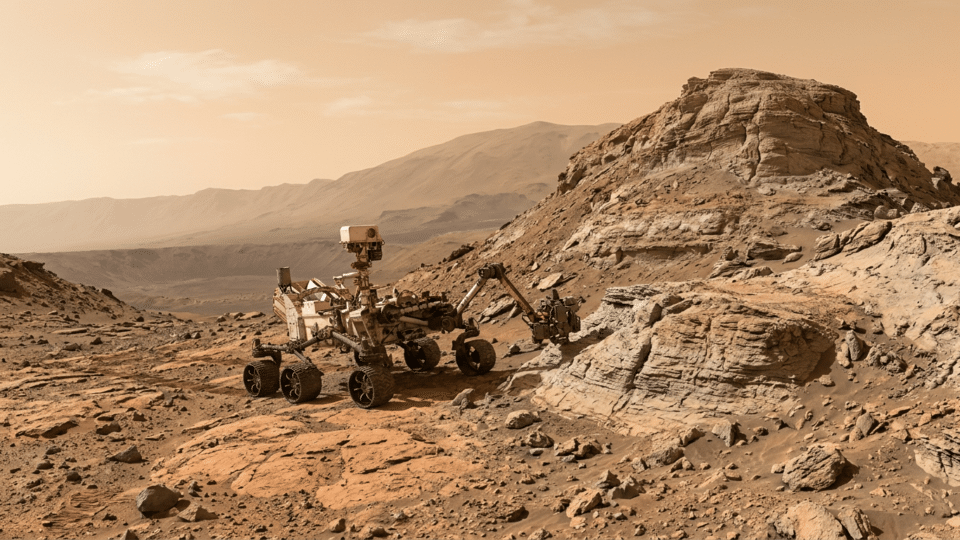
On 21 April 2026, NASA announced that the Curiosity rover had identified the most diverse collection of organic compounds yet observed on Mars in the “Mary Anning 3” sample. The finding involves 21 carbon-containing molecules, seven of which were reported on the Red Planet for the first time. The result matters because it shows that ancient Martian rocks can preserve more complex organic chemistry than was previously known. But it is not a discovery of life, nor is it evidence that Mars was inhabited.
The distinction is essential: in chemistry, “organic” primarily means “carbon-based,” not “produced by organisms.” Carbon and its compounds can also arise through geological reactions and processes in a planet’s atmosphere, or be delivered by meteorites. NASA itself states that the molecules found by Curiosity may have either a biological or a geological origin. NASA’s announcement on the Mary Anning 3 sample analysis describes the discovery as confirmation of chemistry favourable to life, not confirmation of life itself. nasa.gov
What Curiosity found
The sample was drilled in 2020 from a rock called “Mary Anning 3” in the Glen Torridon region of Mount Sharp, within Gale Crater. The study, published in Nature Communications on 21 April 2026, describes more than 20 organic molecules detected in clay-rich sandstones deposited in a lake and river environment around 3.5 billion years ago. NASA summarises the inventory as 21 carbon-containing molecules, seven of them reported on Mars for the first time. nature.com
For additional context, see Euclid found 31 early quasars: why we see them after more than 13 billion years, an article that explores an aspect directly related to this subject.
Among the molecules identified in the experiment that yielded the seven new detections were aromatic compounds such as naphthalene, methylnaphthalene, trimethylbenzene and tetramethylbenzene, as well as benzothiophene, a molecule containing carbon and sulphur. These names may sound striking, but taken individually they are not “signatures of organisms”. They are compounds consistent with several possible chemical histories.
One important nuance: headlines about the “most diverse molecules” refer to the variety of compounds. In March 2025, Curiosity set a different record: that of the largest organic molecules detected on Mars up to that point—decane, undecane and dodecane, with chains of 10, 11 and 12 carbon atoms. They were found in a different sample, “Cumberland”, from Gale Crater. NASA/JPL explained at the time that they could be fragments of larger fatty acids, although that analysis also could not determine whether the compounds had a biological origin. jpl.nasa.gov
What the SAM instrument measured and why the method matters
Curiosity does not carry a full terrestrial laboratory, but a mini-laboratory called SAM—Sample Analysis at Mars. The rover’s arm grinds the rock, and the powder is fed into the instrument. SAM heats the sample and analyses the released gases using a mass spectrometer and a gas chromatograph.
For Mary Anning 3, the team used a “wet chemistry” experiment with tetramethylammonium hydroxide, abbreviated as TMAH, on Mars for the first time. The reagent helps release or transform larger, less volatile molecules that would otherwise be difficult to observe directly. In other words, the detector does not photograph intact molecules in the Martian rock: it measures the chemical products resulting after the sample is treated and heated.
This does not weaken the discovery; it defines its meaning accurately. The experiment shows that the rock contained organic material complex enough to generate that set of compounds under SAM’s controlled conditions. The authors compared the signals with cleaning measurements taken before and after the analysis, and the seven reported molecules did not appear in those controls. They also tested the TMAH reaction on the Murchison meteorite to examine how larger organic molecules can produce some of the compounds observed by SAM. doi.org
Why “organic” is not synonymous with “living”
On Earth, organisms produce many organic compounds. But that does not mean every organic compound indicates organisms. Fatty acids, aromatic hydrocarbons and sulphur-containing molecules can also arise without biology—for example, through interactions among water, rocks and minerals, through thermal reactions, or through the chemical transformation of organic matter delivered by meteorites.
For a discovery to become a convincing biosignature, researchers would need more than the presence of carbon: a pattern that is difficult to explain through geology, distinctive molecular distributions, suggestive isotope ratios and a coherent mineralogical context. Ideally, several independent lines of evidence would need to point to the same conclusion. Curiosity’s current data do not reach that threshold.
| What the data say | What it means | What it does not allow us to say |
|---|---|---|
| Confirmed | The Mary Anning 3 sample yielded more than 20 organic molecules detected by SAM; NASA identifies 21, seven of them new for Mars. | It does not prove that the molecules were produced by organisms. |
| Likely | The rock’s clays and water-related history favoured the concentration and preservation of organic material over billions of years. | It does not prove that this environment was actually inhabited. |
| Possible | Some measured compounds may come from initially larger organic molecules transformed during the TMAH experiment. | It does not establish the precise structure of all the original molecules in the rock. |
| Still unknown | The ultimate origin of the organic material: geological, meteoritic, biological or a combination. | It does not permit the announcement that “NASA found life on Mars”. |
What the rock says about Mars 3.5 billion years ago
The discovery is nevertheless highly valuable. The region where the sample was collected preserves evidence of lakes, watercourses and periods alternating between wetter and drier conditions. Clays are relevant because they can protect organic molecules from degradation. On present-day Mars, which is cold, dry and bombarded by radiation, an ancient sedimentary rock can serve as a chemical archive.
This reinforces the idea that early Mars had ingredients and environments compatible with prebiotic chemistry—reactions that may precede the emergence of life. That is a different statement from “life emerged there”. The former is supported by geological and chemical data; the latter remains an open question.
For pupils and teachers, a useful comparison is this: finding bricks and mortar does not prove that there was a house. Organic molecules are chemical raw materials. A biosignature would be a much more specific pattern, showing that matter had been organised and altered by biological processes.
Why the next step cannot simply be a more spectacular headline
The SAM instrument has pushed impressive limits for a miniaturised laboratory sent to another planet, but researchers emphasise that samples analysed in laboratories on Earth could be investigated with more sensitive equipment and through more independent tests. In the meantime, the Mary Anning 3 result cautiously changes the question: not “Did Curiosity find life?”, but “How well can Mars preserve the chemical traces of life which, if it ever existed, would have disappeared billions of years ago?”
It is a less spectacular question than an announcement about aliens, but it is much closer to what Curiosity and its SAM instrument actually measured.
Frequently asked questions
Did NASA find life on Mars?
No. Curiosity identified organic molecules—that is, molecules containing carbon—but NASA and the study’s authors say their origin may be biological or geological.
What is the difference between the 2026 and 2025 discoveries?
The result announced in April 2026 concerns the greatest diversity of organic compounds: 21 carbon-containing molecules. The March 2025 result concerned the largest organic molecules then detected on Mars, carbon chains containing 10–12 atoms.
Why can clays on Mars preserve organic molecules?
Clay minerals can adsorb and protect organic compounds in fine sediments, reducing their exposure to processes that degrade them. This makes clay-rich rocks useful targets in the search for ancient chemistry.


Discuția cititorilor
Ai o opinie sau o întrebare despre acest articol? Spune-ne ce crezi.
Fii primul care deschide discuția.
Te rugăm să păstrezi un limbaj civilizat și să discuți la subiect. Comentariile spam sunt filtrate automat.