
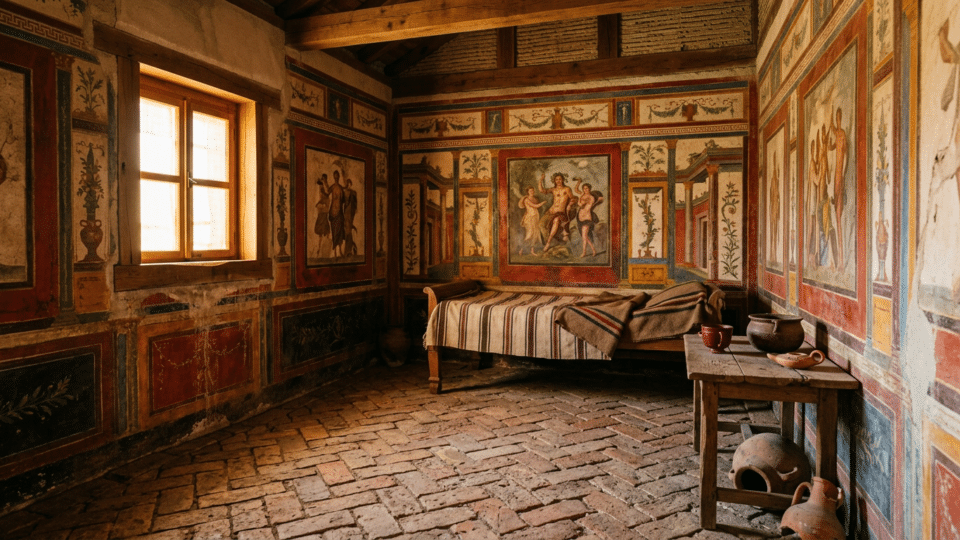
The discovery was announced on 23 August 2025, not in 2026. In the Great Gate–Great Tower sector at Histria, archaeologists found the remains of a burned Roman dwelling, along with more than 40 coins and ornaments made of precious metals. For the public, the hoard is the spectacular element. For research, however, the limestone floor, walls with painted plaster and the way the objects remained embedded in the fire layer are equally important.
The National Museum of Romanian History’s press release preliminarily dates the dwelling to between the mid-2nd and mid-3rd centuries AD, during the Principate. The institution says the property most likely belonged to an important family. This hypothesis is well supported by the discovery as a whole, but it does not mean archaeologists can already identify the owner’s name, occupation or the exact cause of the fire.
Why a floor and walls can say more than a coin
A coin can provide a chronological reference point, while an ornament can indicate access to valuable goods. A dwelling, however, preserves the relationship between things: where they were used, which rooms were finished more carefully, which objects were kept together and what happened to them at a moment of destruction.
In the same context, see also Euclid found 31 early quasars: why we see them after more than 13 billion years, which presents additional relevant information.
In Histria’s case, three clues should be considered together:
| Clue | What it can reasonably suggest | What it cannot yet prove |
|---|---|---|
| Limestone paving | Investment in fitting out the space, more durable construction and a higher standard than a simple beaten-earth floor. | That the entire house was luxurious or that its owners belonged to a specific social category. |
| Painted plaster | An interior that was planned and decorated; this finish required materials, skilled labour and maintenance. | The painted designs, original colours, meaning of the decoration or the family’s personal tastes, before the fragments are analysed. |
| Coins and ornaments in a burned wooden casket | The existence of a place for storing valuables and the fact that the fire caught the objects there. | That the valuables were hidden because of an attack, that the residents died or that the hoard was deliberately abandoned. |
In archaeology, context is decisive. The same bracelet found in isolation says far less than a bracelet found alongside coins, in a carbonised box, in a room with carefully executed finishes. This is why the value of the discovery cannot be reduced to the precious metal.
Painted walls: a sign of status, not a portrait of an elite
Painted plaster was a decorative solution familiar in the Roman world, used to turn masonry walls into coloured surfaces, sometimes with panels, imitations of wall cladding or figurative motifs. At Histria, the National Museum of Romanian History’s press release confirms only the presence of walls with painted plaster. It has not yet published a description of the motifs, pigments or the room in which they were preserved.
This distinction matters. The phrase “painted walls” does not yet justify a Pompeian-style reconstruction, nor does it prove that the whole building had the same level of decoration. Archaeologists must determine whether the fragments come from one room or several, whether they fell in place or were displaced by collapse, and whether the decoration belongs to the same phase of the house’s use.
Even so, the association between painted plaster and limestone paving is significant. Together, they indicate investment in the visible aspects of domestic life: not merely a functional shelter, but a space in which comfort, receiving guests or expressing social position may have mattered. This is a conclusion about the household’s resources and standard of living, not a final judgment on the family’s rank.
The burned casket preserves an interrupted action
According to the National Museum of Romanian History, the coins and ornaments were probably stored in a wooden casket. The fire caused the metal objects to fuse together, preserving the shape of the container. This is one of those cases in which a destructive event preserves the very relationship between objects: the valuables did not happen to end up together in the ground, but had been stored together before the fire.
The cautious conclusion is that the dwelling had a space or container dedicated to small, easily portable valuables. It is not yet known whether this was a reserve for expenses, the family’s jewellery, temporary storage or a form of protection against a risky situation. Analysis of the coins may refine the date at which the assemblage was lost: the most recent identifiable coin can provide a terminus post quem, meaning the year after which the deposit or fire must have occurred. It does not automatically provide the exact date of the disaster.
Equally important, no cause of the fire has yet been published. An urban fire can result from an accident, domestic activities, a local incident or violence. Directly linking the discovery to an invasion or political crisis would, at this point, be speculation.
A house must be read within the city plan, not in isolation
The dwelling stands in the Great Gate–Great Tower sector, investigated by the National Museum of Romanian History since 2000. In the same area, teams have documented streets, large-scale buildings, drainage channels, drinking-water pipes, a well and a kiln. This changes the perspective: the house was not an island, but part of an urban fabric with movement, supply and water management.
The museum’s page on the site mentions street routes made from limestone slabs, buildings located between the street and the enclosure wall, and everyday or luxury objects that help reconstruct daily life in the Roman city. The National Museum of Romanian History’s research context for the Histria sector shows why, over time, the layout of streets and water networks can say as much about residents as the hoard found in a single room.
Put simply, archaeologists will be able to ask: did the house have direct access to a main street? Was it close to a commercial area, gate or public building? Was it rebuilt in several phases? Did it have rooms with different functions? The answers do not emerge from an isolated object, but from the overlap of walls, floors, fire deposits and datable objects.
Histria was not merely a Greek ruin when this house was inhabited
Histria was founded by Milesian colonists in the 7th century BC and remained inhabited until the 7th century AD. According to CIMEC documentation, it is the first attested city on the territory of present-day Romania. In the 2nd and 3rd centuries AD, when the newly discovered dwelling was probably in use, the city already had a very long history and was part of the Roman world on the western coast of the Black Sea.
This continuity explains why Histria is so important to Dobruja and Romania’s history: the site offers not a single frozen image of Antiquity, but successive layers of Greek, Roman and Late Roman city. CIMEC’s historical presentation of Histria and information from the Constanța National History and Archaeology Museum show the scale of the monuments and civilian quarters investigated here.
For this reason, the house with painted walls is not simply a “Roman villa” featured in a news headline. It may add a more concrete chapter to the history of a port and trading city: what private spaces looked like, who could afford elaborate finishes and what goods circulated within an urban household on the western Black Sea coast.
What comes next—and what would be premature to claim
The National Museum of Romanian History announced that the artefacts have entered the laboratory for investigation, restoration and conservation, ahead of any possible public presentation. Restoration may separate objects fused together by the fire, identify metals and manufacturing techniques, and make decisive details on the coins legible.
Until a full report is published, the most firmly supported conclusions are these: there was a burned Roman dwelling, probably datable to between the 2nd and 3rd centuries AD; the house had limestone paving and painted plaster; it contained coins and ornaments kept in a wooden casket; and the assemblage suggests a household with resources above a modest level. The family’s identity, the function of each room, the precise date of the fire and its cause remain open questions.
This is, in fact, the most valuable aspect of the discovery: it does not promise a complete story too soon, but preserves enough traces for the story of a Roman family at Histria to be tested step by step.
Frequently asked questions
When was the Histria discovery announced?
The National Museum of Romanian History announced the discovery on 23 August 2025. The dating of the objects and dwelling is preliminary, to the 2nd–3rd centuries AD.
Why are walls with painted plaster important?
They indicate an interior that was carefully arranged and investment in finishes. However, without a complete analysis of the fragments, the decorative motifs, colours and their distribution within the house are not yet known.
Does the hoard prove that the dwelling was attacked?
No. The discovery confirms a fire and that the valuables were not recovered, but the cause of the fire has not been published. An attack would be only one of several possible explanations.


Discuția cititorilor
Ai o opinie sau o întrebare despre acest articol? Spune-ne ce crezi.
Fii primul care deschide discuția.
Te rugăm să păstrezi un limbaj civilizat și să discuți la subiect. Comentariile spam sunt filtrate automat.