
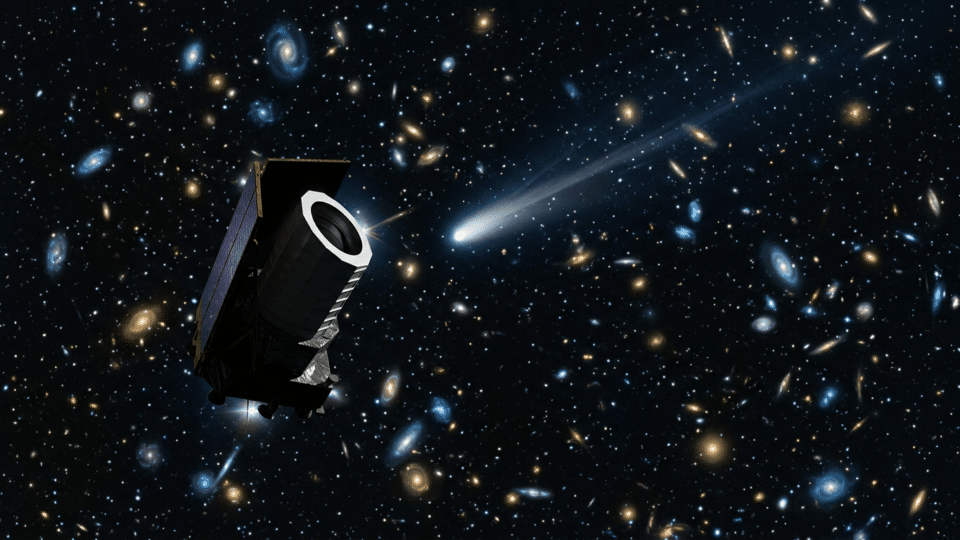
The Euclid space telescope was not sent into space to look for comets. The European Space Agency (ESA) mission maps galaxies to study indirectly how dark matter and dark energy affect the Universe. Yet in images taken between 16 and 24 September 2026, Euclid captured a much closer object: comet C/2026 S1 (Euclid), the first previously unknown comet discovered by the mission.
ESA’s announcement of 19 October 2026 is notable not only for the result, but for the path to confirmation. A moving object can be a nuisance in an image intended to capture distant galaxies. In this case, that very movement provided the clue that made it possible to identify a comet, then verify it through ground-based observations and formally register it within the astronomical small-body reporting system.
What is known so far: Euclid detected the object in five fields of view and 16 exposures in the Euclid Deep Field North. On 8 October, the Minor Planet Center published circular MPEC 2026-T146, designating it C/2026 S1 (Euclid). Some aspects of the orbital data remain preliminary, especially the very long-term orbital period.
Comet C/2026 S1 (Euclid) appeared as a streak, not a point
Euclid fixes on patches of sky to produce deep images of galaxies. Galaxies are so distant that, over the duration of an exposure, they remain effectively still. An object in the Solar System, however, moves against this background of distant sources.
During long exposures, this motion turns the object into a luminous trail. The image released by ESA shows exactly this: the comet leaves a streak across Euclid’s field of view, while background galaxies remain stable points or diffuse shapes.
Software designed to detect moving objects flagged the trail. Using its estimated position and speed, the team then searched for the object in other data. According to ESA’s official account, the positional prediction helped recover the candidate in several images. Once the frames were aligned with its motion, the object showed a central source surrounded by a diffuse coma — the cloud of gas and dust that indicates cometary activity.
The comet was therefore not observed as it might be in a conventional night-sky photograph. It was identified through the fundamental difference between what Euclid was observing — almost stationary cosmic sources — and what crossed the frame: a moving body in the Solar System.
For more astronomy coverage, see Euclid found 31 early quasars: why we see them after more than 13 billion years, which offers complementary detail on the subject.
From a trail in the data to an officially designated object
An unusual trail in an image is not enough to announce a new comet. It could be an instrumental artefact, a satellite, an already catalogued asteroid, or an object observed too briefly to establish its motion. The discovery therefore passed through several filters.
- Detection: the algorithm identified the object moving through Euclid images.
- Verification: the team compared its positions with catalogues of known comets and asteroids.
- Reporting: the observations were sent to the Minor Planet Center, the body that collects and publishes observations of such objects.
- Observational confirmation: ground-based observatories added subsequent measurements, helping to refine the trajectory.
On 8 October 2026, the Minor Planet Center’s MPEC 2026-T146 circular published the designation COMET C/2026 S1 (Euclid). In comet nomenclature, the letter “C” denotes a non-periodic comet or one with a very long period, while “2026 S1” encodes the year and discovery interval, as well as the order of designation within that interval. “Euclid” retains the name of the mission that supplied the initial detection.
Follow-up observations are not separate discoveries. They are the stage through which an initial detection becomes more reliable and an orbit can be calculated from a richer set of positions. Jura Observatory in Switzerland, for example, published measurements of C/2026 S1 made on 5 and 6 October, associated with the same MPC circular.
Why “it found a comet while looking for dark matter” needs one qualification
The wording in the headline captures the contrast between the mission’s objective and the result, but it needs context. Euclid does not measure dark matter directly. The telescope studies how the distribution of galaxies and their light are affected by the Universe’s invisible structure, including through gravitational lensing. From these kinds of data, researchers can infer properties of dark matter and dark energy.
The comet was thus found in data obtained for a cosmological survey, not during an operation in which Euclid was “measuring a particle” of dark matter. Its accidental nature refers to the observations’ primary purpose. The detection itself was methodical: it involved an algorithm, checks across successive images and comparison with astronomical databases.
The case also illustrates a broader feature of modern research: data produced to answer one question can contain useful signals for another. In cosmology, trails left by objects crossing the frame must be identified and controlled. For Solar System astronomy, those same trails can open a line of investigation.
An orbit almost perpendicular to the plane of the planets
ESA estimated that the object was around 1.3 billion kilometres from Earth, in a region roughly between the orbits of Jupiter and Saturn. Its position was unusual in geometrical terms, however: the comet travels on an orbit strongly inclined to the plane in which the planets of the Solar System broadly lie.
Data from the NASA/JPL Small-Body Database, in an orbital solution dated 14 October 2026, indicate an inclination of about 85.2 degrees and an estimated perihelion of about 8.74 astronomical units. One astronomical unit is the average distance between Earth and the Sun, nearly 150 million kilometres.
The estimated perihelion suggests that this comet remains very far from the Sun: beyond Jupiter’s orbit and near Saturn’s orbital region. This is one reason it should not be presented as an astronomical spectacle visible to the naked eye or as an obvious target for amateur astronomers in Romania. Such a claim would require updated ephemerides, a credible brightness estimate and local observing conditions.
Why the orbital period should not be reduced to a fixed number
A highly elongated orbit can lead to estimates of enormous periods, sometimes on the order of hundreds of thousands of years. For C/2026 S1, however, this figure depends sensitively on the available observations and the orbital solution selected. The JPL database shows very large uncertainties for the semimajor axis and sidereal period.
The cautious wording is that current data support a comet with a highly elongated orbit and a very long period. It would not be responsible to turn a provisional estimate into a definitive date for when the comet “will return”.
Euclid is not becoming a specialist comet-hunting telescope
The discovery has scientific and technical value, but it does not change the mission’s role. Euclid deliberately avoids areas near the plane of the Solar System, where there are more small bodies, zodiacal dust and sources of contamination for its cosmological objectives. Its survey strategy is also not designed to revisit the same field frequently, as a dedicated asteroid or comet monitoring programme would.
ESA also states that C/2026 S1 is not a suitable target for Comet Interceptor, the mission being prepared to visit an as-yet unexplored comet. The value of this case lies elsewhere: it can test the alert process and the collaboration between a space-based cosmology observatory, automated detection tools and the ground-based observing network.
In that sense, the comet is not a change of direction for Euclid. It demonstrates that a mission’s archives and analysis tools can produce additional results when viewed through a different scientific question.
Romania’s connection is its participation in the mission, not the comet’s confirmation
Romania participates in the Euclid project through the Romanian Space Agency (ROSA) and the Institute of Space Science, including contributions related to data analysis and interpretation, according to information published by ROSA on the Euclid mission.
This is the verifiable Romanian context for the news. The sources consulted contain no independent Romanian confirmation of comet C/2026 S1, and there is no reason to attribute the role of discoverer or validator of the object to Romanian institutions.
For the public, the value of the discovery does not lie in a promise of a “comet in the sky”, nor in any change to Euclid’s objectives. It lies in the full path of an observation: a streak that might have been treated as noise becomes, through repeated data, verification and collaboration, a newly recognised object in the Solar System.
Frequently asked questions
Is C/2026 S1 the first comet ever observed by Euclid?
No. ESA says that Euclid had previously observed known comets. C/2026 S1 is the first previously unknown comet discovered by the mission.
Why does the comet appear as a streak in Euclid images?
Euclid tracks a fixed field of galaxies in long exposures. The comet moves across that background during an exposure and leaves a trail. Once the images are aligned with its motion, the central source and diffuse coma can be distinguished.
Can comet C/2026 S1 be seen from Romania?
The sources consulted do not provide enough information for a public observing recommendation. The comet is at a great distance, and visibility depends on updated ephemerides, brightness and the instruments available.
Will it be visited by ESA’s Comet Interceptor mission?
No. ESA has said that C/2026 S1 is not a suitable target for Comet Interceptor. The discovery may be useful for testing alert procedures, not for intercepting this comet.


Discuția cititorilor
Ai o opinie sau o întrebare despre acest articol? Spune-ne ce crezi.
Fii primul care deschide discuția.
Te rugăm să păstrezi un limbaj civilizat și să discuți la subiect. Comentariile spam sunt filtrate automat.