
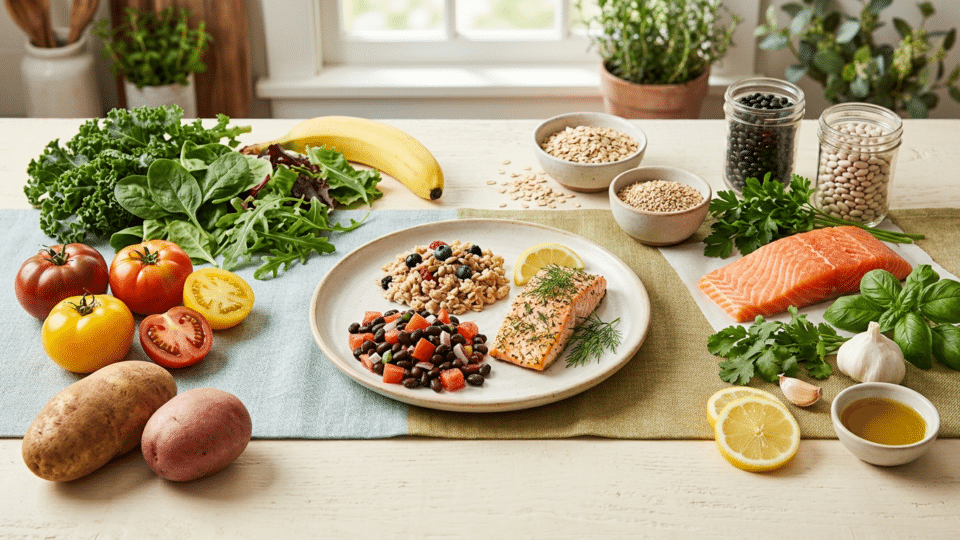
The short answer: there is currently no verified nationwide figure showing how much a monthly “blood-pressure-friendly diet” costs in Romania. A single number might look useful, but it would conflate very different things: prices in one city on one day; the needs of one person or a family; time available for cooking; promotions; and the amount of food that is actually eaten.
There is, however, a practical conclusion supported by medical recommendations: a food basket geared towards less salt and fewer highly processed products does not have to be built around salmon, avocados or organic products. Its foundation can include pulses, oats and other whole grains, seasonal vegetables and fruit, potatoes without large amounts of added salt, plain dairy products, and protein sources selected to suit the budget. Costs generally rise when the basket regularly includes more expensive fish, large quantities of nuts, ready-made products or convenience options.
This article does not propose a medical diet or attribute a guaranteed effect on blood pressure to foods. It explains what can responsibly be said about the cost of a blood-pressure-friendly diet, what is missing for a calculation in Romanian lei, and how one that can be verified could be constructed.
Medical recommendations are not a shopping list
The World Health Organization recommends that adults consume less than 2 grams of sodium a day, equivalent to less than 5 grams of salt. Sodium does not come only from the salt shaker: WHO lists bread, processed foods, cured meats, salty snacks, sauces and concentrated seasonings among important sources.
The European Society of Cardiology’s 2024 guidelines retain reducing salt to below 5 grams a day among the lifestyle measures for elevated blood pressure and hypertension. This benchmark does not mean that everyone should buy the same products or follow a standard menu. It provides a way to assess a food basket: where salt is hidden and what can be substituted.
For example, bread, cheeses, canned foods, smoked products and sauces may contribute more to salt intake than the salt added at the table. Two products in the same category can have very different values on their labels. A serious comparison therefore cannot simply label an item “canned food” or “bread”; it must identify the exact product and the declared salt content per 100 grams or per serving.
Potassium-rich foods are often discussed in relation to blood pressure, but they are not a universal recommendation. People with chronic kidney disease, hyperkalaemia or certain treatments need to discuss their diet individually with a doctor or dietitian. The 2024 KDIGO guideline underscores the need for individualisation precisely in situations where potassium must be controlled.
Why a single monthly figure would mislead
An adult who cooks at home with dried pulses, buys seasonal vegetables and uses leftovers in subsequent meals does not have the same food basket as someone buying small portions, quick meals, pre-portioned fish and out-of-season vegetables. Both choices may aim to reduce sodium, but they involve very different costs and preparation times.
It also matters what question the total is answering. Is it the money spent at the checkout in a month, or the cost of food actually consumed? A larger packet of oats or lentils may be paid for in full in one month even though part of it remains for the next. Conversely, perishable fruit and vegetables may become a greater expense than their per-kilogram price suggests if some are thrown away.
Online retailers may also display prices that vary by locality, stock, sales channel, loyalty card and promotion. An isolated screenshot cannot describe prices across Romania. It can document only the price of one product, in one place, at one specific time.
Eurostat data provide context, not a grocery bill calculation. In 2025, Romania’s price level index for food and non-alcoholic beverages was 78.9, with the European Union average set at 100. Eurostat explicitly notes that these relative price levels are not adjusted for differences in income. So the fact that a basket may be relatively cheaper than the European average does not automatically show whether it is affordable for a low-income household in Romania.
What most affects the cost of a low-salt basket
The main driver of cost is not the label “healthy”, but the structure of the basket. In a transparent analysis, the following substitutions should be calculated separately:
| Choice compared | What may reduce the cost | What needs checking |
|---|---|---|
| Dried pulses / canned pulses | Dried beans, lentils or chickpeas may cost less per serving. | Time, cooking energy, final yield and the salt shown on canned-product labels. |
| Fresh / frozen vegetables | Seasonal produce and some frozen products may reduce waste. | Price per edible kilogram, added sauces or salt, and local availability. |
| Fresh / frozen / canned fish | Frozen options may be more predictable in price and storage. | The product’s salt content, added oil or sauce, portion size and frequency of consumption. |
| Nuts / seeds | Seeds may be a cheaper alternative at some times. | The actual serving, salted varieties, and the difference between packet price and cost per serving. |
| Home-cooked food / convenience products | Cooking in larger quantities may lower the cost per serving. | Time available, energy use, waste and the sodium in ready-made products. |
This comparison does not place canned or frozen products in a “bad” category. For a household with a busy schedule, they may make a dietary pattern easier to follow. The right question is whether the specific product fits the goal of reducing sodium and whether its price, including the risk of waste, suits the budget.
For more information on diet, see Ultra-processed foods under the spotlight: how to identify them and what studies say about health, which provides complementary detail on this subject.
A minimum method for a repeatable calculation
Any future total published as “one month of eating for healthy blood pressure” should be an editorial simulation, not a prescription or a snapshot of how Romanians eat. Specialist literature shows that methods for comparing diet costs differ substantially between countries and studies, which is why tools need to be adapted to the local context.
To be verifiable, the calculation should publish at least:
- the number of people, number of days and assumption about meals prepared at home;
- every food item, the quantity purchased and the estimated quantity consumed;
- the retailer, city, date and type of price: regular, promotional or conditional on a card;
- the price per package, per kilogram and per serving consumed;
- the salt value on the labels of products for which sodium is relevant;
- the rule for leftovers, products remaining for the following month and waste;
- permitted substitutions when a product is unavailable.
The basic formula is simple: cost per food item = quantity consumed × unit price. But the total becomes meaningful only once the units are clear. The unit price must be expressed per comparable kilogram, litre or item; the quantity consumed must be distinguished from the quantity in the package; and the final sum must be dated, because a one-week promotion does not describe an ordinary month.
A credible comparison would include at least three scenarios: a basic one, built around affordable foods and home cooking; an intermediate one, with greater variety; and a flexible one, which pays more for portioned products or time savings. Each should be calculated for one adult and, separately, for two people. Simply doubling the amount is not always accurate, because larger packages and batch cooking can lower the cost per serving.
What households can do now, without a “miracle menu”
A personal budget can be checked more effectively by starting with products already being bought rather than with an idealised list. For one or two weeks, keep receipts and note products with significant salt levels on the label: bread, cheeses, cured meats, canned foods, semi-prepared foods, instant soups, sauces and snacks. Then compare the cost and salt content of a real alternative, rather than of a food category in general.
The change does not have to happen all at once. One option is to gradually replace a highly processed meal with a home-cooked meal whose flavour comes from herbs, onion, garlic, lemon or seasonings without much added salt. For packaged products, the label matters more than the promise on the front of the pack.
Diet is only one component of blood-pressure control. It does not replace prescribed treatment, proper blood-pressure measurement or a medical consultation. A very high blood-pressure reading accompanied by symptoms such as chest pain, shortness of breath, sudden weakness, speech difficulties, confusion or severe headache requires urgent medical assessment.
Conclusion: a dietary pattern that supports healthy blood pressure can be adapted to a budget, but no one can yet provide an honest monthly figure for all of Romania without a basket documented simultaneously across several stores and cities. The useful number will not be the roundest one, but the one that shows exactly what was bought, when, where, how much was consumed and what trade-offs it entails.
Frequently asked questions
Do I have to buy organic products or expensive fish for a blood-pressure-friendly diet?
No. General recommendations focus on reducing sodium and on a dietary pattern with more minimally processed foods. Pulses, whole grains, seasonal vegetables and fruit can play an important role; the specific choice depends on budget, labels and an individual’s medical situation.
Why is it not enough to stop adding salt at the table?
A significant share of sodium may come from bread, cured meats, cheeses, canned foods, salty snacks, sauces and other processed products. The product label and the serving consumed provide the relevant information.
Can I increase my potassium intake without asking a doctor?
It is not appropriate for everyone. People with kidney disease, hyperkalaemia or certain treatments may need individualised advice on potassium. Speaking to a doctor or dietitian is important before making a major change.
Sources consulted
- World Health Organization — Reducing sodium intake to reduce blood pressure and risk of cardiovascular diseases in adults
- European Society of Cardiology — 2024 ESC Guidelines for the Management of Elevated Blood Pressure and Hypertension
- KDIGO — 2024 Clinical Practice Guideline for the Evaluation and Management of Chronic Kidney Disease
- Eurostat — Household consumption price levels across the EU in 2025
- PubMed — Assessing the Cost of Healthy and Unhealthy Diets: A Systematic Review of Methods




Discuția cititorilor
Ai o opinie sau o întrebare despre acest articol? Spune-ne ce crezi.
Fii primul care deschide discuția.
Te rugăm să păstrezi un limbaj civilizat și să discuți la subiect. Comentariile spam sunt filtrate automat.