
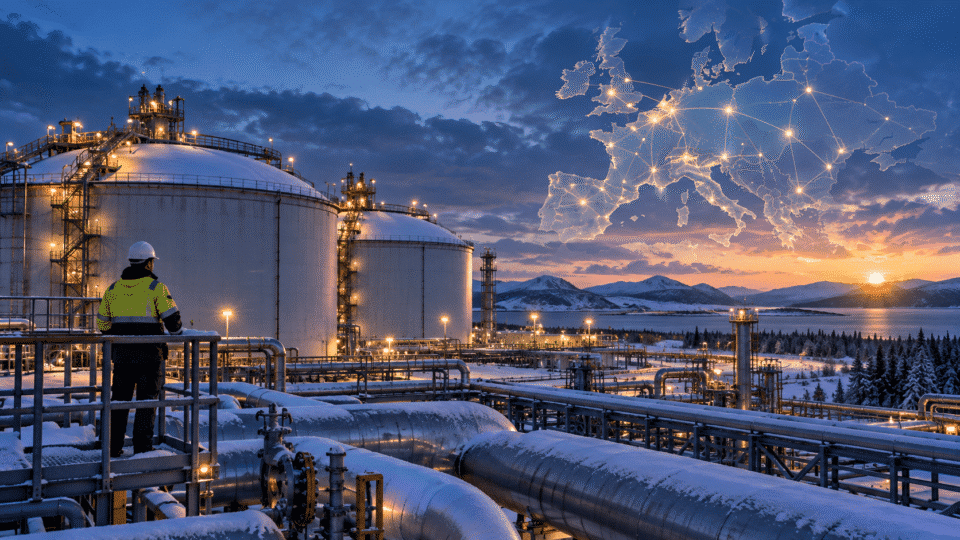
Romania’s gas storage facilities are entering an important phase of modernisation. The European Union is funding expansion and greater flexibility at Bilciurești and Depomureș, two facilities considered essential to Romania’s and the region’s energy security.
As Europe remains exposed to volatility in the gas market, the speed at which gas can be injected into and withdrawn from storage is becoming almost as important as the total volume held.
Romania’s gas storage facilities: why Bilciurești and Depomureș matter
Bilciurești is Romania’s largest underground gas storage facility. The modernisation project aims to increase its daily delivery capacity from 14 million to 20 million cubic metres per day, or about 43%.
For more on energy in Romania, see Neptun Deep in 2027: who stands to benefit from Black Sea gas and what the €4 billion investment means, which provides complementary details on the subject.
Storage capacity will also increase by around 108 million cubic metres per cycle, approximately 9%.
Depomureș: more capacity and a much higher withdrawal rate
At Depomureș, the first phase of the project aims to increase working gas capacity by 33%, or 100 million cubic metres, to 400 million cubic metres.
At the same time, daily injection and withdrawal rates are expected to rise by 75%, to around 3.5 million cubic metres per day.
Why withdrawal speed matters
In a normal winter, a large stored volume provides reassurance. During a spell of severe cold or a supply disruption, what matters is how much gas can actually enter the system in a single day.
A facility able to deliver gas quickly is better placed to respond to peaks in demand and reduces pressure to make spot-market imports.
Romania’s growing role in regional energy security
The storage upgrades are not intended solely for domestic consumption. CINEA highlights the projects’ role in integrating the regional market in Central and South-Eastern Europe.
That means Romanian infrastructure could become more relevant to flows between Romania, Bulgaria, Hungary, the Republic of Moldova and other connected markets.
Why gas remains important in the energy transition
Europe is investing heavily in renewables, but the energy system still needs flexible sources and fuels that can cover periods of low wind or solar generation.
Gas is not a final solution for decarbonisation, but it remains an important component of security and flexibility at this stage.
Storage facilities as seasonal batteries
The difference is that energy is stored not as electricity but as fuel. Gas can be injected during periods of lower demand and withdrawn in winter or at times of system stress.
What Romanian consumers stand to gain
- greater security during periods of high consumption;
- more flexibility for operators;
- less reliance on urgent purchases;
- infrastructure better prepared for external shocks.
What storage facilities cannot solve
A large storage facility does not automatically guarantee low prices. Gas prices depend on procurement costs, contracts, imports, infrastructure and conditions in the European market.
Storage reduces the risk of shortages and can improve flexibility, but it cannot completely insulate Romania from the regional market.
The European context remains tense
In 2026, the European Commission continued to treat gas and diesel security as priority issues. The EU system was considered prepared for winter, but with storage levels lower than in previous years.
Bilciurești and Depomureș are the last major CEF gas projects under implementation
CINEA says the projects are part of the last generation of gas investments supported through the Connecting Europe Facility. The programme’s focus is shifting increasingly towards electrification, hydrogen, smart grids and CO₂ infrastructure.
What comes next
If the works are completed as planned, Romania will have not only more storage space but also the ability to respond more quickly to sudden changes in demand.
The regional context is further explored in InfoBuz’s analysis of European gas storage ahead of the 2026–2027 winter.
Conclusion
Romania’s gas storage facilities are becoming more valuable not only because of their volume, but also because of how quickly they can operate. Bilciurești and Depomureș could turn storage from a static reserve into a more flexible tool for regional energy security.
Sources: CINEA – modernisation of Romania’s gas storage facilities; European Commission – DG Energy.




Discuția cititorilor
Ai o opinie sau o întrebare despre acest articol? Spune-ne ce crezi.
Fii primul care deschide discuția.
Te rugăm să păstrezi un limbaj civilizat și să discuți la subiect. Comentariile spam sunt filtrate automat.