
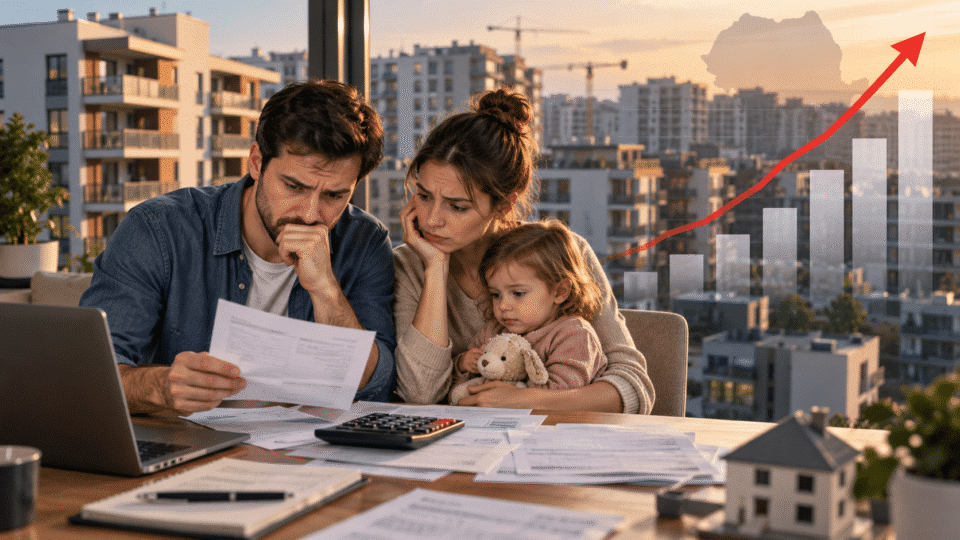
Europe’s housing crisis is no longer confined to major capitals. Eurostat data show that more than 34 million people in the EU live in households that spend at least 40% of their disposable income on housing.
Between 2015 and the second quarter of 2026, house prices across the EU rose by around 69% on average. At the same time, rents, energy bills and financing costs have continued to weigh on household budgets.
Europe’s housing crisis: What the 40% threshold means
Eurostat uses the “housing cost overburden” indicator for households that spend 40% or more of their disposable income on housing.
The calculation includes rent or mortgage interest, utilities, water, energy, heating, maintenance and certain recurring housing-related costs.
More than 34 million Europeans are affected
The EU average was 7.7% of the population in 2025. For people at risk of poverty, however, the rate rose to 29.1%.
The gap shows that the issue is not simply the price of a home, but the relationship between housing costs and income.
Greece is the extreme case
In Greece, 26.4% of the population lived in households exceeding the 40% threshold. Among people at risk of poverty, the share reached 82.6%.
Denmark, Germany and Sweden are also above the EU average, though for different structural reasons: rent levels, ownership structures, incomes and social-protection systems are not directly comparable.
Romania looks better in European statistics, but the picture requires careful reading
Romania is below the EU average on the aggregate housing cost overburden indicator. That does not mean housing is “cheap” for everyone.
For more Eurostat-related information, see Inflation in Romania: the EU’s highest in September 2026, at 6.5%, which provides complementary details on the subject.
The high rate of home ownership, including homes without mortgages, reduces the statistical pressure. For young people, tenants in large cities and low-income households, however, affordability can be far more difficult than the national average suggests.
House prices have risen far faster than public perception
Eurostat reports an average increase of around 69% in EU house prices between 2015 and Q2 2026. In some countries, prices more than doubled.
The problem is compounded when incomes grow more slowly than rents and prices.
Energy is once again a major factor
Experts cited by Euronews warn that energy could become one of the main drivers of rising housing costs in the coming year.
This matters particularly for poorly insulated homes, where a high heating bill can quickly turn seemingly manageable rent into a total cost that is difficult to sustain.
Why cities are more exposed
Across the EU, the housing cost overburden rate is higher in cities than in rural areas. Strong demand, limited supply and land costs push prices upwards.
For young people, this creates a dilemma: better jobs are in cities, but so are higher housing costs.
Tenants are usually the most vulnerable
Households renting on the private market bear rapid market increases more directly. Owners with fixed-rate loans or mortgage-free homes are less exposed in the short term.
Why interest rates matter even when prices stagnate
A home may have the same price, but the monthly payment can rise when financing becomes more expensive.
That is why affordability must be assessed through the total monthly cost, not only the price per square metre.
Europe is preparing measures for more affordable housing
The EU Council already regards housing as a shared European issue, rather than only a local one. The pressure stems from rising prices, a lack of supply and the widening gap between incomes and costs.
What this means for Romania
- more pressure on rents in major cities;
- demand for smaller, more energy-efficient homes;
- greater importance of energy costs;
- increased interest in suburbs and towns within metropolitan areas;
- a need for better public transport between outlying areas and employment centres.
A cheap home to buy can be expensive to run
An apartment with poor insulation, ageing systems and high maintenance costs can become more expensive each month than one with a somewhat higher purchase price but better energy efficiency.
InfoBuz also examines why tenants, pensioners and families with children experience inflation differently in 2026, an important context for understanding housing affordability.
Conclusion
Europe’s housing crisis is, at its core, an affordability crisis. What matters is not only the cost of a home, but how much of a family’s income housing absorbs after rent or loan payments, energy, water and maintenance are included.
Romania is not among the countries facing the most severe European indicators, but its major cities may increasingly feel the same pressure: incomes rising more slowly than housing costs.
Sources: Eurostat – Key figures on European living conditions 2026; Council of the EU – housing crisis; Euronews Business – housing cost overburden.



Discuția cititorilor
Ai o opinie sau o întrebare despre acest articol? Spune-ne ce crezi.
Fii primul care deschide discuția.
Te rugăm să păstrezi un limbaj civilizat și să discuți la subiect. Comentariile spam sunt filtrate automat.