
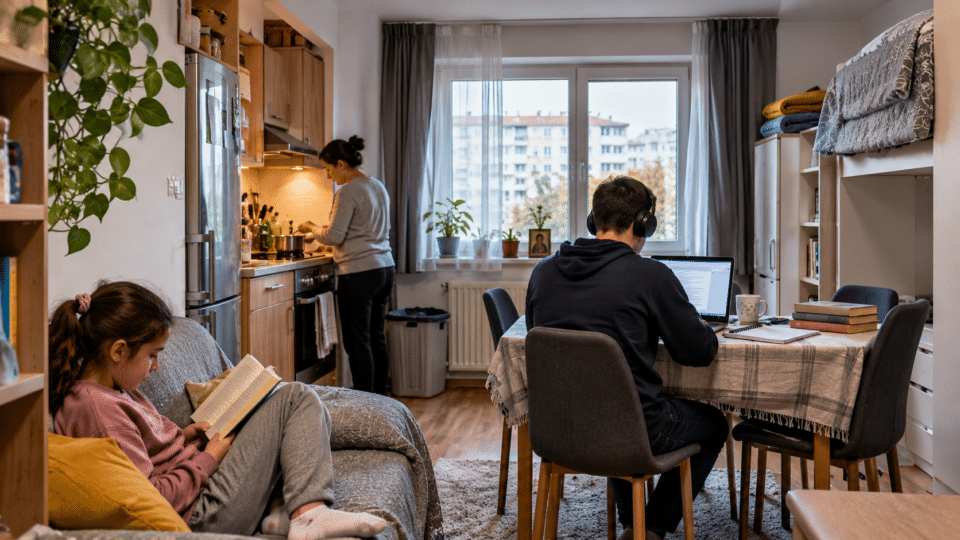
Overcrowded homes in Romania: In 2025, 60.4% of people aged 15 to 29 lived in households without enough rooms under the European statistical definition. The European Union average was 26.9%. Romania ranked first in the EU, according to Eurostat’s 29 September 2026 release.
The figure is striking, but it can be misread: it does not mean that six in ten young people are homeless, that all live with their parents, or that their homes breach a legal requirement. It measures whether there is a minimum number of rooms relative to the people in a household and their ages. That distinction changes how the issue should be explained.
The apparent paradox is that Romania also had the EU’s highest rate of people living in owner-occupied households in 2024: about 94%, according to Eurostat. At the same time, a home may be too small for the number of generations using it, while renting an alternative remains difficult. InfoBuz brings together Eurostat statistics and the European Commission’s 2026 analysis of Romania’s housing market to set out what can—and cannot—be concluded.
Overcrowded homes in Romania: highest rate in the EU, with a 33.5-point gap
| Country or group | Young people aged 15–29 in overcrowded homes, 2025 | Note |
|---|---|---|
| Romania | 60.4% | Highest share in the EU |
| Latvia | 54.9% | Second-highest level in the EU |
| Bulgaria | 52.8% | Third-highest level in the EU |
| EU, weighted average | 26.9% | Average for young people aged 15–29 |
| Cyprus | 3.5% | Lowest share |
Romania exceeds the EU average by 33.5 percentage points (60.4 minus 26.9), and its share is around 2.25 times higher. These comparisons say different things: percentage points measure the absolute gap, while the 2.25 ratio shows the relative scale.
For the population as a whole, regardless of age, Eurostat reports 40.4% in Romania and 16.8% in the EU for 2025. Young people in Romania are therefore 20.0 percentage points more exposed to overcrowding than Romania’s population overall. This is not a comparison with other countries, but a generational gap within Romania.
What Eurostat means by an overcrowded home
When people think about crowding, they may picture floor area or the number of people sharing a bedroom. Eurostat instead applies a minimum-room standard that depends on a household’s composition. Statistically, each household needs one common room, with additional rooms for couples, single adults and children according to specific rules. It is an indicator for comparing housing conditions, not an order requiring owners to alter their homes.
- One common room for the household.
- One room for each couple in the household.
- One room for each single person aged 18 or over.
- One room for every pair of single people of the same sex aged 12–17.
- One room for each person aged 12–17 not included in the preceding pair.
- One room for every pair of children under 12.
A “room” should not automatically be understood as any space shown on an apartment’s floor plan. The rule concerns rooms suitable for living in the statistical sense; a kitchen or storage room does not automatically become a bedroom in this calculation. The applicable detail is found in the EU-SILC definitions, rather than in assumptions drawn from property listings.
| Hypothetical household composition | Illustrative statistical minimum | Example of a home below the threshold |
|---|---|---|
| Two parents and two children aged 8 and 10 | 3 rooms: common room + couple + two children | A 2-room apartment |
| Two parents and two teenagers aged 14 and 16 of different sexes | 4 rooms: common room + couple + one for each teenager | A 3-room apartment |
| Two parents and one unmarried adult child aged 20 | 3 rooms: common room + couple + adult | A 2-room apartment |
| Two adult flatmates who are not a couple | 3 rooms: common room + one for each adult | A 2-room apartment |
The practical conclusion: a family may own a well-maintained apartment with clear title, yet its home may be classified as overcrowded if its children have grown up or a third generation is living there. A dwelling large enough in square metres may also have an unsuitable room layout.
The issue starts early: 65.5% of Romanian teenagers aged 15–19
Eurostat’s detailed analysis shows that about 65.5% of Romanians aged 15–19 lived in overcrowded households in 2025. Overcrowding generally tends to decline with age; in Romania, the gap between the 15–19 and 25–29 age groups was 15.4 percentage points.
This distribution matters because the problem does not begin on the day a young person looks for their first rental. For many, it exists during their school years, when space for study, quiet and privacy may matter greatly. The statistic does not, however, directly measure educational outcomes, family conflict or mental health; it cannot be said to have caused a particular effect without separate studies.
Romania’s paradox: 94% in owner-occupied households, but little available space
According to Housing in Europe – 2025 edition, 94% of Romania’s population lived in homes owned by the household in which they lived in 2024; the corresponding European average was about 68%. This indicator does not mean that 94% of people aged 15–29 personally own an apartment. Many live in a home owned by a parent or another family member.
The same Eurostat dataset reported just 1.1 rooms per person in Romania in 2024, compared with 1.7 across the EU. Romania and Slovakia were at the bottom of the ranking. This is a different measure from the overcrowding rate: average rooms per person does not directly show how people are distributed by age or household composition. The two figures nonetheless point in the same direction, suggesting structural pressure on living space.
For more Eurostat coverage, see Romania’s Q3 2026 GDP: up 2.1% in one quarter, but down 0.3% over nine months. How is this explained?, which provides complementary detail on this subject.
There is another contrast relevant to public policy: in Romania, the share of people living in under-occupied homes—too large for the household using them—was only 7% in 2024, against about 33% in the EU. This does not demonstrate that Romania has no empty homes; it only shows that the statistics find relatively few occupied homes with surplus rooms.
Why family home ownership does not mean young people can live independently
When an apartment passes between generations, a young person may not pay rent but may still not have a room of their own. Family ownership offers stability, but it does not automatically create a second home when a child becomes an adult. Before moving out, that person must be able to cover rent, a deposit, utilities or a mortgage down payment, potentially in the city where they work.
In its 2026 country report, the European Commission notes that Romania’s formal rental market remains small and that informal rentals make it difficult to estimate the market’s real size. The Commission also points to contractual protection and rental affordability, especially in urban areas. Ownership data alone cannot measure how affordable it is to set up a new household.
According to the same Commission analysis, Romanian house prices rose by around 69% between 2014 and 2025, more slowly than incomes over the period as a whole. This may suggest an improvement in the aggregate price-to-income ratio, but it does not mean every young person can buy easily: entry-level pay, savings for a deposit, interest rates and differences between cities remain decisive.
Why living with parents and overcrowding are not the same indicator
Eurostat estimated that young people in Romania left the parental household at an approximate average age of 27.4 years in 2025, compared with 26.3 years across the EU. This is a separate indicator, statistically constructed from participation in the parental household, rather than a count of everyone who moves out in a given year.
A 26-year-old may live with their parents in a sufficiently large home and not fall into the overcrowding category. Conversely, they may live in a rented apartment with other adults and be classified as living in overcrowded conditions. The 60.4% figure cannot therefore be explained simply by saying that “young people stay at home too long”. This may be a contextual factor, not proof of causation.
The cost of moving: a risk that does not end when a home is found
Eurostat separately uses the housing cost overburden indicator: the share of people living in households where housing costs absorb at least 40% of disposable income. In 2025, the EU rate was 9.1% for people aged 15–29, compared with 7.7% for the overall population. In Romania, 17.5% of those aged 20–24 were in this situation, according to the official analysis.
This threshold is not synonymous with “rent that is too high”, because the statistical concept of housing costs is broader and must be considered alongside Eurostat’s methodology. It does, however, point to an important risk: a young person may leave an overcrowded home only to enter an independent household whose financial burden is extremely hard to sustain.
InfoBuz simulation: from too few rooms to financial pressure
| Fictional monthly budget | Housing | Share of income | How to read it |
|---|---|---|---|
| 5,000 lei disposable income | 2,200 lei monthly housing costs | 44% | Above the arithmetic 40% threshold |
| 6,500 lei disposable income | 2,200 lei monthly housing costs | 33.8% | Below the arithmetic 40% threshold |
| 5,000 lei disposable income | 1,600 lei monthly housing costs | 32% | More budget room for other needs |
For the same 2,200 lei housing cost, a 1,500 lei difference in income substantially changes monthly pressure. A family able to help save for a deposit, local jobs and contract security can shape the decision to move as much as an apartment’s floor area. For an analysis of actual rental costs, see InfoBuz’s article on rent in Romania in relation to income.
What role do public housing and the rental market play?
The European Commission’s 2026 report describes Romania’s public and social housing stock as among the smallest in the EU. For 2021, the document states that the state owned around 1.46% of the total housing stock, while 96% was privately owned. This statistic concerns the composition of the housing stock in an earlier year and should not be confused with the share of people living in owner-occupied households.
In the same analysis, the Commission notes the mismatch between regions where inherited homes, sometimes unused, exist and cities with jobs and demand for rentals. An empty property in a commune does not automatically help a student or worker who needs daily access to a university or industrial centre. A lack of convenient transport or a building’s condition may reduce the usefulness of an apparently available home.
For young people, two distinct types of solution matter: more space where they already live and the financial means to form independent households. Policies focused only on increasing the number of homeowners risk overlooking renters, school pupils and students, or families that do not qualify for a loan.
Why new apartments in large cities alone cannot solve the problem
New homes in an expensive district can increase supply without being affordable to people exposed to overcrowding. Price, usable floor space, the number of rooms, proximity to schools and employers, utilities and transport all matter. A project of 1,000 studio flats may suit some single people, but it does not automatically address the needs of families with teenagers.
Moreover, the national average conceals important differences among rural homeowners, urban renters, extended families and young people moving within the country. Eurostat does not publish a comparable ranking of youth overcrowding for each Romanian county in its September release. It would not be accurate to claim on the basis of this statistic that conditions in Constanța are worse or better than in Cluj, Iași or Bucharest.
Five directions that could change the situation, beyond slogans
- Affordable, well-located rental housing: investment and predictable rules for tenants and landlords, with affordable rents assessed against real incomes.
- Greater local transparency: data by age, household type, region and income, allowing rural crowding to be distinguished from urban pressure.
- Renovating usable homes: refurbishment and conversion where demand exists, rather than only new projects located far from jobs.
- A family-appropriate supply: enough rooms, access to schools, community spaces and flexible solutions for changing household composition.
- Targeted protection for low-income people: social housing, transparent support schemes and long-term monitoring of results, without confusing a policy target with a home that has actually been delivered.
These are possible public-policy directions, not measures that Eurostat has experimentally tested. Their effectiveness should be assessed through cost, the number of beneficiaries and a verifiable reduction in overcrowding. For the European dimension of housing costs, also read InfoBuz’s analysis of Europe’s housing crisis.
What Romania should publish for a full investigation
Ideally, authorities would provide an annual dashboard showing the overcrowding rate by age group, income and area of residence; the number of social homes actually usable, waiting times for beneficiaries, average rents in formalised contracts, and the distribution of households by number of rooms. These figures should be considered alongside the cost of travelling to jobs, rather than each being interpreted in isolation.
A more useful measure of success than the “number of apartments announced” would be a decline over time in the share of young people living in overcrowded households, without simultaneously pushing more people over the 40% financial threshold. The two objectives—adequate space and an affordable cost—must be pursued together.
Frequently asked questions about overcrowded homes in Romania
Does 60.4% of young people mean that many live with their parents?
No. The 60.4% indicator measures whether a home is overcrowded relative to household composition, regardless of who owns it. Living with parents and living in an overcrowded space are distinct situations.
Does it refer to 60.4% of all Romanian apartments?
No. The percentage is based on people aged 15–29 living in private households, not on the number of apartments in Romania.
If I have two rooms and four people, is the home always overcrowded?
The number of people alone is not enough. Age, relationships between members, the distribution of couples and rules for children all matter. For a couple and two children under 12, the standard example requires three rooms; other configurations have different thresholds.
Is Romania also first in the EU for lack of home ownership?
On the contrary: in 2024, Romania had the EU’s highest share of population living in owner-occupied households. The indicator does not, however, say how many young people personally own a property.
Why do young people leave home later?
Income, employment, education, rental prices, family relationships and cultural norms can all shape the decision. Aggregate data do not assign one single reason to all young people; Romania’s 27.4-year average is a separate indicator from overcrowding.
Is there a 60.4% rate for Constanța or Bucharest?
That cannot be claimed on the basis of Eurostat’s release. The 60.4% figure is national and applies to people aged 15–29. An urban or county-level analysis would require comparable local series.
What is the difference between overcrowding and housing cost overburden?
The first measures whether there are enough rooms for the household’s composition. The second refers to housing costs reaching at least 40% of the household’s disposable income. A household can have one problem, both or neither.
Primary sources and methodology
- Eurostat, 29 September 2026 – 27% of young people lived in overcrowded homes in 2025 (indicator ilc_lvho05a; Romania 60.4%, EU 26.9%).
- Eurostat, Young people – housing conditions, September 2026 (definitions, age distribution, age of leaving the parental household and cost burden).
- Eurostat, Housing in Europe – 2025 edition (reference data on ownership and rooms per person: 2024).
- European Commission, Romania Country Report 2026, Annex 16 – Housing (rental market, housing supply, public housing and affordability).
- Eurostat, 15 September 2026 – When do young people leave the parental home? (indicator yth_demo_030).
Editorial note: overcrowding and financial-burden data are for 2025; the ownership rate and rooms per person are for 2024; and the public-housing-stock statistic in the Commission annex refers to 2021. Comparisons between years and populations are explicitly distinguished. The household and budget tables include in-house simulations, not interviews, real cases or prices collected from the market. This article analyses aggregate indicators and does not establish individual causes of overcrowding.



Discuția cititorilor
Ai o opinie sau o întrebare despre acest articol? Spune-ne ce crezi.
Fii primul care deschide discuția.
Te rugăm să păstrezi un limbaj civilizat și să discuți la subiect. Comentariile spam sunt filtrate automat.