
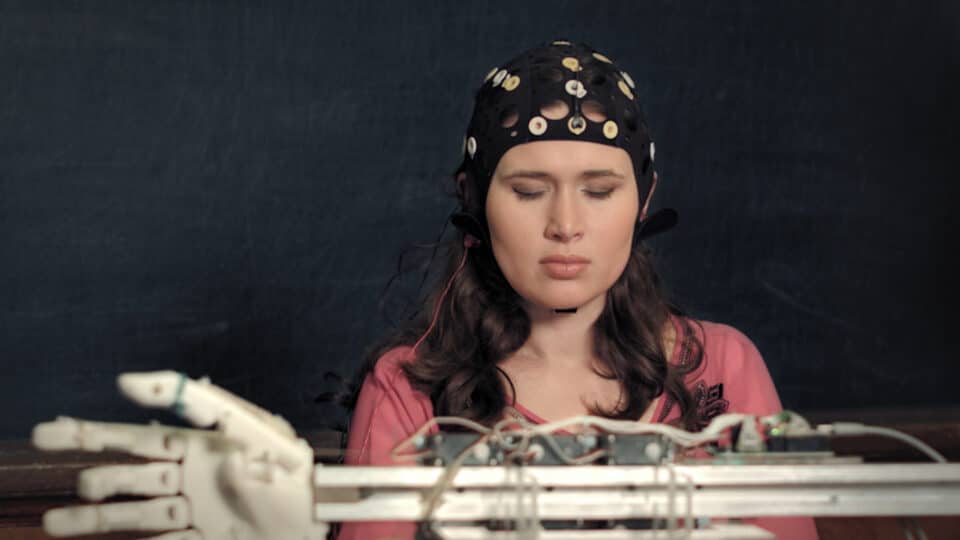
A brain-computer interface (BCI) can convert neural activity associated with an attempt to speak into text, synthetic speech and even the movements of a digital avatar. In 2026, the technology passed an important threshold: one participant with paralysis used a system at home for thousands of hours for conversations, messages, email and work, while another team showed that speech and gestures can be decoded simultaneously to control a virtual avatar.
For someone who has lost control of the muscles required for speech, the difference is substantial. Traditional assistive communication may rely on eye movements, a cursor, selecting letters or other relatively slow methods. New neuroprostheses aim to bypass the muscles and read signals directly from the brain’s motor areas while the person deliberately attempts to speak.
The wording matters: these devices do not “read all thoughts” or extract ideas at random from a person’s mind. The systems are trained to recognise neural patterns associated with intended actions, such as trying to say words or make a gesture. In current studies, participants know which task they are carrying out and actively work with the system.
What is a brain-computer interface, and how can it restore speech?
A brain-computer interface, commonly known as a BCI, creates a link between signals from the nervous system and an external device. In speech neuroprostheses, electrodes record neural activity in regions involved in controlling the tongue, lips, jaw, larynx and other structures needed for speech.
When a person with paralysis tries to say a sentence, their muscles may no longer be able to make the required movements, but the brain may still produce activity patterns associated with motor intention. Machine-learning algorithms are trained to turn those patterns into phonemes, words, text or acoustic parameters.
Depending on the system, electrodes may be placed on the surface of the cortex — electrocorticography, or ECoG — or inserted into cortical tissue as intracortical microelectrodes. More invasive implants can provide highly detailed signals, but they require neurosurgery and involve risks that must be assessed in clinical studies.
2026 advance: speech and gestures can be conveyed at the same time
On 14 September 2026, a University of California, San Francisco team led by Edward Chang published a new demonstration in Nature Neuroscience: the same electrode array was able to decode both speech and body gestures in parallel.
The study involved three participants with severe paralysis affecting the vocal tract. Two also had severe limb paralysis, while the third had moderate limb impairment. Researchers recorded cortical activity while participants attempted or imagined movements of the face, mouth, hands, arms and other body parts.
Two people then used personalised virtual avatars. The system could animate gestures including a wave and a thumbs-up while a separate decoder interpreted speech at the same time. For one participant, in a real-time copying task, the system achieved about 82% accuracy for individual gestures; in the simultaneous task, it reached about 66% for gestures and 70% for speech. In a limited conversational scenario, average accuracy was about 85% for gestures and 75% for speech.
These findings are proof of concept and do not mean that an avatar can interpret any gesture or any sentence in unrestricted conversation. The demonstration used a limited vocabulary of gestures and expressions, and the system had been trained on those categories. Still, the study shows that signals for speech and movement can be separated well enough to support multimodal communication.
Why an avatar matters more than it might seem
Human conversation is not simply a sequence of words. A smile, raised eyebrow, hand movement or change in intonation can alter the meaning of a sentence. For a person with severe paralysis, losing this non-verbal dimension can leave communication technically correct but socially much poorer.
That is why researchers are seeking to reconstruct not only text but also the user’s expressive identity. In earlier work, the UCSF team demonstrated control of a facial avatar whose lips and facial muscles moved in synchrony with decoded speech. The 2026 study extends that idea to the body and gestures.
For the full-body avatars, researchers discussed participants’ preferences for the face, body, clothing and virtual environment. This matters because a communication neuroprosthesis is not merely a technical tool; it is also an extension of how a person chooses to present themselves to others.
A man with ALS used a BCI at home for more than 3,800 hours
Another major 2026 result came from UC Davis, Brown University and Mass General Brigham. The study, published on 15 June in Nature Medicine, followed the long-term use of an intracortical interface by Casey Harrell, a participant with amyotrophic lateral sclerosis, tetraparesis and severely impaired speech.
Four arrays, comprising a total of 256 microelectrodes, were implanted in the participant’s motor cortex. The system had two main functions: a speech decoder that converted brain activity into text, and a movement decoder used to control a cursor.
Over nearly two years, the participant used the system at home for more than 3,800 hours, almost every day. According to the study, he communicated 183,060 sentences, totalling nearly 1.96 million words, at an average speed of about 56 words per minute.
In controlled tests, in which he was asked to attempt words displayed on a screen, the decoder exceeded 99% word accuracy across a 125,000-word vocabulary. During unconstrained use at home, the participant rated 92% of sentences as at least mostly correct. He used the system for messages, email, web browsing, video calls and to continue his professional work.
In the same context, see also The invisible doctor: continuous AI health monitoring and who controls your body data, which provides further relevant information.
This is among the field’s most important advances because it moves BCI use from the laboratory into a real-world setting. Demonstrating a technology for an hour in the presence of researchers is one thing; using it at home for thousands of hours without the research team present is a very different level of maturity.
The system can even reproduce the voice a person had before
Text is useful, but voice carries identity. In some recent systems, decoded words are converted into a personalised synthetic voice using recordings made before a disease severely affected the person’s speech.
In a 2025 study published in Nature, a neuroprosthesis with 256 microelectrodes implanted in the cortex of a person with ALS produced synthetic speech almost instantaneously. The system generated not only phonemic content, but could decode certain paralinguistic features, allowing changes in intonation and even the performance of short melodies.
Such results illustrate the difference between a standard speech synthesiser and an expressive neuroprosthesis. The aim is not only for the listener to understand the words, but for the user to convey rhythm, emotion, accent and personal character.
In 2025, speech was generated in 80-millisecond intervals
Latency was one of the problems facing early systems. A conversation in which every sentence appears several seconds later can become tiring and unnatural. A UCSF and UC Berkeley team reduced that delay through a continuous-synthesis system published in Nature Neuroscience in 2025.
The decoder processed neural activity in steps of about 80 milliseconds, producing a continuous audio stream. The participant — a woman who could no longer speak after a stroke — silently attempted to say sentences, and the system converted cortical signals into speech in near real time.
This matters because natural conversation depends on feedback. People hear their own voices, adjust their pace and respond quickly to the person they are speaking with. The more a BCI reduces delay, the closer communication comes to this natural loop.
It is not telepathy: what the system actually decodes
In popular language, such technologies are sometimes described as “mind reading”. That is misleading. Most of the speech systems discussed here decode attempted speech: the person deliberately tries to articulate a word or sentence, even if their muscles can no longer produce sound.
The model is trained on many examples in which researchers know which sentence a participant is trying to say. The algorithm learns the relationship between the neural pattern and linguistic units. This is very different from being able to extract any memory, opinion or unformulated inner thought.
Moreover, the systems are highly personalised. Anatomy, electrode placement and neural patterns differ from person to person. A decoder trained for one participant cannot automatically be assumed to work identically for someone else.
Why the implant remains a major barrier
The most striking speech results generally use implants. Surgery provides access to high-resolution signals, but involves risks including infection, bleeding, tissue reactions and the need for hardware maintenance.
Some current systems use connectors that pass through the skin and external cables. Such configurations are acceptable in research, but impractical for widespread clinical use. The UCSF team says the next direction is a fully implantable, wireless version.
The technology must demonstrate not only performance but also stability over years, biocompatibility and an acceptable complication rate. That is precisely why studies such as BRAVO and BrainGate2 are feasibility and safety studies, not commercial products available in every clinic.
How large is the calibration problem?
The brain and the signals being recorded are not perfectly stable. The relative position of electrodes, signal quality and neural activity can change. Earlier systems often required recalibration sessions with a technical team.
The 2026 UC Davis study is important precisely because it reduced this dependence. The transformer-based speech decoder could operate with very little or no daily calibration, and the system continued to learn and adapt throughout use.
For a BCI to become a genuine assistive device, its user cannot depend on a researcher arriving every morning to start the system. Operational independence is almost as important as accuracy.
One interface can control voice, a cursor and an avatar
The broader direction of the field is to integrate several channels of communication. In the home-use study, the participant could use activity associated with speech for text input and a movement decoder for cursor control. In the UCSF study, speech and gesture signals drove an avatar.
In the long term, the same interface could control a computer, phone, synthetic voice, avatar, smart-home devices or even robotic systems. Research published in 2025 showed that an AI “copilot” can improve brain-computer-interface performance in controlling a cursor and robotic arm, suggesting that artificial intelligence can compensate for some errors in neural signals.
InfoBuz has also examined how optogenetics enables the control of neural activity through light. BCIs take a different approach: rather than directly altering neurons for communication, they seek to interpret neural activity and turn it into external commands.
Which conditions could benefit from this technology?
The first targets are conditions in which cognition and language may remain relatively intact but control of the muscles used for speech or movement is lost. These include amyotrophic lateral sclerosis, spinal cord injuries, severe strokes, and certain forms of paralysis or locked-in syndrome.
Not everyone with these conditions is automatically a candidate for an implant. Eligibility depends on anatomy, general health, the type of impairment, surgical risks and the clinical-study protocol. Current systems are investigational, and potential benefits must be assessed individually.
Privacy and control may become the most difficult questions
As BCIs become more capable, questions arise that are not solely medical. Neural data are exceptionally sensitive. Who stores them, and for how long? Can they be used to train other models? What happens if a device is compromised digitally?
There is also the problem of errors. If a system decodes a sentence incorrectly, it is essential that the user can quickly correct the message and that there is a clear distinction between what the person intended and what the algorithm produced.
These questions will become even more important if neuroprostheses gain access to messaging, online accounts, household devices or robots. A direct brain-computer channel must be designed with security, auditing and user control built into its architecture.
Are we close to a product a doctor can prescribe?
The technology is much closer than it was a few years ago, but it is not yet a routine medical product. Studies involve very few participants and are concentrated in specialist research centres. Implantation requires neurosurgery, while the hardware and software are still being developed.
On the other hand, the demonstration of independent use for more than 3,800 hours shows that the question is no longer simply, “Can it work in a laboratory?” The focus is shifting to long-term reliability, simpler implants, manufacturing, cost, authorisation and access.
BrainGate2 and other studies continue to recruit eligible participants, and in 2026 several feasibility programmes are investigating intracortical interfaces for communication and computer control. This indicates a gradual transition from one-off demonstrations to a medical technology being evaluated systematically.
What the next five years could bring
- Wireless implants: removing external cables and reducing reliance on bulky equipment.
- More expressive speech: control over intonation, rhythm, emotion and a personalised voice.
- Complete avatars: integrating facial expressions, gestures and posture with speech.
- Less calibration: algorithms that automatically adapt to changes in neural signals.
- Full digital control: keyboard, cursor, messaging, applications and assistive devices through the same interface.
- Studies involving more participants: needed to establish how broadly the striking performance reported so far can be generalised.
A brain connected to a computer is no longer just a science-fiction demonstration
A few years ago, most BCI results were controlled demonstrations: moving a cursor in a laboratory or decoding a few words in one session. In 2026, the same category of technology can allow a person with ALS to communicate from home almost every day, write millions of words, work and use the internet.
At the same time, digital avatars are beginning to reproduce not only words but also gestures and part of the expressiveness that makes human conversation what it is. This may be the real turning point: the aim is no longer merely to obtain text from the brain, but to rebuild as complete a form of social presence as possible.
The technology remains experimental and should not be confused with unrestricted “mind reading”. But for people who know exactly what they want to say and can no longer control the muscles required for speech, the difference between an inaccessible neural signal and a voice heard by their family can be enormous.
Frequently asked questions about brain-computer interfaces
Do brain-computer interfaces read thoughts? Not in the popular sense of the term. Current systems are trained for specific activities, such as deliberately attempting to speak or move a cursor.
Can a paralysed person speak through a BCI? In clinical studies, yes. Researchers have demonstrated the conversion of neural activity into text and synthetic speech, including in long-term home use.
How fast does it work? It depends on the system. A 2025 study generated speech in 80 ms steps, while the 2026 home-use study reported an average of 56 words per minute in the participant’s communication.
Is it commercially available? Not as a routine medical product for this indication. The systems described are experimental devices being tested in clinical studies.
Is surgery required? For the systems with the strongest results described here, yes. Electrodes are surgically implanted on or in the cortex.
Can it control an avatar as well? Yes. UCSF researchers demonstrated real-time control of digital avatars through decoded speech and body gestures.
Sources and transparency
- Nature Neuroscience – Simultaneous speech and gesture decoding for multimodal communication in paralysis, 14 September 2026
- NIH – Device helps people with paralysis communicate, 7 October 2026
- Nature Medicine / PubMed – Long-term independent use of an intracortical brain-computer interface for speech and cursor control, 15 June 2026
- UC Davis Health – BCI use at home for nearly two years
- Nature – An instantaneous voice-synthesis neuroprosthesis, 2025
- Nature Neuroscience – A streaming brain-to-voice neuroprosthesis to restore naturalistic communication, 2025
- Nature – A high-performance neuroprosthesis for speech decoding and avatar control, 2023
- Nature Machine Intelligence – Brain-computer interface control with artificial intelligence copilots, 2025








Discuția cititorilor
Ai o opinie sau o întrebare despre acest articol? Spune-ne ce crezi.
Fii primul care deschide discuția.
Te rugăm să păstrezi un limbaj civilizat și să discuți la subiect. Comentariile spam sunt filtrate automat.