
Updated: 9 October 2026 la 11:29. Articolul a fost revizuit pentru a reflecta informațiile disponibile la această dată.
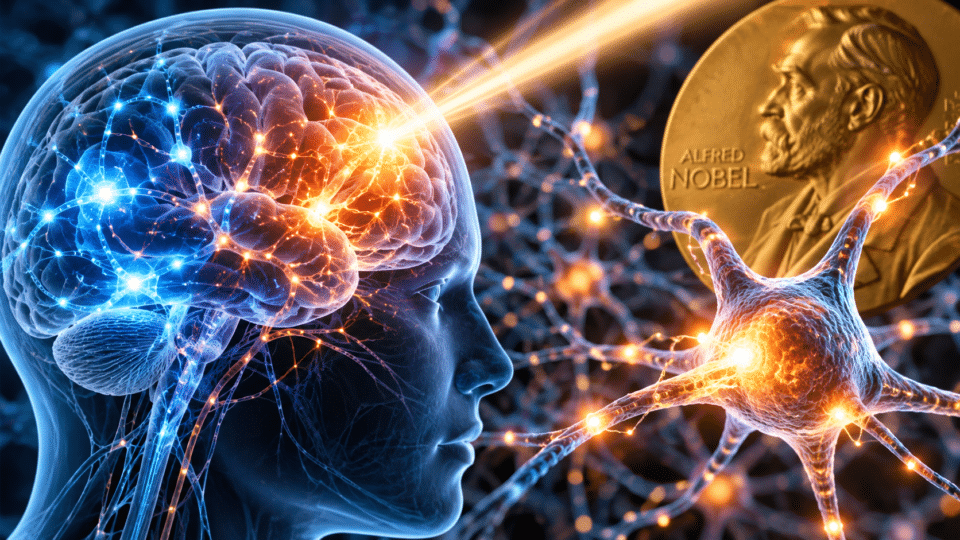
On 5 October 2026, the Nobel Prize in Physiology or Medicine was awarded to Karl Deisseroth, Peter Hegemann and Georg Nagel for discoveries concerning light-activated ion channels and optogenetics. The idea sounds like science fiction: a pulse of light can activate or inhibit neurons. In the laboratory, this is possible—but not simply by shining a light onto someone’s head.
Above all, the prize recognises a methodological shift in neuroscience. Optogenetics allows researchers to intervene in a precisely defined population of cells and observe the consequence: does a signal, movement, memory or response change? The technique can therefore help answer the difficult question of whether the activity of certain neurons merely accompanies a behaviour or actually produces it.
The European Commission and the Deutsche Forschungsgemeinschaft describe the prize as recognition for discoveries that made it possible to control cellular activity with light, with particular importance for studying the nervous system.
Optogenetics Nobel 2026: What Light Controls
Neurons communicate through electrical signals. On the membrane of every cell are proteins that control the passage of ions—electrically charged particles such as sodium, potassium and chloride. When the flow of these ions changes, the neuron’s electrical state can change as well: it may become more likely to transmit an impulse or, conversely, more difficult to activate.
At the centre of this story are channelrhodopsins, light-sensitive proteins. Hegemann and Nagel studied them in connection with Chlamydomonas, a single-celled alga that orients itself according to light. Research showed that these proteins can act as ion channels opened directly by light.
This is the crucial detail: light does not naturally “command” every neuron. Researchers must first make certain cells produce a photosensitive protein. They then deliver light, usually to a precise area and with parameters adapted to the protein being used. Opening or closing the channels changes ion flow and, consequently, the cell’s electrical activity.
“Switching on” and “switching off” are therefore useful terms for the public, but they simplify the process. The effect depends on the protein chosen, the cell type, the colour, intensity and duration of the light, and the biological circuit under study.
From Algae to Testing Cause in the Brain
Karl Deisseroth’s contribution was essential in turning this mechanism into a tool for neuroscience. If a particular population of neurons can be made sensitive to light, a researcher can activate or inhibit it at highly precise moments and track the effect.
The difference from simple observation is important. A scan, an electrical recording or a statistical correlation may show that activity in an area of the brain occurs at the same time as a behaviour. But simultaneity alone does not prove that the activity caused the behaviour.
Optogenetics offers a controlled intervention: alter the activity of a group of cells and observe what follows. Nature described this ability to test cause-and-effect relationships as one of the technology’s major contributions to brain research.
In this sense, the Nobel Prize does not reward a metaphorical “remote control for the brain”, but an experimental tool of unusual precision. It can be used to investigate the roles of cells and the connections between them in controlled biological models.
What the Method Allows Now—and What the Nobel Does Not Show
| Claim | What it means in practice |
|---|---|
| Optogenetics can activate or inhibit selected cells | In experiments, cells must express light-sensitive proteins, and light must be delivered in a controlled way to the intended target. |
| The method helps study neural circuits | Researchers can test whether changing the activity of a population of neurons produces a measurable consequence. |
| The method is relevant to the medicine of the future | This is a genuine research direction, but scientific relevance does not equate to an approved, widely available procedure. |
| The prize does not prove that a routine treatment using light exists | Statements about the prize emphasise the discovery and its research use; they do not announce a standard neurological therapy for patients. |
Why It Is Not a Routine Procedure for Patients
The distance between an elegant experiment and a safe therapy is considerable. To use optogenetics on neurons, several problems must be solved at once: safely delivering genetic instructions to the right cells, precisely controlling the expression of photosensitive proteins, getting light to the target tissue, ensuring long-term safety, and ethically and clinically evaluating the intervention.
The human brain is larger and less accessible than many experimental models. In addition, a method that produces an effect on a circuit does not automatically become a treatment: it must be shown that the effect is beneficial for the disease, reproducible, sufficiently safe, and superior or complementary to existing options.
For this reason, the responsible wording is that optogenetics may influence the future development of some medical interventions, not that the Nobel Prize certifies a cure through light. The European Commission’s communication also mentions research pursuing possible neurological applications, but these should be understood as directions for investigation, not routine medical services.
A Nobel Prize for Basic Research, Too
The story also carries a broader lesson. A question that may seem remote from medicine—how does a single-celled alga respond to light?—helped give rise to a tool that changed how brain circuits can be investigated.
The path was not the instant invention of three people, but an accumulation of discoveries about proteins, cell membranes, genes, light and the physiology of neurons. The 2026 prize brings the contributions of Deisseroth, Hegemann and Nagel to the fore, but its explanatory value lies in this bridge: from the fundamental biology of an alga to experiments able to test much more rigorously what particular nerve cells do.
The same caution is needed when reading about other spectacular results in biology: a molecule or signal detected in a laboratory is not automatically a diagnosis or treatment. For example, “organic” does not automatically mean life, just as experimental control of neurons does not automatically mean clinical control of the human brain.
Frequently Asked Questions
What Is Optogenetics?
Optogenetics is a research method that combines genetics and light. Target cells are made to produce light-sensitive proteins, and controlled illumination can alter their activity.
Can Light Control Any Neuron?
No. In the classic form of optogenetics, neurons must first express a light-sensitive protein. The effect then depends on the type of protein, the cells and how the light is applied.
Is Optogenetics an Available Treatment for Neurological Diseases?
It should not be confused with a routine treatment. The 2026 Nobel Prize primarily recognises the discovery and impact of a research method; turning experimental results into therapies requires clinical validation and regulation.
Sources Consulted
- EU-funded researcher Peter Hegemann wins 2026 Nobel Prize in Physiology or Medicine — European Commission
- DFG Congratulates Peter Hegemann and Georg Nagel on Nobel Prize in Physiology or Medicine — Deutsche Forschungsgemeinschaft
- Medicine Nobel awarded for brain ‘switch’ that controls neurons with light — Nature
- Nobel medicine prize goes to 3 scientists for shining light on brain activity — Associated Press


Discuția cititorilor
Ai o opinie sau o întrebare despre acest articol? Spune-ne ce crezi.
Fii primul care deschide discuția.
Te rugăm să păstrezi un limbaj civilizat și să discuți la subiect. Comentariile spam sunt filtrate automat.