
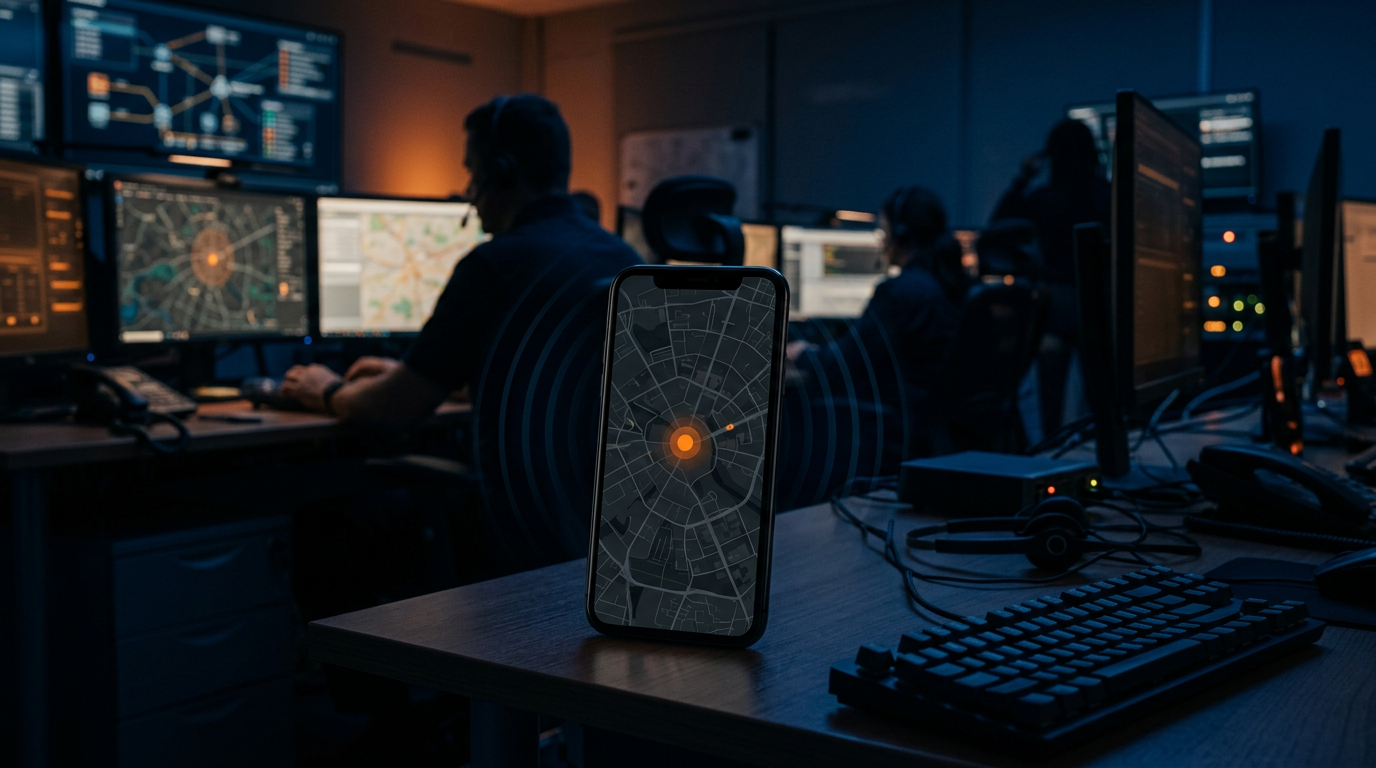
At the end of 2025, almost 90% of active mobile devices included in ANCOM’s analysis were estimated to support AML, the Advanced Mobile Location function that can send a caller’s position to 112. This is encouraging news for emergency infrastructure, but the figure has an important limitation: it does not mean that almost 90% of calls to 112 were located successfully, quickly or to within a few metres.
In brief: a phone can help an emergency dispatcher locate you, but the outcome depends on an entire chain: the phone model and software, the availability of a SIM card and signal, positioning methods, transmission of data through the network, and its reception by Romania’s Single National Emergency Call System. In a real emergency, clearly stating the address, locality, landmarks and access details remains necessary.
What ANCOM’s data show about 112 call location
The study published by ANCOM in July 2026 uses mobile operators’ reports from three points in time: December 2024, June 2025 and December 2025. It considered devices with SIM cards that can place calls to 112, excluding SIMs used solely for data. The analysis also included smartwatches able to make calls independently.
For the end of 2025, ANCOM reported that more than 90% of the devices analysed supported 4G, VoLTE and GNSS, the satellite positioning system used by phones. Almost half supported 5G. The estimated share supporting AML was almost 90%.
The figures come from ANCOM’s statistical study on the capabilities of mobile devices for calling 112. The authority says it standardised and checked the data received from operators, and that some degree of error is possible. In particular, AML support was estimated from operating-system versions and information reported by operators.
The percentage therefore describes the estimated capability of active devices. It is neither an individual test of every phone nor a statistic on how many real calls sent coordinates to 112.
From a phone’s position to the dispatcher’s screen: four distinct stages
The word “locate” conceals several operations. They should not be treated as one and the same.
| Stage | What may happen | What may limit it |
|---|---|---|
| Device capability | The phone has hardware and software compatible with GNSS, 4G, VoLTE or AML. | An older model, out-of-date software or an incompatible configuration. |
| Position calculation | The phone may combine GNSS signals, Wi-Fi, the mobile network and sensors. | Indoors or in basements, terrain, weak signal or dense urban environments. |
| Position transmission | Location data may reach the emergency system through AML or communications infrastructure. | No active SIM, lack of the required connectivity, roaming or a critically low battery. |
| Operational use | The 112 dispatcher uses the data alongside the conversation with the caller and network information. | A coordinate does not automatically identify a floor, flat, entrance or access route for responders. |
AML, short for Advanced Mobile Location, is the mechanism intended to turn a position calculated by a phone into information sent to the emergency system during a call. The technical page of Romania’s Special Telecommunications Service (STS) explains that location may combine GNSS/AGPS, Wi-Fi, the mobile network and device sensors. STS also stresses that the available methods are complementary, not infallible.
The distinction matters in practice: a phone may have GNSS and “know” roughly where it is, without that position necessarily being transmitted or received in the same form in every emergency call.
A phone without 5G can still send a useful position
5G is not a simple test of whether a phone is “good for 112”. ANCOM’s study explicitly states that 112 calls are not yet generated over 5G. In the authority’s analysis, 5G support is primarily an indicator of how modern a device is and of its data capability, not proof that an emergency call is carried on 5G radio access.
4G and VoLTE are more relevant to the call path. VoLTE carries a call over IP, and ANCOM links this development to faster transmission of information needed for location. The technical framework adopted through ANCOM Decision No. 332/2024 sets obligations for providers concerning the transmission of calls and location information to the 112 system.
A 4G phone without 5G is therefore not, in itself, at a disadvantage when locating a 112 call. Conversely, a new 5G phone does not automatically provide a perfect coordinate if it is in a basement, has no working connectivity, or is in a situation where the AML flow cannot transmit data.
For context, 5G coverage and adoption in Romania are different indicators from the way an emergency call is handled.
What remains available when AML does not work
Network-based location does not disappear when AML is unavailable. ANCOM’s rules require mobile providers to transmit primary location information for 112 calls, regardless of the type of network or device. This includes, among other things, the network cell identifier and, where available, the sector identifier.
Cell ID or Sector ID can give a dispatcher an area associated with mobile infrastructure, but they are not equivalent to coordinates obtained by a phone from several sources. Their usefulness varies with the density of antenna sites and the caller’s location. It is therefore wrong both to regard an older phone as “useless” and to treat AML as a substitute for speaking with the dispatcher.
There is also the “Apel 112” app, but it is a separate solution from AML. ANCOM says the app requires location to be enabled on the phone and requires a data service. Installing it is not a condition for the AML mechanism built into the phone and network.
For more information on digital safety, see also Stolen Android phone: what can lock it automatically, what you can locate without internet and the right order of steps, which provides complementary details on this subject.
Conditions that can make a difference in an emergency
The STS page on AML, which describes published implementation conditions for Android and iPhone, identifies several relevant factors: an active SIM, functioning services, access to SMS and/or the internet as applicable, available GPS and Wi-Fi functions, and restrictions connected with airplane mode or a critically low battery. For iPhone, the page mentions conditions relating to the iOS version, a compatible network and access to SMS.
These should be read as operational explanations, not as a list of guarantees for every model active in 2026. The STS page contains implementation information that may change with phones, operating systems and networks. Google’s documentation on Emergency Location Service confirms at Android platform level that the service can automatically send location to emergency services when a call or text is made to a supported emergency number, depending on region and configuration.
Roaming warrants particular attention. The European Commission’s report on 112, published on 18 December 2024, treats emergency-system compatibility with AML and the availability of phone-derived location for roaming users separately. By September 2024, only eight countries had confirmed such availability while roaming. This is not a measurement for Romania, but it shows why the presence of the feature on a phone does not automatically resolve cross-border situations.
What to tell 112 even if your phone appears to locate you
In an emergency, automatic data can save time, but it should not replace verbal information. First say what happened and where you are: the locality, street, number, floor or flat, a nearby landmark and, where relevant, difficult access for an ambulance, firefighters or police.
- Do not end the call to try to turn on GPS or an app if the dispatcher is asking you questions.
- If you do not know the address, give observable landmarks: a road, intersection, direction of travel, route, building or nearby point of interest.
- If you are in a large building, specify the entrance, level and any information that can guide responders after they arrive.
- If it is safe to do so, keep the phone charged and available in case of a return call.
ANCOM’s data are useful because they point to a better technical baseline among devices used in Romania. Their limitation is equally important: the study contains no public national rate for calls in which AML actually reached the 112 system, with a given delay and a given location error. Until such operational results are published, the accurate formulation remains conditional: a phone can make a significant contribution to locating a caller, but cannot by itself promise the exact location of every person.
Frequently asked questions
Do ANCOM’s data mean that 90% of calls to 112 are automatically located?
No. The figures concern the share of active devices analysed and estimated to support AML at the end of 2025. The study does not publish a rate for real calls in which coordinates were successfully received by the 112 system.
Do I need 5G for my phone to help locate a 112 call?
No. ANCOM states that 112 calls are not yet generated over 5G. For the emergency flow, phone compatibility, 4G/VoLTE where available, GNSS, AML and actual connectivity are more relevant.
Is the Apel 112 app required for AML location?
No. The Apel 112 app and AML are distinct mechanisms. The app uses data and enabled location, while AML is a function that may be integrated into the phone and the emergency-call flow.
If my phone sends coordinates, do I still need to give the address?
Yes. Coordinates may be incomplete or insufficiently precise, and do not automatically indicate the floor, flat, entrance or correct access route. Give the address and landmarks as clearly as possible.
Sources consulted
- ANCOM – Statistical study on certain technical capabilities of mobile devices used in Romania from the perspective of calling the 112 service, June 2026
- STS / CNCPIC – AML location, active for emergency calls
- ANCOM Decision No. 332 of 25 June 2024
- European Commission – 2024 Report on the implementation of the EU emergency number 112
- Google – Emergency Location Service on Android








Discuția cititorilor
Ai o opinie sau o întrebare despre acest articol? Spune-ne ce crezi.
Fii primul care deschide discuția.
Te rugăm să păstrezi un limbaj civilizat și să discuți la subiect. Comentariile spam sunt filtrate automat.