
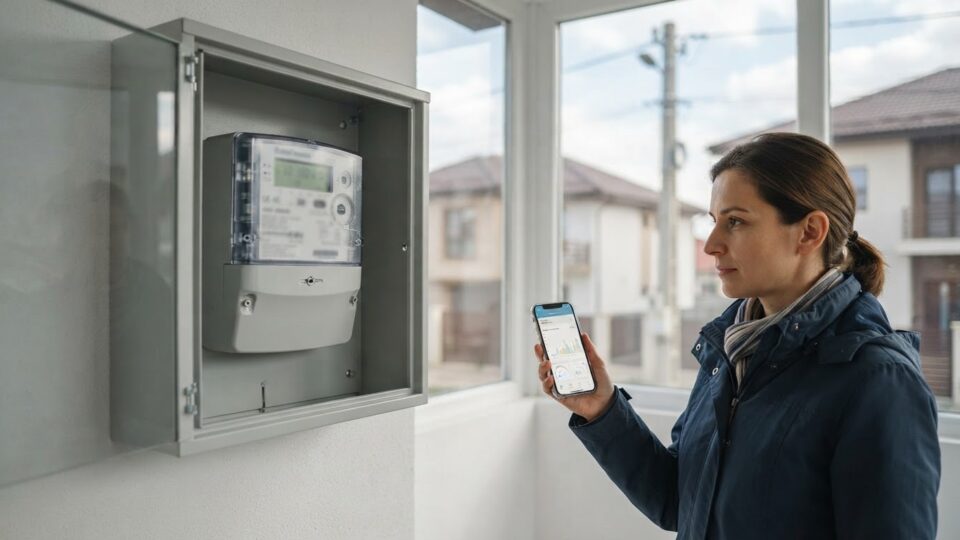
Smart meters will become part of daily life for millions of Romanian consumers over the next two years. On 26 November 2026, the National Energy Regulatory Authority (ANRE) approved an update to the national timetable for rolling out smart metering systems. The goal is for 70% of Romania’s consumption points to be integrated into these systems by 31 December 2028.
Dobrogea has the most ambitious regional target, at 86%. For residents of Constanța, Tulcea, Călărași and Ialomița counties, the change could mean more than no longer having to submit meter readings every month: access to consumption history, bills that are easier to check, and the option of supply contracts with dynamic pricing. The device does not automatically lower a bill, however, nor does it guarantee that every address will be upgraded by the same date.
Smart meters in Romania: the approved 2027–2028 timetable
According to ANRE’s official statement of 26 November 2026, distribution system operators have committed to integrating an additional 3,357,815 consumption points in 2027 and 2028. At the end of 2025, 3,578,830 users had already been integrated, representing 34.54% of all consumption points at that time.
| Period | Indicator | Value |
|---|---|---|
| 31 December 2025 | Integrated users, reported position | 3,578,830 (34.54%) |
| 2027 | Planned additional integrations | 1,361,182 |
| 2028 | Planned additional integrations | 1,996,633 |
| Total, 2027–2028 | Committed additional integrations | 3,357,815 |
| 31 December 2028 | National coverage target | 70% |
About 59.5% of the integrations planned for the two years are concentrated in 2028. The annual volume scheduled for 2028 is almost 46.7% higher than that for 2027. The final year of the timetable will therefore be decisive in meeting the target. The exact number of functioning meters at the end of the period cannot be calculated simply by adding the figure reported in 2025 to the integrations scheduled for 2027–2028: complete results for 2026 are unavailable, and the total number of consumption points may change.
Dobrogea leads the national timetable: what the 86% target means
Targets set for the eight concession areas range from 52% to 86%. The highest levels are planned for the three areas operated by Rețele Electrice Romania.
| Area or reference point | Target by the end of 2028 |
|---|---|
| Rețele Electrice Dobrogea | 86% |
| Rețele Electrice Muntenia | 81% |
| Rețele Electrice Banat | 80% |
| Romania | 70% |
| Lowest announced area target | 52% |
The 16-percentage-point gap between Dobrogea and the national target reflects regional planning, not a guarantee for every locality. By the end of 2025, Dobrogea had exceeded the number of integrations set out in its cumulative plan by 10%. That performance of 110% of plan does not mean that more than 100% of homes already had smart meters. The indicator measures delivery against an interim target.
Rețele Electrice has published its installation map and timetables for 2027–2028, including a file specifically for the Dobrogea area. Its published 2026 list includes Constanța, Medgidia and Năvodari in Constanța County, as well as Măcin, Ostrov and Tulcea in Tulcea County. For 2027–2028, residents need to consult the regional timetable and obtain confirmation from the distribution operator to establish whether an address is included. A locality appearing in a programme does not mean installations will take place simultaneously at all its properties.
An electronic meter is not necessarily a functioning smart meter
The key distinction is not the appearance of the display, but integration into the distribution operator’s communications system. An electronic meter may show a reading digitally without the operator being able to receive its data automatically. A device integrated into a smart metering system communicates measurement information to the operator’s infrastructure, within the limits of its configured functions.
In the Rețele Electrice network, one of the solutions used is PLC communication, which runs through the network’s conductors to a concentrator and then to central systems. Other deployments may use different technologies. Consumers should not assume that every meter uses their home Wi-Fi or that the device is directly connected to their phone. Details on metering and remote reading are available on the distribution operator’s official page.
| Feature | Conventional meter | Meter integrated into a smart metering system |
|---|---|---|
| Cumulative reading | Available | Available |
| Remote reading | No, under the traditional model | Yes, when communications are working |
| Consumption profile over time | Generally unavailable to the customer | Possible, depending on configuration |
| Dynamic-price contracts | Not without suitable metering | Possible, if contractual conditions are met |
| Reporting of network events | Limited | Possible, according to system functions |
Electricity bills: what changes and what does not
The main advantage is reduced reliance on manual readings and estimated consumption. When measured data are collected, validated and sent to the supplier, it can bill for actual consumption during the period. A consumer who uses little energy in a given month should not, under normal remote-reading conditions, receive a bill based on a much higher estimate and later be issued a correction.
Automatic reading does not rule out communications incidents, delays in data validation or bill corrections. If a bill shows an estimate after the device has been installed, check whether the consumption point has actually been integrated into the smart metering system and whether the billing period predates activation. Where there are discrepancies, request the reading history and an explanation of the calculation method.
Installing a meter does not in itself change the contractual energy price, regulated distribution tariffs, taxes or other bill components. A direct financial benefit arises when a customer uses energy more efficiently or chooses a contract that makes use of their actual consumption profile.
How much could a dynamic energy-pricing contract save?
In its list of consumer rights, ANRE says that a customer with a smart metering system may enter into dynamic-price contracts under the legal conditions. The supplier must explain the risks and benefits of such a contract. Dynamic pricing should not be confused with a fixed day/night tariff: in the first case, the variable component follows the market mechanism set out in the contract, while in the second, rates are set for defined time bands.
InfoBuz has prepared the following illustrative example to show how much the timing of consumption matters. It assumes monthly consumption of 200 kWh, a fixed final rate of 1.20 lei/kWh, and a hypothetical two-band offer at 0.90 and 1.50 lei/kWh. These figures are not supplier offers and simplify the structure of a bill; they do not include any fixed subscription charges.
| Monthly scenario | Lower-priced consumption | Higher-priced consumption | Calculated cost | Difference from fixed rate |
|---|---|---|---|---|
| Fixed rate | 200 kWh × 1.20 lei | 240 lei | — | |
| Flexible consumption | 140 kWh | 60 kWh | 216 lei | −24 lei (−10%) |
| Balanced consumption | 100 kWh | 100 kWh | 240 lei | 0 lei |
| Predominantly higher-priced consumption | 60 kWh | 140 kWh | 264 lei | +24 lei (+10%) |
In the example above, shifting 40 kWh from the higher-priced to the lower-priced band saves 24 lei without reducing total consumption. A dynamic contract may interest owners of an electric vehicle, heat pump or battery set up to optimise consumption. For a household that uses electricity almost exclusively at peak times and cannot change its schedule, the result may be the reverse. Dynamic prices should be assessed against a representative consumption history, not merely the cheapest hour on a single day.
How to check actual consumption and identify hidden loads
Instantaneous power is measured in kW, while accumulated energy is measured in kWh. A device that continuously draws 1 kW for two hours uses 2 kWh. If you can access a load profile, you can identify periods when consumption rises for no obvious reason and compare nights, working days and weekends.
An additional constant load of 25 W means 0.025 kW × 24 hours × 30 days, or 18 kWh per month. At the hypothetical price of 1.20 lei/kWh, that costs 21.60 lei a month. Before switching off equipment, check its role: refrigerators, alarms, medical devices and safety equipment need a power supply. Compatible appliances can be measured with a suitable plug-in wattmeter, without work on the electrical panel or sealed meter. See also InfoBuz’s analysis of standby consumption.
For active contracts, ANRE’s new rules on digitising the supplier–customer relationship provide for a free online account from 1 October 2026. The data available depend on the metering system, and use of the account is optional. See ANRE’s official information and the guide to notifications at 80% of estimated consumption.
What the 1.8.0 and 2.8.0 codes mean for prosumers
For a prosumer, bidirectional metering and data validated by the distribution operator are essential. OBIS code 1.8.0 normally indicates total active energy imported from the grid, while 2.8.0 indicates total active energy exported to the grid. Confirm their meaning in the documentation for the meter model and in the operator’s instructions on meter readings.
| Register | Opening reading | Closing reading | Difference |
|---|---|---|---|
| 1.8.0 – import | 12,540 kWh | 12,760 kWh | 220 kWh |
| 2.8.0 – export | 8,120 kWh | 8,470 kWh | 350 kWh |
The 130 kWh difference between exports and imports does not represent the solar panels’ total output, nor is it equivalent to a credit of 130 lei. Some output may be used instantly in the home or through a storage system, without passing through the connection meter as exported energy. Billing and settlement are carried out according to the applicable mechanism and contractual prices. The new compensation rules are explained in InfoBuz’s analysis of ANRE Order No. 67/2026.
Who pays for installation and how to check the schedule
The distribution operator manages metering equipment and works under its modernisation programme; the supplier sells the electricity and issues the bill. For example, Delgaz Grid states that smart-meter installation under its programme creates no additional direct cost for the customer. Infrastructure investment costs may be covered through regulated distribution mechanisms and non-repayable funding. Works requested separately, such as relocating a meter, may be subject to different terms and charges.
For a scheduled installation, identify the distribution operator and the POD code on the electricity bill, check the area list and ask for confirmation of the address’s status. On the day of the work, check the installation team’s identification, ask for the final reading on the old device and the new meter’s data to be recorded, then monitor the first bill issued. Do not independently buy a device to replace the distribution operator’s meter, and do not accept unjustified requests for payment or bank details from people presenting themselves as installers.
More digitisation, but also responsibility for data protection
Detailed consumption profiles can reveal clues about a household’s daily routine. For that reason, access to personal data and metering information must be protected. Use unique passwords for supplier and distribution-operator accounts, check recipients when authorising access to your history, and avoid publishing photos of bills containing identifying information.
Some meters allow remote operations, including disconnection and reconnection, subject to applicable technical and legal conditions. This capability does not remove consumer rights or authorise arbitrary interruption of supply. In the event of an outage, consult information from the distribution operator and supplier without breaking seals or interfering with electrical equipment.
What happens through 2028 and why European funding matters
ANRE will monitor delivery of the investments, and departures from imposed obligations may result in sanctions under the law. The Modernisation Fund may help accelerate the programmes. The effectiveness of the investment, however, depends not only on the number of installed devices but also on communications quality, data availability, system interoperability and their use by customers and operators. Digitisation can help identify faults and plan networks, but it does not replace the physical investment needed in cables, transformers and distribution capacity.
Frequently asked questions about smart meters
Will all Romanians have smart meters by the end of 2028?
No, not under the updated timetable. The national target is 70% of consumption points, with regional differences.
Do I still need to submit a meter reading?
Under normal conditions with active remote reading, no. If the device has not yet been integrated or there are communications problems, check the supplier’s instructions.
Does a smart meter automatically reduce the bill?
No. It provides more detailed measurement and information; any saving depends on consumption and the contract.
The real change: from estimates to usable data
For Romanian consumers, the 2027–2028 timetable raises the prospect of more transparent bills and better control over costs. Dobrogea has a target above the national average, but each consumption point must be checked individually. The real value of the modernisation will be measured not only by the number of meters installed, but by whether remote reading works, the quality of billing and consumers’ ability to make informed decisions.
InfoBuz editorial analysis, documented on 28 November 2026. National data come from ANRE’s statement, while cost calculations are in-house simulations using hypothetical tariffs. The timetable is not a promise of installation at any specific address. The main image is an illustration generated with artificial intelligence.


Discuția cititorilor
Ai o opinie sau o întrebare despre acest articol? Spune-ne ce crezi.
Fii primul care deschide discuția.
Te rugăm să păstrezi un limbaj civilizat și să discuți la subiect. Comentariile spam sunt filtrate automat.