
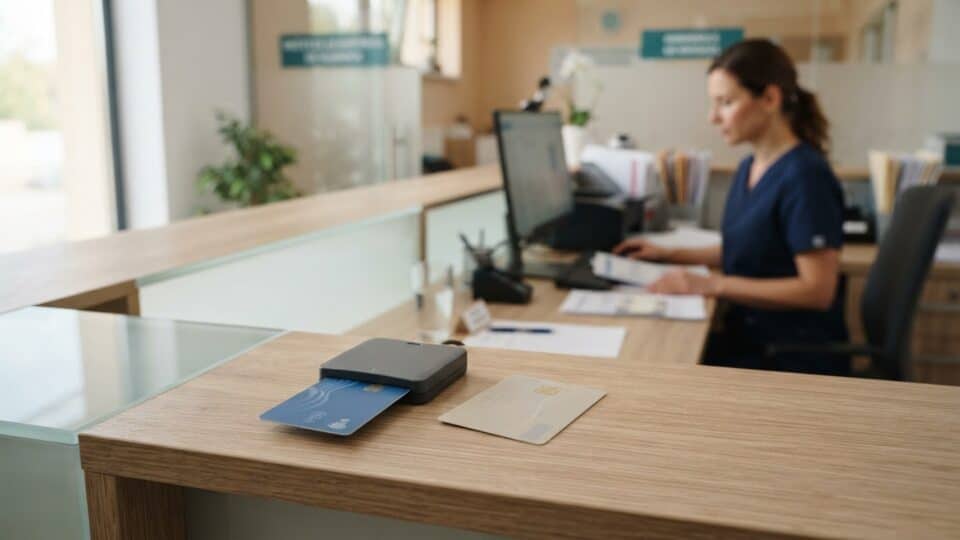
Romania’s national health insurance card is at the centre of an important change to the country’s healthcare system. The electronic identity card (CEI) is intended to take over the role of authenticating patients and confirming medical services, but implementation is not yet uniform. On 27 November 2026, the National Health Insurance House (CNAS) said it was working to fix problems in the health-card IT component and make it compatible with electronic identity documents.
The change was publicly presented with 1 December 2026 as a reference date, but the latest technical information calls for caution. Patients should not throw away their existing card, urgently replace their identity document, or postpone appointments simply because the system is in transition. This guide distinguishes between temporary rules, the legislative bill adopted by Parliament, and functions that still need to be implemented in doctors’ offices, hospitals and pharmacies.
Health insurance card: what CNAS announced on 27 November
In an official statement distributed by Agerpres, CNAS confirmed interventions affecting the CEAS component, the national health insurance card system. They are intended both to stabilise the system and to integrate the healthcare functionality of the CEI. Software providers are due to receive information on the updated development kit needed to adapt their applications. The institution said that measures ensuring continuity of services and reimbursements remain applicable during the work.
In practical terms, a technical problem with a card reader or platform does not automatically mean that an insured patient loses their entitlements. The rules governing referrals, eligibility for a service, a provider’s contractual relationship with the health insurance fund, and other conditions for receiving care nevertheless remain relevant. A practice must follow CNAS procedures for the specific situation; it cannot assume that every service becomes free merely because the system is unavailable.
At the beginning of November, CNAS had temporarily kept the IT rule concerning the absence of a card-based signature disabled until 30 November. The information was reported by TVR on 5 November. The more recent statement of 27 November sets no new, specific date for restoring normal parameters. The rules applying after 30 November should therefore be followed through official updates, without automatically extending this temporary exception to all of 2027.
Digitalisation timeline: what is confirmed and what remains a target
| Date | Development | Status |
|---|---|---|
| 31 August 2026 | Publication of specifications for adapting CEAS/CEI applications | Official CNAS announcement |
| October–November 2026 | System adaptations and temporary continuity measures | Confirmed through CNAS updates |
| 18 November 2026 | Adoption of bill L496/2026 by the Chamber of Deputies | Parliamentary stage |
| 23 November 2026 | Bill presented in Parliament for the exercise of the right to refer it to the Constitutional Court | Stage before promulgation |
| 27 November 2026 | Interventions affecting CEAS and CEI compatibility work | Official statement |
| 1 December 2026 | Publicly announced reference date for using the CEI at medical appointments | Widespread implementation is not confirmed |
| January–summer 2027 | Announced transition for electronic medical documents | Timeline communicated by CNAS leadership |
| 31 December 2027 | Deadline for the alternative use of documents, provided for by the legislative bill | Conditional on the law entering into force |
In a TVR report of 23 November, 1 December was presented as the date on which the electronic identity document could be used instead of the health card. Subsequent technical statements, however, show that systems require intervention. The verified sources provide neither a schedule for each provider nor confirmation that every practice will be ready at the same time. A launch target is not the same as universal service availability.
What the law says about the electronic ID and national health card
Integrating electronic identity into healthcare has had a legal basis since before 2026. Article 338 of Law No. 95/2006 was amended by Law No. 162/2020 to allow the CEI to be used in the health insurance system. The current difficulty is aligning that rule with a technical transition in which patients and providers do not have the same equipment.
The version of bill L496/2026 adopted by the Chamber of Deputies on 18 November introduces a derogation until the end of 2027: the two documents could be used alternatively for authentication and validation. The text also provides for joint technical rules from the Ministry of Internal Affairs and CNAS, as well as 90-day deadlines for issuing the relevant orders after the law enters into force.
The bill seeks to make electronic verification of insurance status a routine procedure. Electronic proof would include the time of verification, the result, the operation identifier and data needed for identification, without information about a person’s health status. Requests for certificates would be limited where status can be verified digitally, while retaining exceptions for system unavailability and other cases set out in the text.
These provisions should not be presented as obligations already in force. The official record of initiative L496/2026 shows that it remains at the parliamentary stage before promulgation. At the time this article was researched, no publication of the law in the Official Gazette had been identified. Until the procedure is complete and the rules are published, CNAS must confirm the exact procedure for switching between documents in each patient’s case.
Electronic ID, simple ID and health card: what is the difference?
The widely used expression “new ID card” can refer to two different documents. The CEI includes electronic components and allows digital authentication. The simple identity card (CIS) is also a modern-format identity document, but does not contain the chip required for those functions. Both are used for identification, but they do not offer the same IT capabilities.
| Document | Main role | What to remember at a medical appointment |
|---|---|---|
| National health insurance card (CEAS) | Confirmation of services in the social health insurance system | Keep the document; check its status if you have received a CEI. |
| Electronic identity card (CEI) | Identification and digital functions | Its use in healthcare depends on system compatibility and the applicable rules. |
| Simple identity card (CIS) | Identification within Romania | It has no chip and cannot replace the electronic function of the CEAS. |
| 1997-model identity card | Identification until its legal expiry date | It does not need to be replaced solely to access medical services. |
| European Health Insurance Card | Access to necessary care during temporary stays in covered states | A separate document governed by its own rules. |
Identity and health insurance are different matters. An identity document establishes the holder’s identity, whereas insured status follows from the conditions set by health legislation. Obtaining a CEI does not automatically activate insurance, independently change entitlement to subsidised medicines, or guarantee reimbursement for every requested service. If someone is not correctly registered in CNAS records, that issue must be resolved separately.
Practical guide: which documents to take to a medical appointment during the transition
| Patient’s situation | Practical recommendation |
|---|---|
| You have an older identity card and a health insurance card | Keep and take your existing documents. There is no need to obtain a CEI urgently solely for an appointment. |
| You have received an electronic identity card | Ask the provider whether its application accepts the CEI, and check the status of the old card with the health insurance fund before giving it up. |
| The card is lost or damaged | Contact the health insurance fund for the applicable solution and, if necessary, a replacement certificate and duplicate card. |
| You have not been issued a card | Ask for your insurance status to be checked; the absence of a card that has not yet been issued does not remove entitlement to the corresponding services. |
| The IT system is not working | Ask for the CNAS continuity procedure to be applied and keep your medical documents. |
| You have a medical emergency | Do not delay seeking emergency care because of the card or electronic identity document. |
The official SIUI service can be used to check insurance status. Use only the official website and enter the required information in private conditions. If the result does not match your situation, contact the health insurance fund with the relevant supporting documents. An incorrect display may have administrative or technical causes and does not, on its own, establish a person’s final legal position.
Two PIN codes: what they mean and how to protect your digital identity
According to the Ministry of Internal Affairs’ instructions on CEI codes, activating the electronic document involves choosing a four-digit PIN for authentication and a six-digit PIN for electronically signing documents. These functions are distinct. The technical procedure through which a medical application uses the CEI must comply with CNAS specifications; it does not automatically require both codes at every appointment.
The security rule is straightforward: do not share the codes by phone, text message, email or forms received through unverified links. Do not photograph both sides of the document for purported card updates requested by unknown people. When you need to confirm an operation electronically, check the stated purpose and enter your personal code under the conditions indicated by the authorised provider. Do not confuse confirmation of an appointment that was actually provided with signing administrative documents unrelated to it.
The Ministry of Internal Affairs portal also explains reactivation procedures when electronic functions are blocked. If the document is lost or stolen, the competent authorities should be notified promptly. Keeping the codes separate from the card reduces the risk of unauthorised use. For appointments and medicines, ask the provider what alternative it can use until reactivation is completed.
Electronic prescriptions, referrals and appointments in 2027
In statements made on 23 November, CNAS leadership outlined a transition period running from the beginning of 2027 until the summer for electronic medical documents. The aim is for the issuance and use of referrals, prescriptions and medical letters to be traceable in the system, reducing dependence on printed forms. Some electronic workflows already exist; modernising them does not mean that every paper document will disappear at once.
On 27 November, another CNAS statement announced documentation for integrating providers’ appointment systems with e-HealthaMea. Once an effective connection is made, appointments may be synchronised between the portal and a clinic’s system, including when booked by phone or at reception. The aim is to prevent two people from reserving the same time slot. The documentation is available on the CNAS technical portal.
The publication of specifications does not demonstrate, however, that all clinics are already connected. Patients should check the actual availability of slots and keep their booking confirmation. A medical consultation and the assessment needed to issue a document are not replaced simply by the existence of an application. See also InfoBuz’s analysis of appointments through e-HealthaMea.
Who could save time, and what should be measured after implementation
Digitalisation could reduce repetitive tasks and administrative travel. For example, if 100 patients each avoid one 30-minute trip per month solely for a formality that can be completed online, the collective saving is 50 hours. If a practice handles 30 administrative operations a day and each takes one minute less, it would save 30 minutes daily. These are simulations, not results measured by CNAS.
Assessing the reform will require data on average validation time, the proportion of providers compatible with the CEI, error rates, appointments actually made through the portal, and time lost by patients when the system is unavailable. A digital public service must also work for people without a smartphone or permanent internet access. Counter services and continuity procedures are essential, especially in localities with few medical providers.
The national card is not the European card, nor is it a complete medical record
Using the CEI at a medical appointment does not automatically mean that a person’s entire medical history is stored on the identity-document chip, nor does it remove confidentiality rules. Authentication provides a way of confirming identity; access to medical information must take place through legally established systems and access rights. For healthcare during travel, the European Health Insurance Card remains a separate tool. Read the InfoBuz guide to the European Health Insurance Card and its analysis of the European Health Data Space.
Frequently asked questions
Must I obtain an electronic ID from 1 December?
The verified information does not establish a general obligation to obtain a CEI solely in order to receive medical services. Valid documents and insurance status must be treated separately.
Can I use both cards after obtaining a CEI?
The bill adopted by Parliament provides for alternative use until the end of 2027, but its entry into force and technical implementation must be confirmed. For the status of your document, consult CNAS or your health insurance fund.
If the doctor’s application cannot read the CEI, do I have to pay for the appointment?
Not automatically. Technical problems alone do not justify losing access to services for which you are eligible. The provider must apply the procedures in force; eligibility and reimbursement rules remain separate issues.
One digital identity, but a transition that must be managed properly
The CEI may simplify access to healthcare, and digital verification may reduce bureaucracy. The benefits will be real when doctors’ offices, pharmacies and platforms work consistently, without patients bearing the consequences of technical errors. Until then, keep existing documents, check official information and do not postpone necessary care because of the IT transition.
InfoBuz editorial analysis, updated on 29 November 2026. Universal operational availability on 1 December, or publication of initiative L496/2026 in the Official Gazette, had not been confirmed. The timeline and technical rules may change. This material does not replace CNAS instructions for an individual case. The image is an AI editorial illustration using fictional documents.


Discuția cititorilor
Ai o opinie sau o întrebare despre acest articol? Spune-ne ce crezi.
Fii primul care deschide discuția.
Te rugăm să păstrezi un limbaj civilizat și să discuți la subiect. Comentariile spam sunt filtrate automat.