
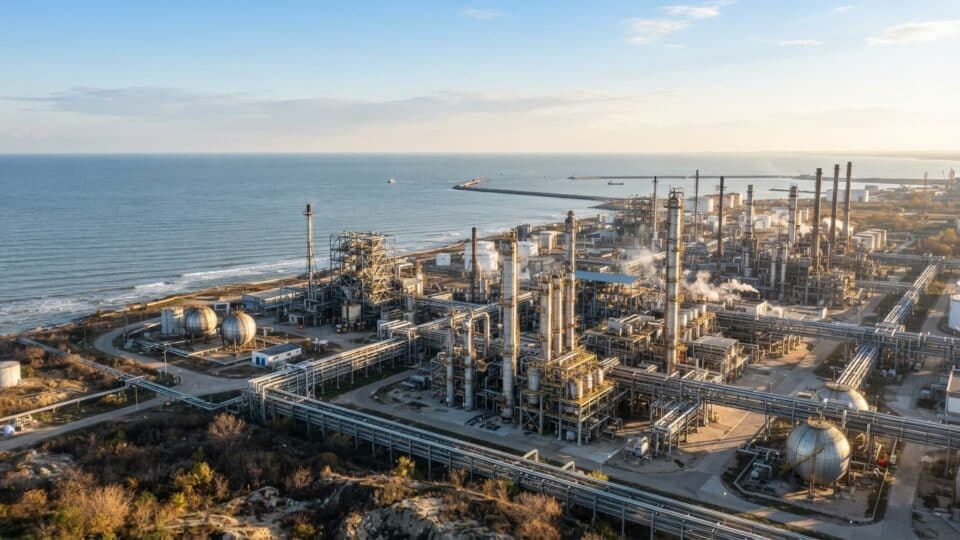
The Petromidia refinery in Năvodari is at the centre of a major financial shift for Romania’s energy industry. On 27 November 2026, Rompetrol Rafinare reported a consolidated net profit of USD 185.65 million for the first nine months of the year, after a USD 20.65 million loss in the comparable period of 2025. The improvement exceeds USD 206 million, even though Petromidia processed a lower volume of feedstock than a year earlier.
The recovery has implications for fuel supplies, public revenues, industrial investment and the activity of service providers in Dobrogea, the south-eastern Romanian region on the Black Sea coast. However, the consolidated result is not the standalone profit of the Petromidia refinery, and one favourable year does not remove vulnerabilities accumulated in previous years. InfoBuz examines the economic mechanisms behind the figures and what to watch in 2027.
Petromidia and Rompetrol Rafinare’s results: from loss to profit
The filing published on the Bucharest Stock Exchange on 27 November sets out unaudited interim consolidated results prepared under IFRS. The reporting scope includes the parent company and its subsidiaries in distribution, logistics, petrochemicals and services. The indicators below should therefore be interpreted at the consolidated Rompetrol Rafinare level.
| Indicator (USD million) | 9M 2025 | 9M 2026 | Difference |
|---|---|---|---|
| Gross turnover | 4,443.76 | 5,791.71 | +1,347.95 |
| Net turnover | 3,223.49 | 4,245.43 | +1,021.94 |
| EBITDA | 175.04 | 347.33 | +172.30 |
| Operating profit (EBIT) | 82.97 | 242.30 | +159.33 |
| Net result | −20.65 | 185.65 | +206.30 |
Gross turnover rose by about 30%, while EBITDA increased by 98%. The EBITDA margin against net turnover rose from 5.4% to 8.2%. For an industrial company with costly assets, the difference between EBITDA and net profit matters: equipment depreciation, financing costs and taxes reduce the final result available at the end of the period.
The third quarter made a notable contribution. Consolidated net profit was USD 145.23 million in July–September, compared with USD 32.54 million in the same quarter of 2025. About 78% of cumulative profit in 2026 was generated during those three months. This pattern means that mechanically extrapolating recent performance to the whole of 2027 would be risky. A refinery can report very different quarters even when its installations are operating under comparable conditions.
Why a refinery can earn more while processing less
The economic value of refining does not depend solely on the tonnes of crude entering the installations. It also depends on the gap between feedstock costs and the value of the resulting products, the product mix, and energy and logistics costs. Higher volumes may have only a modest effect when margins are very thin; conversely, lower volumes can produce a better result in favourable market conditions.
In its detailed third-quarter financial report, Rompetrol Rafinare presents Petromidia’s refining indicators and the combined financial results of Petromidia and Vega. Margin trends explain a substantial part of the change.
| Indicator | 9M 2025 | 9M 2026 |
|---|---|---|
| Feedstock processed at Petromidia | 4.330 million tonnes | 4.087 million tonnes |
| Petromidia gross margin | USD 82.7/tonne | USD 146.5/tonne |
| Petromidia net margin | USD 39.3/tonne | USD 88.5/tonne |
| Refining-segment EBITDA | USD 150.62 million | USD 352.99 million |
| Refining-segment net result | −USD 7.71 million | USD 250.45 million |
The volume processed at Petromidia fell by 5.6%, while the net margin per tonne increased by about 125%. The difference is USD 49.2 for every tonne in the calculation base used by the company. The indicator is determined by relating EBITDA to sales volume, and should therefore not be mechanically multiplied by all feedstock processed to reconstruct accounting profit.
A simplified example illustrates the sensitivity of industrial activity on this scale: for one million tonnes sold, a USD 10-per-tonne change in operating margin would equal USD 10 million at the operating-indicator level, if volume and all other conditions remained constant. This is not a forecast for Petromidia. It shows why margin movements can matter more than moderate changes in volume.
Crude became more expensive. Why that does not rule out higher profit
When oil prices rise, a refinery must pay more for its feedstock, but refined products can also become more expensive. What matters in assessing the business is the difference between the two movements. In the third quarter of 2026, the RRC report indicates a sharp increase in international diesel quotations compared with the same period in 2025.
| Market benchmark | 9M 2025 | 9M 2026 | Reported change |
|---|---|---|---|
| Brent Dated (USD/barrel) | 70.9 | 93.9 | +32% |
| FOB Med gasoline (USD/tonne) | 704 | 988 | +40% |
| FOB Med ULSD diesel (USD/tonne) | 676 | 1,111 | +64% |
The percentage comparison suggests a favourable context for refining, but quotations in US dollars per barrel and US dollars per tonne cannot be directly subtracted from one another. Conversion depends on product density and yields, while processing costs must also be taken into account. In addition, a company may finance its inventories at prices that differ from those prevailing on the day of sale.
For Romanian drivers, refinery profitability does not automatically mean cheaper fuel. The final price includes taxes, transport, distribution and market conditions. Adequate domestic supply can help reduce pressure during shortages, but it does not eliminate volatility in international quotations.
Not all of the group’s businesses developed in the same way
The consolidated profit masks significant differences between divisions. Refining recovered strongly, while distribution recorded a deterioration in operating performance and petrochemicals remained loss-making. The contrast is central to understanding the industrial outlook in Năvodari.
| Segment | Net result, 9M 2025 (USD million) | Net result, 9M 2026 (USD million) |
|---|---|---|
| Refining | −7.71 | 250.45 |
| Petrochemicals | −32.75 | −46.70 |
| Distribution | 26.24 | 26.10 |
| Consolidated group | −20.65 | 185.65 |
Petrochemicals produced about 77,000 tonnes of polymers, compared with 62,000 tonnes in the reference period, but its net loss increased. The case illustrates that plant utilisation and higher volumes alone are not enough to ensure profitability. Feedstock and energy costs, as well as international competition, remain decisive. For the region, retaining these operations means preserving industrial expertise and a supplier chain that cannot be replaced immediately.
In distribution, EBITDA fell from USD 71.57 million to USD 48.93 million. According to the company, temporary caps on commercial margins affected this segment. The measures also covered refining between April and June; from August, the distribution cap was reintroduced, with the stated end date being the end of January 2027. Legislative developments should be checked before making estimates for the following year.
More fuel for Romania, less for export
Amid regional demand, Rompetrol Rafinare directed a larger share of fuel sales to the domestic market. The comparison with last year points to a change in the destination of deliveries, not an increase in total production.
| Fuel sales (thousand tonnes) | 9M 2025 | 9M 2026 | Difference |
|---|---|---|---|
| Domestic market | 1,952 | 2,184 | +232 |
| Exports | 1,373 | 883 | −490 |
| Total | 3,325 | 3,067 | −258 |
| Domestic share | 59% | 71% | +12 percentage points |
The near-12% increase in domestic deliveries is relevant to transport, agriculture and industry. At the same time, the roughly 36% reduction in fuel exports shows that prioritising the local market may mean foregoing external opportunities. The effect on the trade balance cannot be calculated from this difference in tonnage alone: prices, feedstock imports and imports of finished products must also be considered.
The company’s presentation on energy security emphasises the importance of maritime supply routes and diversified feedstocks. Producing fuel in Romania reduces dependence on imports of finished products, but does not mean independence from crude-oil imports. In an economy connected to Black Sea markets, both dimensions need to be assessed.
What the USD 2.1 billion contribution to the state budget means
In a 27 November statement, Rompetrol Rafinare reported a budget contribution of more than USD 2.1 billion in the first nine months, 50% above the comparable period. The figure also reflects taxes associated with the sale of petroleum products, not only tax levied on profit.
It should therefore not be read as profit received by the state, a dividend, or an amount paid solely out of the company’s margin. Excise duties and other obligations related to petroleum products play an important role. Nor does the local administration in Năvodari automatically receive a share proportionate to the entire nationally reported amount.
The principal shareholders are KMG International, with 54.63% held directly and indirectly, and the Romanian state, through the Ministry of Energy, with 44.7%. The state’s holding does not mean that 44.7% of consolidated profit automatically enters the public budget: dividend distribution depends on distributable profit, reserves, financial obligations and shareholder decisions. See also InfoBuz’s analysis of Romania’s budget deficit and fiscal adjustment.
Investments in Dobrogea: from cogeneration to solar energy
Alongside favourable market quotations, energy efficiency and continuity of production can affect competitiveness over the long term. The Rompetrol Energy cogeneration plant, which entered commercial operation at the end of 2025, has electrical capacity of about 80 MW and also supplies process steam. Cogeneration allows energy resources to be used jointly to produce the electricity and heat required by industrial processes.
On 8 October 2026, the company announced a photovoltaic project for Petromidia, intended for self-consumption and scheduled for implementation by 31 December 2028.
| Photovoltaic-project indicator | Announced value |
|---|---|
| Installed capacity | 9.4 MW |
| Estimated annual production | More than 9,800 MWh |
| Project value | About RON 44 million |
| Non-repayable funding | About RON 14 million |
| Company contribution | About RON 30 million |
| Estimated annual emissions reduction | 6,024 tonnes of CO₂ |
Non-repayable funding represents about 32% of the announced investment. The relationship between estimated annual output and installed capacity is equivalent to around 1,043 hours at nominal power. The solar plant will not entirely replace cogeneration: photovoltaic output varies throughout the day, while a refinery’s needs also include thermal energy. It is a complementary project, intended to reduce conventional-energy consumption during periods of solar production.
Another objective is the modernisation of storage infrastructure. In September, Rompetrol presented a programme to rehabilitate five tanks, which also aims to increase storage capacity. Stocks and logistical flexibility can help a refinery manage the gap between the timing of feedstock deliveries and the pace at which products are sold. The investment also has safety and environmental-protection dimensions, which need to be assessed through compliance and the actual results of the works.
Jobs: why Petromidia matters to the whole of Constanța County
A large refinery generates economic activity beyond its direct headcount. Turnarounds and upgrades involve companies providing steel construction, installation, engineering systems, automation, technical inspection, transport and services. During the March 2026 turnaround, the company reported that more than 2,500 people and 45 companies were involved at the two refineries. These figures describe the mobilisation for the works, rather than newly created jobs or permanent staff employed exclusively in Dobrogea.
For local companies, predictable projects may matter more than a single very large contract. For workers, maintaining skills in welding, installation, maintenance and technical inspection can provide professional continuity. In the absence of a confirmed public recruitment plan or pay decisions, the financial result does not make it possible to calculate wage increases or the number of hires in 2027.
Risks in 2027: what to watch before calling the recovery lasting
Rompetrol Rafinare says fiscal stability is necessary for investment to continue and calls for the removal of IMCA and ICAS in line with the timetable cited by the company. This position should not be presented as a legislative decision that has already been adopted. The report also shows that favourable results follow several difficult years. The company cites cumulative losses of USD 762.5 million in refining and petrochemicals for 2020–2025. These losses have a different reporting scope from the 2026 consolidated profit, so they cannot be directly subtracted to determine how much has been recovered.
For the following year, the principal reference points are refining margins, continuity of supply, energy costs, cash flow and investments actually carried out. Petrochemicals also matter, as higher volumes have not eliminated losses. If international margins normalise, operating results may decline even if the refineries process more. A positive accounting profit does not automatically mean sufficient liquidity for all projects and obligations.
Regional infrastructure remains essential. Modernising transport and industrial connections could improve access for workers and suppliers. See also the analysis of the Constanța metropolitan rail project.
Financial performance matters, but stability takes time
The 27 November report confirms a strong recovery at Rompetrol Rafinare and a favourable operating environment for Petromidia. Higher refining margins and the shift in sales towards the domestic market help explain why 2026 matters to the national economy. For Dobrogea, the outlook is tied to productive investment, industrial expertise, plant safety and continuity of contracts. The test for 2027 will be whether these benefits can be sustained when market conditions are less favourable.
InfoBuz editorial analysis, documented on 28 November 2026. The interim IFRS results are unaudited. Data on investments and activities come from company communications; estimates and the publication’s own calculations are identified separately. This material does not constitute investment advice. The main image is an AI-generated illustration, not a documentary photograph of the refinery.


Discuția cititorilor
Ai o opinie sau o întrebare despre acest articol? Spune-ne ce crezi.
Fii primul care deschide discuția.
Te rugăm să păstrezi un limbaj civilizat și să discuți la subiect. Comentariile spam sunt filtrate automat.