
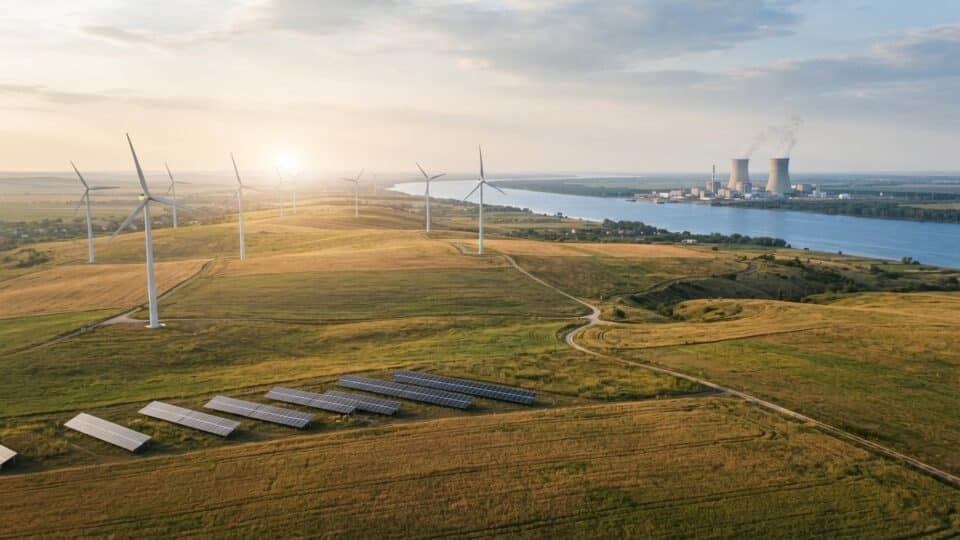
Dobrogea has all the ingredients to become Romania’s leading energy hub: the Cernavodă nuclear power plant, some of the country’s largest wind farms, oil infrastructure at Năvodari and the Neptun Deep project in the Black Sea. In November 2026, three developments made that prospect more concrete: the European Investment Bank’s first €400 million tranche for the refurbishment of Unit 1, turbine contracts for the Crucea Est wind farm, and the approaching point at which offshore gas could enter the national grid.
Yet the region does not automatically become energy-independent simply because it hosts multibillion-euro investments. In 2027, it will also have to manage the temporary withdrawal of a nuclear reactor, while wind and solar output continue to vary with weather conditions. InfoBuz examines existing capacity, confirmed projects, timelines and the conditions under which the counties of Constanța and Tulcea can turn energy resources into sustainable economic development.
Dobrogea’s energy sector: four resources, four different roles in the system
Nuclear energy provides electricity with low operational carbon emissions and, under normal conditions, relatively steady output. Wind and solar power depend on weather resources. Natural gas is a fuel for industry, heating and electricity generation, while batteries make it possible to shift some energy that has already been generated to different hours. None of these technologies can be assessed solely by its nameplate installed capacity.
| Project or asset | Technical reference point | Status as of 29 November 2026 |
|---|---|---|
| Cernavodă – Units 1 and 2 | Two reactors, about 1,400 MW combined | Existing; Unit 1 is due to undergo refurbishment |
| Fântânele–Cogealac | 600 MW of wind power | In operation |
| Crucea Est | 133 MW of wind power | Turbine contracts in place; installation scheduled by the end of 2028 |
| Topolog – batteries | 13.5 MW / 26.83 MWh | Storage project |
| Petromidia – solar PV | 9.4 MW | Self-consumption project with financing secured |
| Neptun Deep | About 8 billion m³ of gas a year at plateau | First production estimated for the first half of 2027 |
| Cernavodă – Units 3 and 4 | About 1,400 MW additional capacity | In preparation; the final decision and project delivery remain conditional |
Cernavodă: the investment intended to preserve nuclear output for another generation
On 17 November 2026, the European Investment Bank announced a first €400 million tranche of a planned €800 million financing package. The aim is to extend Unit 1’s operating life by three decades, subject to licensing and nuclear-safety requirements. The EIB gives a reference project value of €3.1 billion; financing costs and other budget components should be assessed separately in company-approved documents.
The refurbishment does not mean building an additional reactor. It is intended to preserve existing capacity and replace components after decades of operation. According to Nuclearelectrica’s quarterly report, major works are scheduled for 2027–2030, with Unit 1 to be taken offline in 2027 and operations expected to resume in 2030.
The experience of 2026 showed why plants’ actual availability matters more than the capacity stated on a technical data sheet. Low water levels on the Danube and unit outages affected output. The report confirms that Unit 2 was reconnected on 11 November and Unit 1 on 13 November, with both operating at nominal power on the reporting date. This is a reported status, not a real-time measurement at the date of publication. InfoBuz separately tracked the events surrounding the reactors’ restart.
| Nuclearelectrica indicator, company level | 9 months 2025 | 9 months 2026 | Change |
|---|---|---|---|
| Energy produced and supplied to the National Energy System | 7,383 GWh | 5,088 GWh | −31.1% |
| Operating revenue | RON 4.172 billion | RON 3.477 billion | −16.7% |
| EBITDA | RON 2.171 billion | RON 1.683 billion | −22.5% |
| Net profit | RON 1.627 billion | RON 1.182 billion | −27.3% |
Over the first nine months, the gap in energy supplied was 2,295 GWh. It cannot be attributed to a single cause alone: the report describes both the impact of the Danube and outages and interventions. For Romania, planning for the refurbishment period means securing alternative sources, demand flexibility and transmission networks. Renewable capacity can help, but it does not automatically replace a reactor’s continuous output.
Units 3 and 4: a possible doubling, not capacity already built
Nuclearelectrica’s documentation on Units 3 and 4 describes a project to expand the plant with two CANDU reactors. The page gives an estimated cost of €7 billion and commissioning milestones for 2030–2031. These figures come from the project presentation and are neither a final cost estimate nor a guaranteed timetable. The preparation phase must underpin the final investment decision, financing structure and permits.
If the project is delivered in full and the existing reactors remain in operation, the country’s nuclear capacity could reach about 2,800 MW at the same site. But concentrating assets in one region increases the importance of access to water, electricity infrastructure and outage management. The expansion must be accompanied by system strengthening, rather than viewed as a simple addition of megawatts.
Wind power: from Fântânele–Cogealac to Crucea Est
Dobrogea has attractive wind resources, and several wind farms are already integrated into the system. PPC Renewables Romania’s public portfolio includes facilities in Constanța and Tulcea. The Fântânele–Cogealac complex alone totals 600 MW: 252.5 MW at Cogealac, 85 MW at Fântânele East and 262.5 MW at Fântânele West.
| Examples of existing wind farms | County | Nameplate capacity |
|---|---|---|
| Fântânele–Cogealac | Constanța | 600 MW |
| Târgușor and Nicolae Bălcescu | Constanța | 179.4 MW |
| Sălbatica 1 and 2 | Tulcea | 140 MW |
| Land Power | Tulcea | 84 MW |
| Corugea | Tulcea | 70 MW |
| Valea Nucarilor and Topolog | Tulcea | 61 MW |
| Total of examples | Constanța and Tulcea | 1,134.4 MW |
On 18 November, Electrica reported to the Bucharest Stock Exchange that conditions precedent for its Nordex contracts for the Crucea Est project had been met. The planned turbines total 133 MW, and the contractual deadline for installing both phases is the end of 2028. A 15 MW, 60 MWh battery is planned at a later stage. Supply contracts do not amount to the wind farm entering operation.
An illustrative calculation explains the difference between power and energy: a 133 MW wind farm operating at an annual capacity factor of 30% would produce about 350 GWh in a 8,760-hour year. At a 40% capacity factor, output would be about 466 GWh. These figures are hypothetical, not Electrica’s official estimates. The actual factor depends on wind conditions, turbine availability and any grid constraints.
Industrial batteries: reducing mismatches between generation and demand
A 60 MW battery cannot deliver that power indefinitely. Power, expressed in MW, indicates the maximum rate of delivery; available energy, in MWh, determines how long that rate can be maintained. In a region with substantial variable generation, storage can make it possible to use some energy at other times and can provide balancing services.
| Announced storage project | Power | Nominal energy | Theoretical duration |
|---|---|---|---|
| Topolog | 13.5 MW | 26.83 MWh | About 2 hours |
| Târgușor | 60 MW | 120.24 MWh | About 2 hours |
| Crucea Est | 15 MW | 60 MWh | 4 hours |
Together, these three examples amount to 207.07 MWh of planned capacity. For a strictly mathematical comparison, a 700 MW reactor operating at constant output produces 16,800 MWh in 24 hours. The contrast shows why batteries lasting a few hours are useful for daily fluctuations, but cannot on their own replace a plant absent for several months. The system needs a portfolio of solutions: flexible generation, interconnections, adaptable demand and storage capacity sized for its intended purpose.
Industrial solar PV: energy generated where it is consumed
On 8 October, Rompetrol Rafinare presented the Petromidia solar project: 9.4 MW of installed capacity, estimated annual production of more than 9,800 MWh and an investment of about RON 44 million, of which roughly RON 14 million comes from non-reimbursable funding. The project is intended for self-consumption and is due to be implemented by the end of 2028.
The advantage of self-consumption is that some of the energy needed by industry is generated where it is used. In a simulation, if the installation produces 9,800 MWh a year and the average avoidable cost of purchased electricity is RON 350/MWh, the gross value of the substituted energy would be RON 3.43 million a year. At RON 500/MWh, it would be RON 4.9 million. These figures are not profit figures or Rompetrol forecasts: they exclude operating costs, degradation, financing, the consumption profile and possible tariff differences. InfoBuz’s financial analysis of Petromidia details the industrial context.
Neptun Deep: why Black Sea gas changes the energy equation
OMV Petrom and Romgaz are developing the Neptun Deep project, with investment valued at around €4 billion. In an official statement of 28 September, the partners set a target of bringing first gas into the national system in the first half of 2027 and reaching plateau production by the end of the third quarter. At plateau, estimated output is about 8 billion cubic metres a year.
The gas volume represents available chemical energy, not an equivalent amount of electricity. Gas can be consumed directly by industry and households, traded or used in power stations. Converting it into electricity involves losses and requires generating facilities. Billions of cubic metres therefore cannot be added to the megawatts of reactors and turbines.
The regional benefit will depend on local services, infrastructure development and the integration of industrial activity. The national benefit may include diversified supply and lower exposure to imports. Gas and electricity prices, however, remain dependent on the market, taxation, contracts and transmission capacity. Higher domestic output does not guarantee lower bills for every household.
The electricity grid: an essential condition for Dobrogea’s development
Wind farms and reactors alone are not enough; their energy must be safely taken up and transmitted to consumers. Transelectrica includes the 400 kV Constanța Nord–Medgidia Sud line in its Modernisation Fund portfolio, intended to integrate new generation sources. The announced non-reimbursable funding is about RON 111.87 million. A financing contract or the start of works should not be confused with commissioning; the updated timetable should be followed in the operator’s reports.
When winds are strong and solar output is high, but demand and transmission possibilities are limited, constraints can arise. Conversely, demand may remain high in the evening after sunset. A better-sized and more closely monitored grid allows generation to be used more efficiently. The solutions must also include environmental protection, consultation with communities and compliance with safety requirements, rather than merely faster construction.
What energy investments mean for Constanța and Tulcea
The projects create demand for design, construction, mechanical installation, electrical installation, automation and maintenance services. It is important to distinguish between the temporary peak in activity during construction and permanent staffing needs after commissioning. An automated wind farm may employ many workers on site during construction but require a smaller operating team.
The local economic benefit also depends on regional companies’ participation in supply chains, the training of skilled workers and the ability to attract energy-using industrial activity. Ports, rail connections and roads support this development; see also InfoBuz’s analysis of Port of Constanța infrastructure. The sources reviewed contain no verified estimate of the net number of new jobs across the region as a whole.
The 2027–2030 energy timetable: what to watch
| Period | Announced milestones | Main uncertainty |
|---|---|---|
| 2027 | First Neptun Deep gas; start of major works on Unit 1 | Actual commissioning timetable and replacement of nuclear output |
| 2028 | Installation of Crucea Est turbines and implementation of Petromidia solar PV | Delivery, grid connection, acceptance and permitting |
| 2029–2030 | Continued investment and Unit 1’s estimated return in 2030 | Adherence to the schedule and availability of financing |
| After 2030 | The outlook for Units 3 and 4 and new energy projects | Final decisions, financing and approvals |
Dobrogea can become an integrated energy centre, not merely a producing region
Dobrogea already has a strategic role in Romania. Investment in nuclear generation, wind, solar and gas can reinforce that role, provided that networks, storage and industrial demand develop together. The 2027–2030 period will test the system’s ability to manage new sources alongside Unit 1’s temporary shutdown. The real measure of success will not simply be the number of installed megawatts, but the energy actually delivered, industrial competitiveness, safety and lasting benefits for communities.
InfoBuz editorial analysis, documented on 29 November 2026. Capacities, timelines and financing are reported separately as existing, contracted or planned. The simulations are illustrative, and interim financial indicators are unaudited. No up-to-date exhaustive inventory of all regional assets was available. The main image is an editorial illustration generated with artificial intelligence.


Discuția cititorilor
Ai o opinie sau o întrebare despre acest articol? Spune-ne ce crezi.
Fii primul care deschide discuția.
Te rugăm să păstrezi un limbaj civilizat și să discuți la subiect. Comentariile spam sunt filtrate automat.