
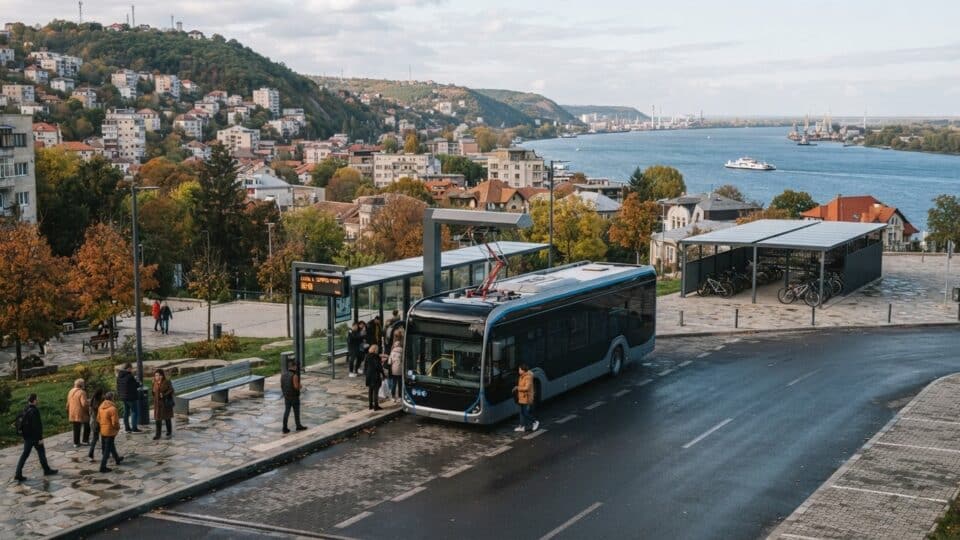
Electric buses in Tulcea: the city is preparing for the latest phase of its public-transport modernisation after the mayor announced, on 27 November 2026, that funding had been secured and contracts signed for two projects worth roughly RON 114.1 million in total. The investments provide for the purchase of another 22 electric buses, a Park & Ride terminal with 222 parking spaces on Antenei Street, and an expansion of the transport network.
More than RON 100.4 million of the total is non-reimbursable funding. For Tulcea residents, the issue is not simply replacing vehicles, but making it easier to combine bus, bicycle and car travel. For these investments to reduce traffic and operating costs, however, they will need to be coordinated with service frequency, charging infrastructure and the operator’s capacity to maintain the new fleet.
Electric buses in Tulcea: how the RON 114 million is divided
The mayor’s announcement, reported by Radio Romania Constanța on 27 November, concerns two complementary projects. The first aims to renew the vehicle fleet and introduce facilities for cyclists. The second integrates public transport with a transfer car park. The financial breakdown released by the municipality was published by DobrogeaNews.
| Indicator | Project 1 | Project 2 | Total |
|---|---|---|---|
| Total value | RON 60.204 million | RON 53.893 million | RON 114.097 million |
| Non-reimbursable funding | RON 49.744 million | RON 50.684 million | RON 100.429 million |
| Difference from total value | RON 10.460 million | RON 3.208 million | RON 13.668 million |
| Non-reimbursable funding as a share of the total | 82.6% | 94.0% | 88.0% |
| Buses planned | 18 | 4 | 22 |
In the first project, non-reimbursable funding covers 98% of eligible expenditure, according to the announcement. Measured against the total value, the proportion is about 82.6%. This distinction matters because investments may include ineligible expenditure, the beneficiary’s own contribution and costs treated separately in funding agreements. It cannot be concluded that the local budget will cover only 2% of the entire investment.
The funding comes from the South-East Regional Programme 2021–2027, through the component for the municipality of Tulcea within the Danube Delta ITI area. Signing the funding agreement is an important step, but procurement contracts for vehicles and works, delivery, acceptance and entry into service are separate stages. The communications reviewed do not give a firm date by which all 22 buses will be carrying passengers.
From 30 to up to 52 electric buses: what the fleet expansion means
The electrification of transport in Tulcea is not starting from zero. In its published fleet overview, operator Transport Public SA Tulcea lists 30 Granton electric buses and another 15 urban buses. The page is not a daily register of available vehicles, so it does not show exactly how many are operating on a given day.
If all 22 additional vehicles are delivered and all 30 existing ones are retained, the electric fleet could reach 52 vehicles, an increase of roughly 73%. This is a conditional calculation, not the officially confirmed size of the future fleet. The overall number of buses will depend on vehicles being withdrawn from service, the replacement of diesel buses and any further purchases.
According to an Agerpres report of 16 January 2025, an earlier stage already included the acceptance of 20 electric buses, alongside work on maintenance, charging and stop infrastructure. Those 20 buses should not be added again to the 30 listed by the operator. They are part of the earlier modernisation.
The buses announced in November 2026 will have comfort and accessibility features. Their real-world range, battery capacity, manufacturer and warranty, however, will need to be examined in the procurement documents and results. A larger number of buses gives the operator the option of extending service or keeping a technical reserve, but it does not automatically guarantee shorter intervals between services. That also depends on the timetable, driver availability and the number of vehicles required on each route.
The Park & Ride terminal on Antenei Street: how it could reduce traffic
The project involves building a transfer car park where people arriving by car can continue their journey by public transport. Its 222 spaces are the car park’s simultaneous capacity, not the maximum number of cars it may serve each day. Such a facility could be useful to commuters and visitors, especially if their destination is in a congested area.
In practice, the terminal’s effectiveness will depend on three factors: road access, the combined cost of parking and bus travel, and the time needed for the transfer. If buses are infrequent or parking is too expensive compared with the alternative in the city centre, drivers may continue using their cars. A large but poorly connected car park does not reduce congestion simply by existing.
| Simultaneous-use scenario | Spaces occupied | People carried, at 1.5 occupants per car |
|---|---|---|
| 25% of capacity | 56 | 84 |
| 50% of capacity | 111 | 167 |
| 75% of capacity | 167 | 251 |
| 100% of capacity | 222 | 333 |
Even full occupancy would not automatically mean 222 cars permanently removed from central traffic. Some users may have come from other car parks, while some trips would have been made by bus anyway. The appropriate measure of success is the net reduction in car journeys and distance travelled in the congested area, assessed before and after the terminal opens.
New routes, stops and cycling infrastructure
The plan includes a new route and the reorganisation of an existing one, with links from the Antenei area. According to information published by Ora de Tulcea on 28 November, new stops are also planned in areas that are to be better connected to the network.
| Component | Planned change |
|---|---|
| Route 3B | Antenei – Satul Pescăresc |
| Route 4B | Reorganisation of Antenei – Gelco Dig |
| Passenger stops | Three new points in the Barajului–Libertății, Fabricilor and Elizeului areas |
| Bicycle parking | 17 secure systems and 15 bicycle racks |
Well-connected cycling infrastructure can extend the catchment area of each stop. A bicycle rack and an isolated cycle lane, however, do not by themselves constitute a functioning network. Route continuity, safe crossings and the ability to leave a bicycle in a secure place matter to people who use several modes of transport every day. In a city with changes in elevation such as Tulcea, routes must also be designed for accessibility, not only for the total length of cycle lanes built.
What operating an electric bus could cost compared with a diesel bus
Energy cost per kilometre is only one element of operating costs. To illustrate the scale of possible savings, InfoBuz developed a hypothetical scenario for a bus travelling 60,000 km a year. It assumes diesel consumption of 35 litres per 100 km at RON 8 per litre, and an electric bus requiring 1.25 kWh per km measured at the charging point, with charging losses included in the assumption.
| Scenario | Energy cost/km | Annual cost for 60,000 km | Difference from diesel |
|---|---|---|---|
| Diesel – RON 8/litre | RON 2.80 | RON 168,000 | Reference |
| Electric – RON 0.80/kWh | RON 1.00 | RON 60,000 | RON 108,000 |
| Electric – RON 1.20/kWh | RON 1.50 | RON 90,000 | RON 78,000 |
| Electric – RON 1.60/kWh | RON 2.00 | RON 120,000 | RON 48,000 |
At the RON 1.20/kWh assumption, the difference would be about RON 78,000 a year for one vehicle. For 22 vehicles each replacing the same diesel mileage, the theoretical difference would reach RON 1.716 million a year. If the new buses are used for additional services, that saving cannot be applied in full, because part of the consumption would be new. Under the model’s conditions, the energy-cost break-even point is RON 2.24/kWh.
Total lifetime cost includes purchase, financing, wages, insurance, tyres, servicing, charging stations, potential battery repairs and residual value. Hilly routes, low temperatures, air conditioning and occupancy levels can alter consumption. Regenerative braking can recover some energy on descents, but does not eliminate the cost of travel. Results should therefore be assessed on comparable routes and over sufficiently long periods.
Charging the fleet: why infrastructure must be sized before delivery
An electric fleet depends on grid connections, charging-station availability and charging schedules. A Dobrogea Online report of 27 November mentions three bus charging stations within the new investments, as well as photovoltaic panels for the terminal building. The article does not specify the complete balance of available power for the entire fleet.
In the previous example, a bus travelling 200 km a day would need about 250 kWh. For 22 buses, daily demand would be 5,500 kWh. Spread evenly across eight hours, this would require average power of around 688 kW. This is not an official technical requirement for the Tulcea depot: in practice, peak power, en-route charging and energy requirements are sized according to the actual timetable, battery condition and required reserve.
Photovoltaic panels may contribute to the building’s consumption or other uses compatible with the planned installation, but there is insufficient information to state that they will fully power the buses. Solar generation must be aligned with the hours when vehicles are stationary. Without that alignment, overnight consumption will still depend on the grid or storage. The regional context is also examined in InfoBuz’s article on Dobruja’s energy development.
What the investment means for a household budget
Investment in buses is not a decision to reduce fares. According to the operator’s fare list, a 30-minute ticket costs RON 3.50, a 30-day named pass costs RON 130, and a one-day pass costs RON 10. These are the reference prices displayed when the page was consulted, not fares promised for 2027 or for the Park & Ride terminal.
| Monthly use | Cost using RON 3.50 tickets | Named pass | Cheaper option |
|---|---|---|---|
| 20 fare-paid trips | RON 70 | RON 130 | Tickets |
| 38 fare-paid trips | RON 133 | RON 130 | Pass |
| 44 fare-paid trips | RON 154 | RON 130 | Pass, saving RON 24 |
| 60 fare-paid trips | RON 210 | RON 130 | Pass, saving RON 80 |
For a commuter making two trips on 22 working days, the pass becomes advantageous in the model above. A comparison with car travel must include fuel, parking and wear and tear, as well as any transfer charge at Antenei. There is not yet a publicly confirmed price for the future car park, so the full cost of an intermodal journey cannot be properly calculated.
What to watch in 2027 if the modernisation is to deliver results
At the next stage, important milestones will be procurement documentation, contract awards, construction work, vehicle delivery and acceptance. For residents, the outcome should be measured through punctuality, the number of services operated, waiting times, accessibility and journey costs. Reducing tailpipe emissions in areas served by electric buses is a local benefit, but the full environmental balance also depends on the source of electricity and the vehicles’ lifespan.
The experience of other regional projects shows why investment in vehicles must be accompanied by passenger facilities and functional connections. See also InfoBuz’s analysis of the Constanța metropolitan rail transport project. Each municipality has different needs and constraints; comparisons should be made through service quality, not only the amount spent.
Electric transport must also be a practical alternative to the car
Tulcea has an important opportunity to connect fleet modernisation with walking, cycling and transfers from cars to public transport. The 22 buses and the Antenei terminal could bring tangible benefits if they are integrated into a frequent, accessible and predictable service. Progress on procurement and construction will be relevant in 2027; the opening of all components cannot be predicted with certainty on the basis of the funding announcement.
InfoBuz editorial analysis, documented on 29 November 2026. Project values come from municipal communications reported by the press, while fares and the fleet structure come from the operator’s webpages. The full funding agreements and delivery timetable were not available in the sources reviewed. The simulations are hypothetical and do not represent officially estimated savings. The image is an AI-generated editorial illustration.


Discuția cititorilor
Ai o opinie sau o întrebare despre acest articol? Spune-ne ce crezi.
Fii primul care deschide discuția.
Te rugăm să păstrezi un limbaj civilizat și să discuți la subiect. Comentariile spam sunt filtrate automat.