
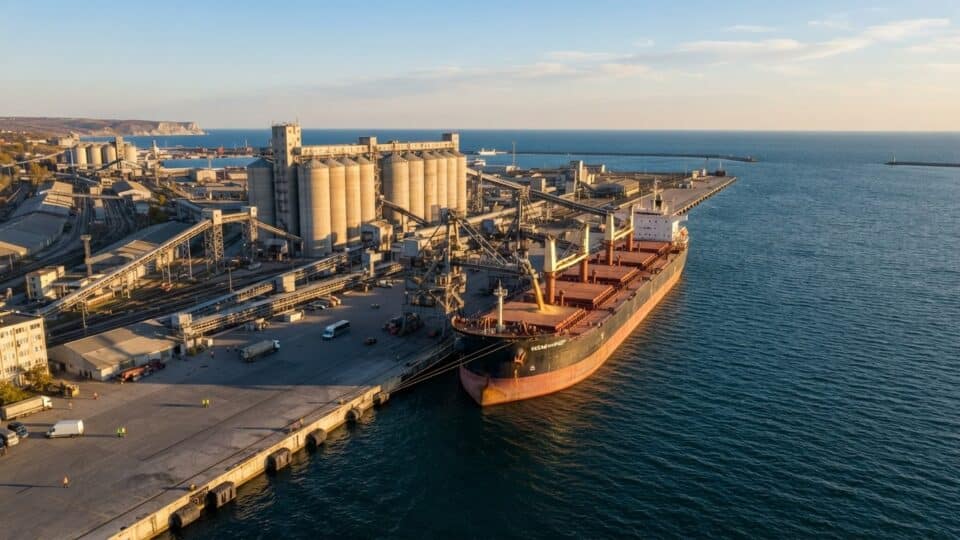
The Port of Constanța is strengthening its role in European agricultural trade at a time when transport costs, infrastructure availability and the security of Black Sea shipping routes can matter as much as the harvest itself. Port authority data reported on 24 November 2026 show grain exports of 18.5 million tonnes in the first 10 months of the year, 17.1% higher than in the same period of 2025.
On 27 November, the signing of the financing agreement for the third phase of modernising the port’s rail infrastructure, worth roughly 776 million lei, was also announced. Together, the two developments point to an important economic opportunity for Dobrogea, Romania’s south-eastern region, but also to a challenge: how can Romania turn rising volumes into predictable logistics services without confusing exports through the port with output from Romanian farmers?
The Port of Constanța in 2026: what the grain volumes show
According to port authority data reported by Magazin Agricol on 24 November, the pace of exports accelerated in October. Comparing cumulative volumes makes it possible to estimate that month’s contribution, although it does not provide an exact breakdown by product or country of origin.
| Indicator | Value | Interpretation |
|---|---|---|
| Grain exported, January–September 2026 | 15.8 million tonnes | +7% year on year |
| Grain exported, January–October 2026 | 18.5 million tonnes | +17.1% year on year |
| Estimated October volume | 2.7 million tonnes | Difference between rounded totals |
| Ukrainian grain, January–October 2026 | 1.65 million tonnes | About 8.9% of total grain exports |
| Total freight traffic, January–September | 51.55 million tonnes | All categories, not grain alone |
The 17.1% annual increase implies an estimated comparable volume of roughly 15.8 million tonnes in the first 10 months of 2025. The difference is in the region of 2.7 million tonnes. It cannot be attributed entirely to Ukrainian transit. Without a full breakdown by origin, the remainder cannot automatically be treated as Romanian production. Aggregate figures are useful for measuring logistics activity, not for calculating national farm revenues.
Ukrainian grain: a logistics opportunity and pressure on capacity
Constanța became an alternative route for regional shipments after Russia’s 2022 invasion. Its links between the Danube, rail, road and sea transport allow flows to be redirected when other routes become unsafe or expensive. In 2026, the volume of Ukrainian grain shipped through the port rose again, but its share of the total needs to remain in perspective.
According to the European Commission’s 19 October update, the Solidarity Lanes handled around 90% of Ukrainian exports of grain, oilseeds and related products in September across the entire network of routes. This percentage is not the Port of Constanța’s share. The network includes road, rail and river connections in several countries.
For a Romanian farmer, the key question is whether capacity is available at the time of delivery and at a competitive rate. Additional freight volumes can support investment and employment, but can also intensify congestion if all volumes arrive in the same period. There is no comparable series of waiting times and rates showing how much of farmers’ logistics costs was caused exclusively by Ukrainian transit.
The 776 million lei rail investment: what will be modernised
The signing of the financing agreement for phase III of the rail infrastructure modernisation was announced by the Ministry of Transport in the final week of November, according to information published by Fonduri Structurale on 27 November. The project includes works at Agigea Sud, rail links to the Ferry-Boat area, and the construction of a traffic-management centre.
| Component | Value or objective |
|---|---|
| Total financing value | 776,239,393.79 lei |
| Eligible value | 641,923,517.53 lei |
| Infrastructure covered | 27 km of railway |
| Traffic management | New centre in the Constanța railway station area |
| Implementation deadline | 31 December 2029 |
The eligible value represents about 82.7% of the project total. It is not equivalent to the share of the EU grant. Nor would dividing the total value by 27 km produce a representative cost for building one kilometre of track, because the project also includes installations, electrification, signalling and traffic management.
The real benefit will depend on integration between the infrastructure, private terminals and the national network. A train may reach the port entrance quickly, but if no unloading slot is available, the time saving is lost. Flow management must coordinate arrivals, free tracks, staff availability and terminal capacity.
Private terminals: storage capacity is not annual throughput
A completed investment provides a more concrete reference point. On 22 July 2026, Transport Trade Services announced through the Bucharest Stock Exchange that the Canopus terminal had been expanded to 180,000 tonnes of storage capacity. The €23 million project, excluding VAT, included silos, cargo intake facilities and handling equipment. The operator is a partnership between TTS and Cargill Agricultura.
| Canopus indicator | Reported value |
|---|---|
| Total storage capacity | 180,000 tonnes |
| Investment excluding VAT | €23 million |
| Funding from own resources | About 35% |
| Two unloading points | 400 tonnes/hour each |
| Investment completed | 20 July 2026 |
A 180,000-tonne silo can handle a much greater annual volume if it is emptied and refilled in successive cycles. At eight full cycles, the theoretical model would suggest 1.44 million tonnes; at 12 cycles, 2.16 million tonnes. These are mathematical examples, not forecasts by the operator. Segregating lots by quality, cleaning facilities and scheduling vessels all limit the full use of space at any given time.
Farm-gate grain prices versus port quotations
An efficient port can reduce logistics costs between a farm and an overseas buyer, but it does not set the price of wheat on its own. That price depends on global harvests, quality, contracts, exchange rates and transport costs. Agrointeligența reported on 26 November a DAP Constanța quotation for milling wheat of €229 per tonne, equivalent to roughly 1,223 lei per tonne at the exchange rate used in its article.
DAP describes a contractual delivery term at the agreed destination. FOB entails different responsibilities, including delivery of the goods on board the vessel. A farm-gate quotation should not be compared directly with an FOB quotation without adjusting for costs and commercial terms. Nor do futures quotations automatically represent the physical price available in every county.
| Hypothetical wheat scenario | Logistics cost/tonne | Value remaining from 1,223 lei/tonne |
|---|---|---|
| Farm nearby | 60 lei | 1,163 lei |
| Medium distance | 120 lei | 1,103 lei |
| Long distance or congestion | 180 lei | 1,043 lei |
For a farm selling 500 tonnes, a logistics saving of 30 lei per tonne would mean 15,000 lei before other costs. This is why predictable transport can matter even when the international price remains unchanged. Lower transport costs do not, however, guarantee that the full benefit reaches the farmer; contractual negotiations determine how value is distributed across the supply chain.
Truck, train or barge: comparing a 10,000-tonne lot
For large volumes, rail and river transport can reduce the number of road journeys, provided that infrastructure and services are available. A simplified example uses hypothetical payloads of 25 tonnes for a truck, 1,000 tonnes for a train and 1,500 tonnes for a barge.
| Transport mode | Assumed capacity | Units needed for 10,000 tonnes |
|---|---|---|
| Truck | 25 tonnes | 400 |
| Train | 1,000 tonnes | 10 |
| Barge | 1,500 tonnes | 7 |
Fewer units do not automatically mean a lower rate. River transport may require transhipment, while rail requires access to a loading facility. Trucks are flexible over short distances, but congestion, driver costs and waiting times become significant at large volumes. An effective strategy combines modes of transport according to the cargo’s origin and the export contract.
Competition with Bulgarian ports and the rest of the Black Sea
Varna and Burgas are part of the same regional maritime transport market. Operators compete for contracts on the basis of berth availability, costs, service quality and links to agricultural areas. A 26 November report by Știrile Constanței gives shared quotations for the Constanța–Varna–Burgas group, illustrating the connection between these markets without showing that prices and costs at every terminal are identical.
Constanța’s structural advantage is access to the Danube hinterland and Central European markets. But geographical distance is not the only factor in choosing a port. An exporter may prefer a longer route if the risk of delays is lower. Competition will be decided by total cost and delivery reliability, not infrastructure size alone. The data reviewed do not provide a complete, comparable ranking of all ports for 2026, so no definitive regional ranking can be established here.
What Constanța and Dobrogea gain from rising exports
Grain activity supports storage, industrial maintenance, transport, quality inspection, freight forwarding and maritime operations. Investment in facilities can create demand for local technical skills, from metal construction to automation. However, the data reviewed contain no verified estimate of jobs newly created in 2026 exclusively as a result of export growth.
For residents, the economic benefits must be assessed alongside effects on road traffic, noise and environmental quality. Shifting some freight to rail and barges may ease pressure on roads, but the effect depends on how projects are implemented. Port infrastructure modernisation must also be coordinated with employee travel. InfoBuz has separately examined the Constanța metropolitan train project, which is intended for passenger mobility rather than grain transport.
The port also matters to other sectors, including energy. InfoBuz’s analysis of Petromidia shows how maritime infrastructure supports industrial supply and petroleum-product distribution. Diversifying activities can reduce the local economy’s dependence on a single agricultural season.
Outlook for 2027: three scenarios, without promises of record traffic
In a favourable scenario, harvests and external demand support high volumes, while operators use available capacity more efficiently. In a moderate scenario, volumes remain strong, but transport costs and ongoing works constrain growth. In an adverse scenario, weak harvests or changing trade routes reduce demand for port services. None is an official numerical forecast.
Useful indicators for assessing next year are monthly grain traffic, the share of Romanian and transit cargo, waiting times, logistics costs per tonne, effective rail capacity and the progress of investments. The rail project’s 2029 deadline rules out any assumption that all of its benefits will be available as early as 2027.
Conclusion: success is not measured only in millions of tonnes
The Port of Constanța has a genuine opportunity to consolidate its role in European agricultural trade. Export growth and infrastructure expansion provide favourable conditions. For farmers, operators and the local community, however, lasting gains will come from predictability, lower logistics costs and the value of services provided in Romania. A competitive port is not simply one that handles a large volume of cargo, but one that enables it to be delivered efficiently and safely.
InfoBuz editorial analysis, researched on 29 November 2026. Aggregate port data are drawn from reports citing the port authority; a full breakdown by grain origin was not available. Calculations and hypothetical scenarios are identified separately. The main image is an AI editorial illustration, not a documentary photograph.


Discuția cititorilor
Ai o opinie sau o întrebare despre acest articol? Spune-ne ce crezi.
Fii primul care deschide discuția.
Te rugăm să păstrezi un limbaj civilizat și să discuți la subiect. Comentariile spam sunt filtrate automat.