
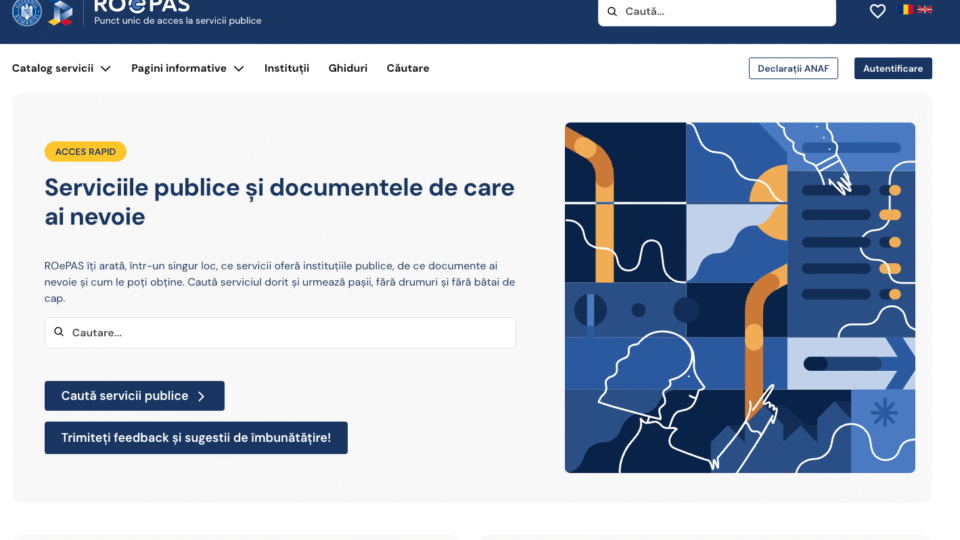
The digitalisation of public services in Romania has a problem that is more visible in the figures than in speeches about the “digital state”. At the time of checking, the National Catalogue of Public Services listed 3,354 services provided by 343 central public-administration institutions. Of these, only 613 can be completed entirely online. Another 30% are only partly online, while 1,736 are available exclusively at the counter.
That means just 18.3% of the services listed in the catalogue are fully digitalised. The figure alone does not tell the whole story, however. Romania already has Ghișeul.ro, ROeID, sector-specific hubs, ROePAS, the Government Cloud and interoperability projects. The useful question is no longer whether platforms exist, but where the journey breaks down between a portal and actually resolving a problem without visiting an institution.
For additional context, see Cernavodă nuclear power plant shuts down completely: Romania temporarily left without nuclear energy, an article that examines an aspect directly related to this topic.
What the 3,354 public services actually show
The National Catalogue of Public Services is managed by the Authority for the Digitalization of Romania and records services provided by central public administration. The figure of 3,354 should therefore not be read as an exhaustive inventory of every local procedure at every town hall in Romania.
When InfoBuz checked, the catalogue showed:
| Status | Number / share |
|---|---|
| Total published services | 3,354 |
| Fully online | 613 – 18.3% |
| Partly online | 30% |
| Counter only | 1,736 – 51.8% |
| Participating institutions | 343 |
The National Catalogue of Public Services publishes the data live, and they may change as institutions update their procedures.
“Fully online” is the test that matters to citizens
A service may offer a PDF form online, online appointments or very good website information, yet still not be a fully digital service. From the user’s perspective, real digitalisation means being able to start the procedure, identify yourself, upload documents, pay where necessary, track progress and receive the outcome without a mandatory visit to a counter.
The catalogue itself illustrates the distinction. For driving licences, for example, the service for issuing a duplicate is listed as online, while issuing a licence with a new validity period is classified as partly online. In the area of identity documents, several procedures are likewise classified as partly online.
In other words, online public services do not automatically mean “counter-free administration”. Sometimes, the internet digitalises only the start of a procedure.
Romania’s paradox: infrastructure exists, but use remains very low
A second indicator shows that the issue is not only supply. According to Eurostat, in 2025 only 24.1% of Romanians aged 16 to 74 had used a public-authority website or app in the previous 12 months. The European Union average was 71.9%.
At the other end of the scale, Denmark reached 98%, the Netherlands 96.2%, Finland 96.1% and Sweden 96%. Romania had the lowest share in the EU on this measure.
This indicator measures use, not the number of services available. The difference between the two perspectives is precisely what matters: an administration can build platforms, but if services are fragmented, difficult to find, require different accounts or still end at the counter, uptake may remain low.
Eurostat – use of e-government services in 2025.
Where public-service digitalisation in Romania stalls: data exchange
One of the most important issues is interoperability: institutions must be able to exchange data with one another in a controlled way, so that citizens no longer have to carry documents from one authority to another.
The European Commission made exactly this recommendation in its 2026 Digital Decade Country Report: Romania has a high level of resources invested in the digitalisation of public services, but needs to build a unified public cloud ecosystem, focus on interoperability and implement the “once-only” principle.
The principle is simple: the state should not ask you again for information that another public institution already holds and can legally transmit. In practice, this automatic data exchange is what separates a truly digital procedure from an electronic form that creates more trips and more copies.
European Commission – Romania’s 2026 Digital Decade Country Report.
The National Interoperability Platform is one of the missing pieces
The Authority for the Digitalization of Romania is developing the National Interoperability Platform (PNI), a project that envisages connecting core registers and integrating with systems including ROeID, the eIDAS node, the Single Digital Gateway and sectoral portals of institutions such as the Ministry of Internal Affairs (MAI), the National Agency for Fiscal Administration (ANAF), the National Trade Register Office (ONRC) and the Ministry of Education.
The stated aim is to reduce administrative burdens and develop integrated services. If it works as designed, the PNI should address some of the situations in which citizens currently become “couriers” between two public databases.
ADR – National Interoperability Platform.
The Government Cloud does not digitalise a service on its own
In September 2026, ADR announced the completion of the Government Cloud infrastructure project. This is an important stage, but infrastructure and a service delivered to citizens are different things.
A modern data centre can host administrative applications, make them more scalable and secure, and facilitate integration. But if a legal procedure still requires a paper document, an institution has not adapted its workflow, or databases do not communicate, the cloud does not eliminate the counter by itself.
ADR also explains that a major part of the programme is not only infrastructure, but the migration and modernisation of existing applications. The migration project targeted at least 30 applications and IT systems used by central administration.
ADR – Government Private Cloud · ADR – migration of applications to the cloud.
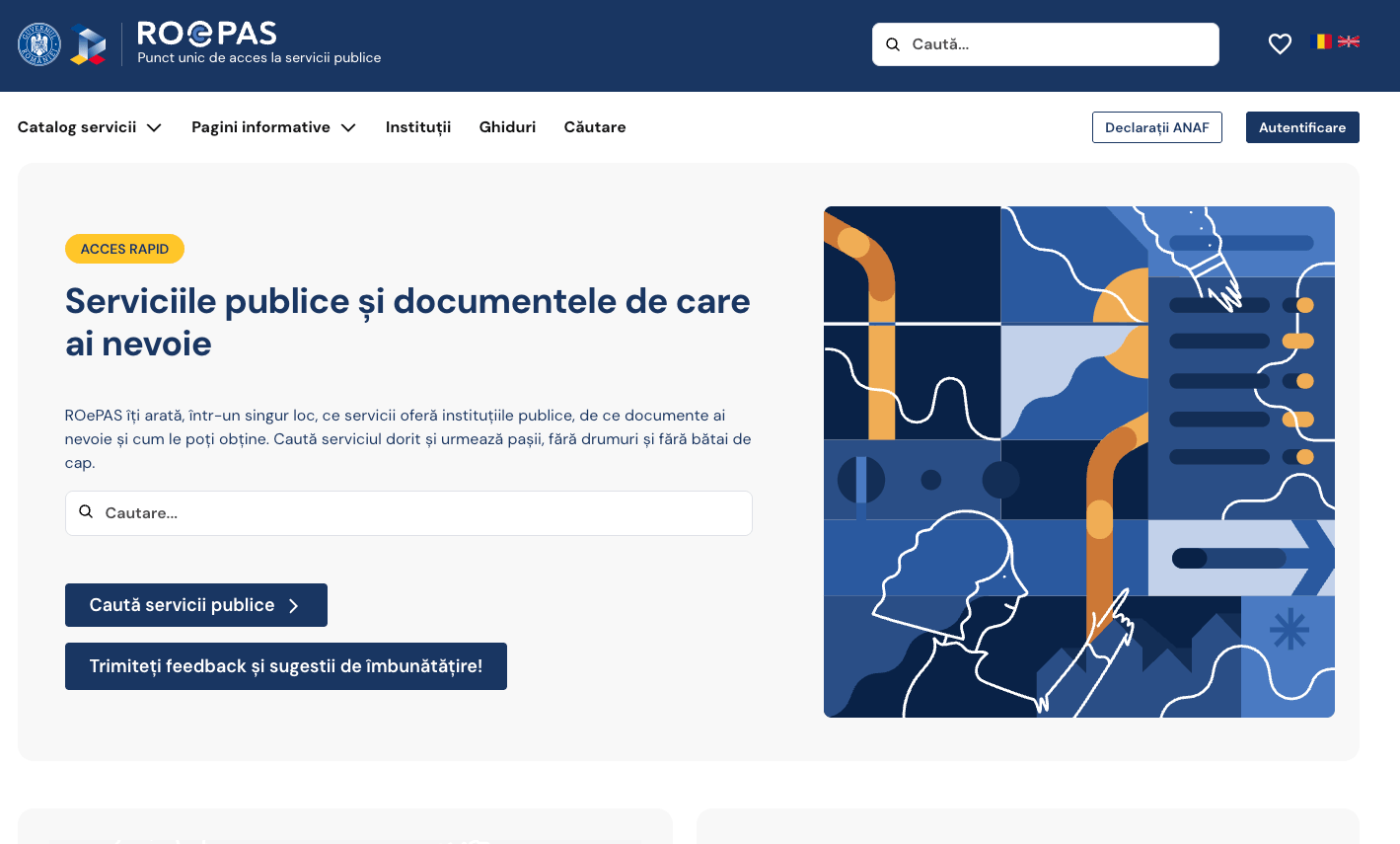
ROePAS aims to solve another problem: “Where do I find the service?”
In March 2026, ADR launched the beta version of ROePAS, presented as a single point of access to digital public services. The platform centralises information, procedures and services, and is intended to replace the former PCUe.
But the launch announcement itself shows the scale of work remaining: institutions must check, update and validate migrated procedures, and services will become available gradually as each authority completes the process.
One limitation that public-service digitalisation in Romania still faces is evident here: a single portal can be built, but the content and workflow of every service still depend on the institution that provides it.

ADR – launch of ROePAS Beta, 12 March 2026.
Digitalisation does not mean merely putting a PDF form online
An old e-government trap is digitising existing bureaucracy without redesigning it. If a procedure involves seven paper approvals and each approval becomes a PDF uploaded separately, citizens use the internet but do not necessarily receive a simpler service.
This is why, in June 2026, ADR launched, with European support, a project explicitly dedicated to user-centred digital public services. The emphasis is no longer only on technology, but on how a service is designed from the perspective of the person using it.
ADR – project for user-centred digital public services.
The number of services can mislead if their importance is ignored
Another reason why the 18.3% figure must be interpreted carefully is the structure of the catalogue. Not all services are used with the same frequency or have the same impact.
The catalogue shows, for example, 727 services in transport, 498 in the environment, 366 in health, 296 in education, training and culture, and 245 in agriculture. The Romanian Naval Authority alone has 494 published services, while the Romanian Civil Aeronautical Authority has 190.
Digitalising 100 rare technical procedures and digitalising a procedure used annually by millions of people therefore do not have the same social effect. For citizens, what matters more is whether they can fully resolve important life events online: identity, family, driving licences, health, work, taxes, education or retirement.
There are also examples where digitalisation works end to end
The picture is not uniformly negative. Some services can already be completed fully online. One practical example is the criminal record certificate for individuals, which can be requested and downloaded electronically through the MAI Hub by users who meet the authentication requirements.
InfoBuz has separately published a guide on how to obtain a criminal record certificate online and what to do if account validation does not work. Services such as this illustrate the difference between “we have a website” and “I can solve the problem without leaving home”.
Another example of the transition is the Electronic Identity Card (CEI). Its integration with other public systems is progressing gradually, but this does not mean every public service can already use it in every scenario. InfoBuz has also explained what CEI integration into the health system means, and what it does not yet replace.
The digital-skills problem cannot be ignored
The European Commission also points to a limitation that is not directly related to servers or applications: low levels of basic digital skills affect the use of digital public services. InfoBuz has separately explained what basic digital skills mean in practice and how they can be assessed.
This means a service is not truly accessible merely because it works in a browser. If the workflow is difficult to understand, authentication is complicated, the language is bureaucratic or the interface is poorly adapted to phones, some citizens will continue to prefer the counter or depend on someone else’s help.
Public-service digitalisation in Romania therefore needs two things at the same time: better services and users able to use them. Completely removing the physical channel is neither realistic nor desirable for every population group; the objective is for an in-person visit to no longer be mandatory where a procedure can be completed digitally.
What should be tracked until 2030
The European target for 2030 is for all key public services for citizens and businesses to be available online. For Romania, real progress cannot be assessed only by the number of portals launched or the value of investments.
- The share of fully online services must increase, not only the share of “partly online” services.
- Interoperability must reduce the documents that institutions repeatedly request.
- ROeID and electronic identification must be usable in a growing number of procedures.
- ROePAS must become a genuine gateway to services, not merely a catalogue of links and instructions.
- The Government Cloud must translate into migrated applications and modernised processes, not infrastructure alone.
- User experience must be measured by completion of the procedure, not by the existence of an electronic form.
- Actual use must move closer to the European average; otherwise, the digital offering is not reaching citizens.
Where the digitalisation of the Romanian state stops today
The figures suggest Romania is no longer at a point where the main problem is a total lack of infrastructure. There is digital identity, online payments, sectoral portals, a single point of access under development, cloud infrastructure and interoperability projects.
Digitalisation most often stops between systems and between stages of the same procedure. The form may be online, but the document comes from another institution. The appointment may be online, but physical presence remains mandatory. The portal exists, but the service has not yet been validated. The state holds the data, but the citizen must provide it again.
This is precisely why the figure of 613 fully online services is more relevant than the total of 3,354. It shows how much of the administration recorded in the catalogue can currently be navigated without interrupting the digital flow.
Conclusion: the next stage is no longer “another portal”
Romania has invested, and continues to invest heavily, in the digital transformation of public administration. The 2026 European report recognises the high level of resources allocated, while ongoing projects address precisely the areas that have lagged behind: cloud, interoperability, electronic identity and user-centred services.
But for citizens, success is not measured in servers, budgets or the number of platforms. It is measured more simply: can I resolve the problem fully online, or must I eventually get up from my computer and go to the counter?
At the end of September 2026, the National Catalogue said that for more than half of the services recorded, the answer was still “the counter”. That is where the distance Romania’s public-service digitalisation still has to travel is clearest.
Sources and documents consulted
- National Catalogue of Public Services – live data on the number of services and their level of digitalisation
- Eurostat – E-government services used by 72% of people in the EU, 2025 data
- European Commission – Romania’s 2026 Digital Decade Country Report
- European Commission – eGovernment Benchmark 2026
- ADR – launch of ROePAS Beta
- ADR – National Interoperability Platform
- ADR – Government Private Cloud
- ADR – migration of applications and IT systems to the cloud
- ADR – development of user-centred digital public services
Editorial note: figures in the National Catalogue of Public Services are dynamic and may be updated by participating institutions. The figures presented in this article reflect the situation checked by InfoBuz on 29 September 2026. The catalogue covers public services published by central public-administration institutions and should not automatically be interpreted as an exhaustive inventory of all local services in Romania.









Discuția cititorilor
Ai o opinie sau o întrebare despre acest articol? Spune-ne ce crezi.
Fii primul care deschide discuția.
Te rugăm să păstrezi un limbaj civilizat și să discuți la subiect. Comentariile spam sunt filtrate automat.