
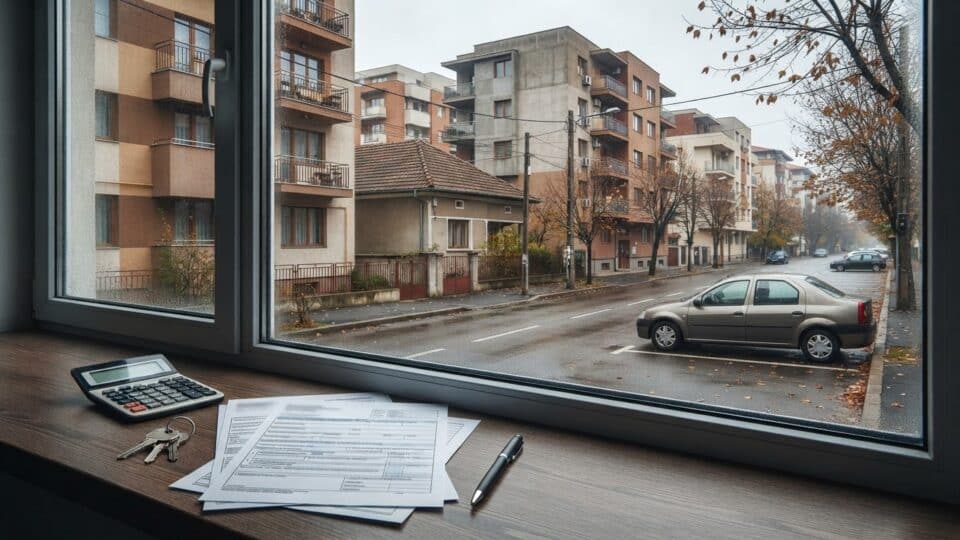
Local taxes for 2027 are beginning to take shape in proposals published by town and city halls, but home and car owners will not necessarily pay proportionately more everywhere. In Constanța, the administration proposes raising the rate for homes owned by individuals from 0.11% to 0.12%, increasing the general additional rate for cars, and scrapping the 200-leu charge for using municipal public or private property.
Other cities are considering keeping 2026 levels. Nationally, the finance minister announced on 6 November that general property taxation based on market value would not be introduced in 2027. InfoBuz explains what the legislation currently in force provides, what local administrations are proposing, and how taxpayers can estimate what they may owe next year—without confusing draft proposals with final decisions.
Local taxes in 2027: what is set and what remains to be decided
| Issue | Status documented on 28 November 2026 |
|---|---|
| Residential property tax based on market value | The finance minister said it would not be introduced in 2027; our research identified no new general methodology applicable to properties owned by individuals. |
| Building tax | Calculated under the Fiscal Code; the applicable rates and values must be checked locally. |
| Vehicle tax | Engine capacity and emissions standard are criteria introduced by the reform applicable from 2026. |
| Taxes in Constanța | A proposal was published on 4 November; selective increases and the removal of the 200-leu charge are proposed. |
| Payment deadlines | General rule: 31 March and 30 September, with the possibility of an early-payment discount for payment in full. |
Two concepts need to be distinguished from the outset: the annual tax set for a property, and charges linked to separate services or circumstances. An owner may owe building tax, land tax and, separately, local charges for certain services. For a car, the annual tax does not replace parking fees, the road vignette, compulsory motor liability insurance (RCA), or registration costs.
Market-value taxation: why the November announcement does not mean taxes are frozen
On 6 November 2026, Finance Minister Alexandru Nazare announced that Romania would not introduce property taxation based on market value from 2027. According to statements reported by AGERPRES, the reform discussed in the context of the National Recovery and Resilience Plan (PNRR) would be considered gradually towards the end of fiscal consolidation. The minister did not set a new, firm implementation date in that statement and said that any measures would be assessed in the budgetary context.
A government announcement is not the same as publishing a legal act. For homes owned by individuals, the general framework identified in the Fiscal Code remains a calculation based on floor area, statutory taxable values, applicable coefficients and the locally set rate. The asking price in a property listing, or the amount paid to buy a house, does not automatically become the home’s tax base. The local rate or other elements of the formula may nevertheless change even if the market-value reform does not take effect.
Fiscal context: who bears the cost of Romania’s budget adjustment in 2027.
How home tax is calculated
Article 457 of the Fiscal Code governs tax on residential buildings owned by individuals. Under the system in force, the calculation starts with the gross built area, the taxable value per square metre corresponding to the building’s characteristics, and the coefficient associated with the zone and the locality’s rank, subject to the adjustments provided by law. The result is multiplied by the applicable tax rate.
In the statutory table introduced for 2026, a type A building with the installations specified by law has a reference value of 2,677 lei per square metre. This is not an estimate of the selling price per square metre. The actual taxable value must be calculated under all applicable legal rules and the local decision. Usable area stated in a sales listing is not always the same as the fiscal area used in the calculation. Source: Article 457, consolidated version as of 25 October 2026, read together with Law No. 239/2025.
To isolate the effect of a rate change, we use three hypothetical taxable values that have already been adjusted. They are not market prices and do not describe specific properties.
| Tax base | 0.08% rate | 0.10% rate | 0.11% rate | 0.12% rate |
|---|---|---|---|---|
| 200,000 lei | 160 lei | 200 lei | 220 lei | 240 lei |
| 300,000 lei | 240 lei | 300 lei | 330 lei | 360 lei |
| 450,000 lei | 360 lei | 450 lei | 495 lei | 540 lei |
For a tax base of 300,000 lei, changing the rate from 0.11% to 0.12% increases annual tax by 30 lei, or about 9.09%. If the tax base also rose, its effect would have to be calculated separately. A hypothetical 7.3% increase in the base, combined with a rate increase from 0.11% to 0.12%, would produce an overall increase of about 17.05%, rather than simply the sum of the two percentages. This is a mathematical scenario, not a claim that Constanța municipality will apply both changes to all homes.
Older buildings: relief reintroduced in 2026
An important change, which could matter for the next tax year if the legislation remains unchanged, is Emergency Ordinance No. 9/2026. It reintroduced reductions in taxable value for buildings aged between 50 and 100 years inclusive (15%) and those over 100 years old (25%). Age is determined at the start of the fiscal year. Under the conditions set by law, major renovations may change the building’s fiscal completion year. Source: Emergency Ordinance No. 9 of 27 February 2026, Article VII.
For example, with a tax base of 300,000 lei and a hypothetical rate of 0.12%, tax before relief would be 360 lei. After a 15% reduction in the base, it would be 306 lei; after a 25% reduction, 270 lei. To apply the rule correctly, taxpayers should check the construction year in the tax records, the legal conditions and any changes for 2027.
People receiving tax relief should check the supporting documents and the duration of their entitlement. A reduction granted by a local decision for 2026 does not automatically continue in every case. Law No. 239/2025 introduced rules on assessing local relief and deciding whether to maintain or end it in 2027.
Vehicle tax: the formula applicable after the 2026 reform
Under Emergency Ordinance No. 78/2025, which amends Law No. 239/2025, tax on passenger cars with internal-combustion engines is calculated according to engine displacement and emissions standard. The number of 200cc bands is rounded up, and each band is multiplied by the rate corresponding to the engine-capacity category and Euro standard. Applicable additional rates, reductions and discounts must be checked locally.
| Passenger-car engine displacement | Non-Euro/E0–E3 | Euro 4 | Euro 5 | Euro 6 |
|---|---|---|---|---|
| Up to 1,600cc | 19.5 | 18.8 | 17.6 | 16.5 |
| 1,601–2,000cc | 29.7 | 28.5 | 26.7 | 25.1 |
| 2,001–2,600cc | 92.2 | 88.6 | 82.8 | 77.8 |
| 2,601–3,000cc | 182.9 | 172.8 | 154.1 | 151.2 |
Engine-capacity thresholds are particularly important. A 1,998cc Euro 6 car has ten 200cc bands, at 25.1 lei each, resulting in 251 lei before local adjustments. A 2,001cc Euro 6 car is already in the next category: eleven bands at 77.8 lei amount to 855.80 lei. The difference is 604.80 lei before additional rates. The engine’s commercial designation is therefore not enough for the calculation.
At the same engine capacity, the Euro standard affects the rate. The Fiscal Code does not automatically distinguish between two engines with the same displacement and Euro standard simply because one runs on petrol and the other on diesel. There are separate provisions for hybrids and electric vehicles. Owners should check the exact engine capacity and emissions classification in the vehicle documents, rather than infer the standard from the year of manufacture.
Constanța: what car owners could pay in 2027
The Constanța City Hall and SPIT Constanța proposal, released on 4 November, provides for the general additional rate to rise from 10.4% to 18%. For individuals who own more than one vehicle in the categories covered by the proposal, the proposed rates are 18% for the first, 30% for the second, and 50% for the third and subsequent vehicles. The order and practical application must be determined under the final version of the decision. Sources: SPIT Constanța and a summary of the proposal published by Ziua de Constanța.
| Example passenger car | Statutory base | With 10.4% (2026) | With 18% (2027 proposal) |
|---|---|---|---|
| 1,598cc, Euro 6 | 132.00 lei | 145.73 lei | 155.76 lei |
| 1,598cc, Euro 5 | 140.80 lei | 155.44 lei | 166.14 lei |
| 1,968cc, Euro 5 | 267.00 lei | 294.77 lei | 315.06 lei |
| 1,998cc, Euro 6 | 251.00 lei | 277.10 lei | 296.18 lei |
| 2,001cc, Euro 6 | 855.80 lei | 944.80 lei | 1,009.84 lei |
| 2,497cc, Euro 6 | 1,011.40 lei | 1,116.59 lei | 1,193.45 lei |
| 2,993cc, Euro 6 | 2,268.00 lei | 2,503.87 lei | 2,676.24 lei |
For a 1,968cc Euro 5 car, a common vehicle type in Romania’s car fleet, applying the 30% rate to the 267-leu base would mean 347.10 lei, while 50% would mean 400.50 lei. This illustrates the impact of owning multiple cars under the municipal proposal, not a general rule for all towns and communes in the county.
The proposal also removes the 200-leu annual charge for using public or private municipal property. Radio Romania Constanța notes litigation surrounding the charge in previous years. Its proposed removal does not automatically make parking free, nor does it justify including the 200 lei in every comparison with the tax actually owed in 2026. The position of sums paid previously must be checked separately.
Hybrid and electric cars: what to check
Under Article 470 of the Fiscal Code, electric cars have a base annual tax of 40 lei. For hybrids with CO₂ emissions of no more than 50g/km, legislation allows a reduction of up to 30% from the amount determined under the hybrid column, subject to the local decision. For those exceeding 50g/km, the dedicated rate applies. The Constanța proposal includes a 30% reduction for eligible hybrids. Not every vehicle marketed as a mild hybrid or plug-in hybrid automatically qualifies for the same reduction. The approved data and applicable local act are decisive.
Comparison across major cities: the same house, different liabilities
Local proposals published in November do not follow the same strategy. A Digi24 summary says Bucharest, Cluj-Napoca and Timișoara propose maintaining some 2026 levels, while Iași provides for a 7.3% update to some taxable values. Constanța proposes an increase in the residential rate. The following table uses the same hypothetical taxable value of 300,000 lei, without assuming that an identical real building would have the same tax base in every city.
| City | Proposed residential rate for individuals | Tax on a hypothetical 300,000-leu base |
|---|---|---|
| Iași | 0.08% | 240 lei |
| Sibiu | 0.08% | 240 lei |
| Cluj-Napoca | 0.10% | 300 lei |
| Timișoara | 0.10% | 300 lei |
| Brașov | 0.10% | 300 lei |
| Constanța | 0.12% | 360 lei |
Official documents can be followed on municipal websites, including Timișoara’s draft decision No. 667/2026 and the Cluj-Napoca public consultation. In the research carried out, we did not identify a final Constanța municipal decision for 2027. The city hall warned that the proposal may be updated if national legislation changes.
Land, payment deadlines and the household budget
Land tax is separate from building tax. The area, zone, locality rank, whether the land is inside or outside the built-up area, and the type of use can all affect the calculation. It cannot be estimated correctly simply by multiplying a land sale price by an arbitrarily chosen rate. Owners of a house with land should check both entries in their tax record.
The Fiscal Code’s general rule for paying building, land and vehicle taxes sets two deadlines: 31 March and 30 September. For payment in full by the first deadline, the local council may set a discount of up to 10%. The Constanța proposal provides 10% for individuals and 5% for legal entities. For a hypothetical liability of 675 lei and a 10% discount, payment would be 607.50 lei before applicable rounding. The benefit should not be assumed for every separate charge.
Under the general legislation, liability for the entire fiscal year is, in principle, owed by the person who owns the asset on 31 December of the preceding year, subject to specific rules on acquisition, disposal and declaration. If you sell or buy a car or home, check the statutory filing deadline and that your tax record has been updated. Local tax-office services and Ghișeul.ro may be used to view and pay amounts, where the institution is enrolled on the platform.
Also read InfoBuz’s analysis of purchasing power and what is known about pensions and wages in 2027.
Frequently asked questions
Will all local taxes rise by 7.3%?
Not automatically. Proposals differ by locality, and some categories have special rules. Indexing the tax base and raising the rate are two distinct mechanisms.
Can I calculate vehicle tax from the year of manufacture alone?
No. You need the exact engine displacement, emissions standard and, where applicable, CO₂ emissions, as well as local rates and relief.
Does the 200-leu car charge disappear across Constanța County?
The discussion concerns a charge specific to Constanța municipality. The municipal proposal does not set the tax liabilities of other towns and communes in the county.
Check the local decision before setting your 2027 budget
Owners now have enough information to make cautious estimates, but not all amounts are final. In Constanța, if the proposal is adopted in the form reviewed here, a home with the same tax base would face an increase of about 9.1% resulting from the rate, while standard vehicle tax would rise by about 6.9% through the additional-rate change from 10.4% to 18%. Proposals in other municipalities take different approaches. The key checks remain the final local act, the asset details in the tax record and any applicable relief.
InfoBuz editorial analysis, documented on 28 November 2026. The examples are simulations, not tax assessments. Local rates for 2027 are presented as proposals where final adoption was not identified. The main image is an illustration generated using artificial intelligence.


Discuția cititorilor
Ai o opinie sau o întrebare despre acest articol? Spune-ne ce crezi.
Fii primul care deschide discuția.
Te rugăm să păstrezi un limbaj civilizat și să discuți la subiect. Comentariile spam sunt filtrate automat.