
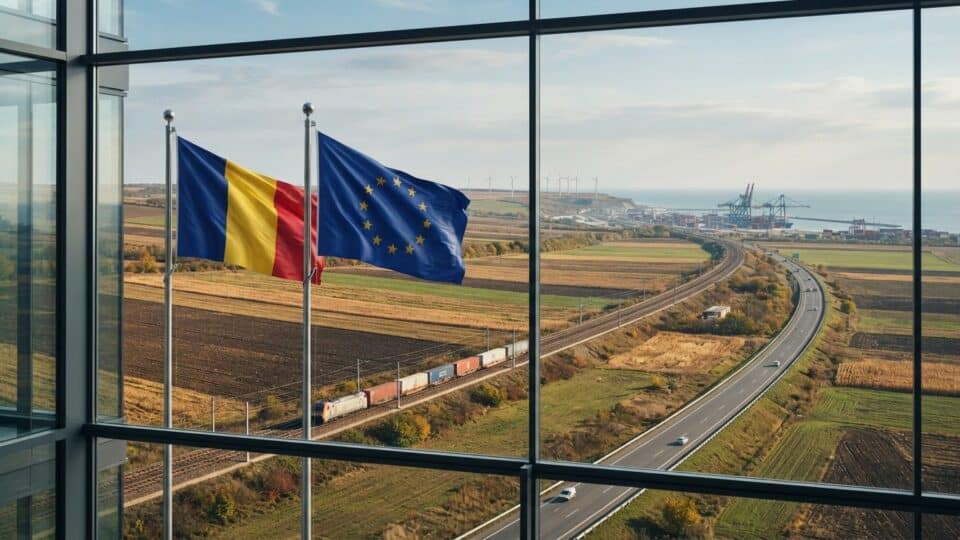
The EU budget for 2028–2034 remains without a political agreement after the extraordinary European Council meeting of 26–27 November 2026. The leaders of the member states failed to agree on the budget’s overall size, how the money should be divided or its sources of financing. The next decisive round of talks is expected at the meeting on 17–18 December.
For Romania, the stakes go beyond the size of a European allocation. The government is preparing a national investment plan for estimated funding of more than €60 billion, but this amount is not an approved, definitive entitlement. At the same time, the new budget architecture could change how farmers, municipalities, infrastructure projects and businesses are funded. Romania must negotiate both how much money it will receive and the rules under which it can use it.
EU budget: why the 26–27 November summit ended without a deal
On 21 November, European Council President António Costa presented a compromise version for the next multiannual financial framework (MFF). It proposes a ceiling of €1.582 trillion, 10.2% below the European Commission’s initial proposal, according to the official presentation of Costa’s proposal.
The discussions focused on three elements: the budget’s size, the distribution of resources among policy areas and the introduction of new EU own resources to limit pressure on national contributions. Countries in favour of a smaller budget are concerned about the cost borne by their taxpayers. By contrast, countries for which agriculture and cohesion are important development tools want to protect that funding, Radio Romania Actualități reports.
The differences were not resolved at the meeting. Since the MFF regulation requires unanimity in the Council of the EU and the European Parliament’s consent, a majority in favour of one version is not enough. The absence of an agreement does not mean that Romania’s current programmes have been suspended or that a specific amount has already been cut from its national allocation.
Four financial benchmarks: how to compare the proposals correctly
Figures ranging from roughly €1.5 trillion to €2 trillion have appeared in public debate. The differences reflect not only political positions but also methodology. Some figures include repayment of the debt raised for NextGenerationEU, while others exclude it; some are expressed in current prices, others in 2025 constant prices.
| Proposal | Value (€bn) | Basis for comparison |
|---|---|---|
| European Commission, July 2025 | 1,613.8 | 2025 prices, excluding repayment of NGEU debt |
| European Commission, including NGEU repayment | 1,763.1 | 2025 prices, including debt repayment |
| European Parliament, April 2026 | 1,789 | 2025 prices, excluding NGEU repayment |
| Irish Presidency, October 2026 | 1,473 | Excluding NGEU repayment |
| Costa proposal, November 2026 | 1,582 | Total ceiling, according to the official presentation |
The European Parliamentary Research Service analysis shows that Parliament wants a larger budget for EU policies, with NGEU repayment outside the ceiling requested for those policies. Separately, the European Commission describes its initial proposal as a budget of almost €2 trillion in current prices.
These accounting differences are crucial. A ceiling expressed in current prices may be larger than one in constant prices without its real funding power increasing to the same extent. Including debt repayment in the total also reduces the amount available for new policies compared with an identical ceiling that does not include that obligation.
Read also InfoBuz’s October analysis of the Irish Presidency proposal to understand how the negotiations have developed.
What Romania wants: protecting traditional funding and accessing competitiveness funds
After the summit, President Nicușor Dan set out two complementary objectives. The first is to maintain funding levels for agriculture and cohesion, alongside flexible rules for using the money. The second concerns Romanian companies’ effective access to instruments for competitiveness and the defence industry. In statements on 27 November, the president said that Romania would remain a net beneficiary of the EU budget regardless of the versions under negotiation. This is the president’s stated position, not a final calculation of Romania’s balance over the next seven years.
Sources: statements in Brussels reported by AGERPRES and Radio Romania Actualități.
On 24 November, the Presidential Administration held a consultation with more than 80 civil-society representatives. The 25 November statement highlights concerns over energy, connectivity, security and reducing regional disparities. These objectives must be turned into eligible projects, not merely political positions.
More than €60 billion for Romania: what the figure means
The 2026–2028 governing programme, presented in October, provides for the preparation of the National and Regional Partnership Plan (PPNR) for an estimated allocation of more than €60 billion. According to AGERPRES’s summary of the programme, the authorities intend to retain the responsibilities of the eight regional programmes, submit the plan informally to the Commission by the end of 2027 and seek its adoption by July 2028.
It would not be accurate to present this estimate as €60 billion in guaranteed funding. The PPNR will depend on the final regulation, allocation formulas, approval of the plan and fulfilment of the applicable conditions. EU-level competitive funding has different access mechanisms and should not automatically be added to the national allocation as though all of it were certain.
To illustrate the scale of the risk, InfoBuz uses a purely illustrative baseline of €60 billion. It is rounded and does not purport to represent Romania’s latest negotiated offer.
| Hypothetical scenario | Seven-year allocation | Difference from baseline |
|---|---|---|
| Maintained | €60bn | 0 |
| 5% reduction | €57bn | −€3bn |
| 10% reduction | €54bn | −€6bn |
| 5% increase | €63bn | +€3bn |
An additional or missing €1 billion could substantially change the capacity to fund projects. Yet an allocation is a ceiling on available resources, not the value of money spent. Its real economic effect also depends on contracting, investment delivery and eligible payments.
Agriculture and cohesion: the new structure could change the rules
Under the Commission’s proposal, programmes for regional development, agriculture, fisheries and other areas would be brought together in a national and regional plan for each member state. On 16 June 2026, the Council adopted a partial negotiating position on these plans. It seeks simpler rules and a stronger role for regions, while retaining links between funding, reforms and investments. The decisive financial aspects have not yet been settled.
In the Costa version, agriculture, fisheries and cohesion together account for 42.4% of the proposed structure, compared with 59.1% in the comparison presented for the 2021–2027 framework. The smaller share does not in itself demonstrate an identical absolute cut: the budget’s size, the reclassification of programmes and new repayment obligations must also be considered.
| Area | 2021–2027 MFF | Costa proposal, 2028–2034 |
|---|---|---|
| Agriculture, fisheries and cohesion | 59.1% | 42.4% |
| Competitiveness, security and defence | 17.7% | 27.7% |
| Global Europe | 9.6% | 9.5% |
| NextGenerationEU repayment | 2.1% | 8.9% |
| Administration | 6.8% | 6.1% |
| Other areas | 4.7% | 5.4% |
For farmers, the key questions are whether income support will have a sufficient ring-fenced amount, how investment will be funded and what conditions will have to be met. A small farm, a large cereal operation and a processing cooperative have different needs. In Dobruja, irrigation efficiency, water availability, soil protection and drought adaptation could be particularly important. The existence of a priority, however, does not amount to approval of a scheme or a per-hectare subsidy.
For municipalities and regions, the risk is that local projects could end up competing with more visible national priorities. The potential benefit is less administrative fragmentation and better coordination of investment. The outcome depends on financial safeguards and on regional authorities having a genuine role in drawing up the plan.
Constanța and Dobruja: six investment opportunities worth preparing
In the South-East region, projects with economic and social impact could combine cohesion, connectivity, energy-transition and competitiveness objectives. The following table is an editorial assessment of opportunities, not a list of projects approved for 2028–2034.
| Regional priority | Examples of investment | What must be demonstrated |
|---|---|---|
| Port of Constanța and logistics | Rail links, intermodal access, operational efficiency | Capacity, reduction of bottlenecks, cross-border usefulness |
| Urban mobility | Public transport, metropolitan connections | Transport demand, operating costs, integration between localities |
| Agriculture and water | Efficient irrigation, drought adaptation, local processing | Sustainable water resources and measurable benefits |
| Energy | Networks, flexibility, energy efficiency | Feasibility, grid access, reduced losses |
| Health and education | Medical equipment, schools, vocational training | Staffing, accessibility, long-term maintenance |
| Danube Delta and coast | Ecosystem protection, water and sewerage, climate resilience | Environmental impact, compatibility with protected-area rules |
One concrete example of the need for preparation is the Constanța metropolitan rail project, for which several corridors are being assessed. Studies, demand assessment and selection of the technical solution matter regardless of the future source of funding. This does not mean that the project has already received money from the new MFF.
Competitiveness: where Romania could win additional funding
The European Competitiveness Fund, research and strategic infrastructure may create opportunities for Romanian companies. In this area, the mere existence of an EU allocation does not guarantee winning funding. If calls are run competitively, applicants will need to prepare projects that meet European criteria, ensure delivery capacity and form partnerships where necessary.
A company with its own technology, a university developing a prototype and an industrial operator modernising its processes may have separate routes to support. Romania could miss opportunities not because it is denied a fixed share, but because applicants lack mature projects, co-financing or sufficiently competitive consortia. Creating applicant-support services and cutting administrative delays could, in this context, have a direct economic effect.
After the NRRP: why a large allocation is not enough
The experience of Romania’s National Recovery and Resilience Plan (NRRP) shows the importance of administrative capacity and timing. An EU-funded project may require national money for the beneficiary contribution, ineligible costs or pre-financing. Pressure on the state budget makes this equation more difficult. See InfoBuz’s analysis of Romania’s investments after the NRRP.
Consider, for illustration only, an eligible investment of €100 million. At a hypothetical funding rate of 85%, the EU contribution would be €85 million and the beneficiary contribution €15 million. At a 70% rate, the beneficiary contribution would rise to €30 million. If a further €10 million in ineligible costs arises separately, it must be covered from other sources. These are not confirmed funding rates for the next period, but an example of why the rules matter.
Infrastructure must also be operated after completion. A water-treatment plant, railway line or medical building does not provide lasting benefits without staff, energy and maintenance budgets. Investment selection should include these costs over the asset’s full lifetime.
The negotiating timetable and what to watch in December
According to the official Council of the EU timetable, the aim is to secure a political agreement before the end of 2026 so that regulations and programmes can be adopted in 2027. The 17–18 December meeting is the next political milestone, not a guarantee of agreement. The new framework is scheduled to begin on 1 January 2028.
In the next negotiations, Romania must pay particular attention to the amount reserved for agriculture and cohesion, the allocation formula among member states, co-financing rules, eligibility deadlines and the role of regions. At the same time, decisions on EU own resources will affect national contributions and the balance between traditional and new policies.
Frequently asked questions about the EU budget
Has Romania already lost 10.2% of its EU funding?
No. The percentage describes the difference between two budget proposals at EU level, not an approved cut to Romania’s allocation.
Is the more than €60 billion guaranteed?
No. It is the estimate used in the governing programme to prepare the national and regional plan. The final amount depends on the negotiations and the legislation that is adopted.
Will agricultural subsidies stop in 2027 because of the deadlock?
This does not follow from the lack of agreement on the next framework. Current programmes follow the rules of their own funding period, while future subsidies will depend on rules approved for the period after 2027.
Romania must negotiate and prepare projects at the same time
The EU budget to 2034 could become an important driver of economic convergence for Romania, but the outcome will depend both on the resources negotiated and on the quality and delivery capacity of its projects. Protecting agriculture and cohesion does not preclude a focus on competitiveness. On the contrary, a more productive economy and better-connected regions can reinforce those objectives. The next negotiations should be assessed by the rules and amounts actually agreed, rather than by promises prematurely treated as certainties.
InfoBuz editorial analysis, documented on 28 November 2026. Final allocations have not been set. Funding scenarios are illustrative. The main image was generated with artificial intelligence and is not a documentary photograph.


Discuția cititorilor
Ai o opinie sau o întrebare despre acest articol? Spune-ne ce crezi.
Fii primul care deschide discuția.
Te rugăm să păstrezi un limbaj civilizat și să discuți la subiect. Comentariile spam sunt filtrate automat.