
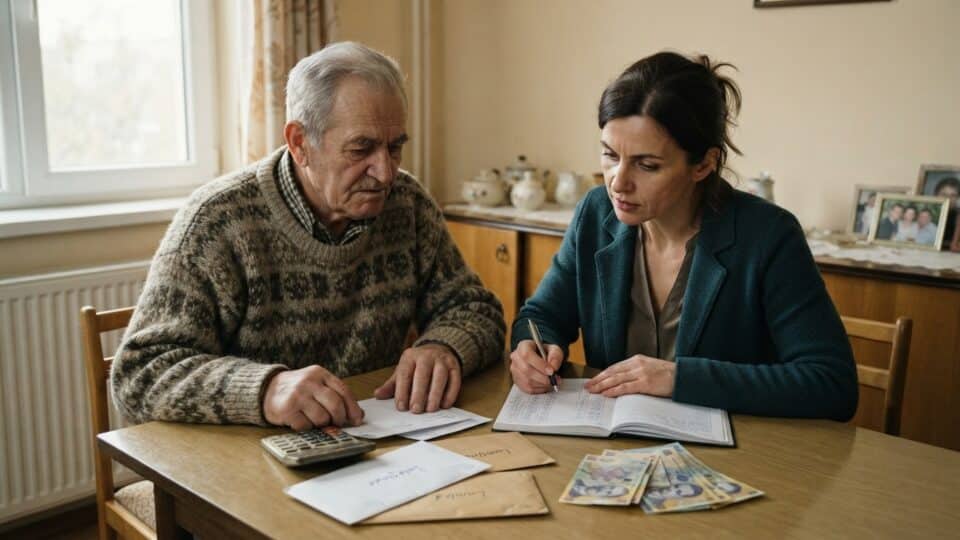
Discussions over pensions and wages in 2027 have become a major issue for millions of Romanians after differing statements made by government representatives on Friday, 27 November 2026. Labour Minister Florin Manole says pensions will be indexed from 1 January 2027, though the percentage has yet to be set. Finance Minister Alexandru Nazare has not offered a guarantee, pointing instead to negotiations over next year’s budget as the point at which decisions will be made.
At the same time, a briefing presented at the government meeting of 26 November highlighted the legal obligations triggered by public debt exceeding 60% of GDP. What does this mean for a pensioner, a public-sector employee or a private-sector worker? InfoBuz separates rights provided for by law, political promises, budgetary constraints and strictly illustrative scenarios.
Pensions and wages in 2027: what is confirmed as of 27 November
| Issue | Position as of 27 November 2026 |
|---|---|
| Reference point value (VPR) in 2026 | 81 lei, under Law No. 141/2025 |
| Pension indexation in 2027 | The general rules are due to apply in 2027 under the legislation in force; budgetary conditions and any legislative amendments remain to be clarified |
| Indexation percentage | No final percentage has been announced |
| General pay rise for public-sector employees | No final decision for 2027 has been announced |
| General gross minimum wage | 4,325 lei a month, applicable from 1 July 2026; any new amount must be officially confirmed |
| 2027 budget | Government approval of the draft is estimated for the second or third week of December |
The crucial distinction is between the existence of a legal mechanism for adjusting incomes and the adoption of a specific measure backed by the necessary budgetary resources. Neither claims of a guaranteed increase by a particular percentage nor claims that every pension will inevitably be frozen until 2031 are supported by the information available.
What the labour minister, finance minister and president said
The labour minister reiterated his intention to restart indexation at the beginning of the year, without putting forward a final percentage. He argued that pensioners had gone through two years in which the reference value remained unchanged and that price rises had eroded purchasing power. His position was reported by News.ro.
The finance minister said the options would be assessed while the budget is being prepared. The indicative timetable communicated publicly places government approval of the draft in the second or third week of December. According to statements reported by Digi24, the minister rejected the interpretation that the public-debt briefing was, in itself, a decision to freeze incomes for five years.
President Nicușor Dan said in Brussels that he could not at this point guarantee increases in both pensions and wages. He stressed the need to meet the deficit target and said debate on budget allocations was only beginning, according to TVR Info.
These three positions are not pieces of legislation. They illustrate a tension between the social objective of protecting incomes and the obligation to produce a sustainable budget. The government programme presented in October provides for pension indexation to resume and for a draft law on public-sector pay to be prepared in 2027, according to AGERPRES. A government programme sets priorities; it does not itself change the amount of a pension or wage.
How Romania’s public pension is calculated and what the law provides for 2027
Under the system regulated by Law No. 360/2023, a contributory pension is calculated by multiplying the total number of points by the reference point value, known by its Romanian abbreviation VPR. The VPR is distinct from the former pension point. In 2025 and 2026, it remained at 81 lei following legislative derogations adopted for those years.
Article 84 of the pension law provides for an annual increase mechanism using the average annual inflation rate and half of the real growth in average gross earnings, based on final indicators reported by Romania’s National Institute of Statistics (INS). The law also includes rules for negative values and limits related to changes in social contributions and inflation. Article XXXI of Law No. 141/2025 keeps the VPR at 81 lei for 2026 and postpones application of those provisions until 2027.
Legislative sources: Law No. 360/2023, Articles 83–84, consolidated text and Law No. 141/2025, Article XXXI, consolidated version as of 12 November 2026. The authoritative texts are those published in Romania’s Official Gazette.
The legislation currently in force therefore provides for the mechanism to resume in 2027, but the concrete result depends on the applicable legal indicators and any subsequent legislation. It would be wrong to take a recent monthly inflation figure and present it as a certain indexation percentage. Annual inflation in a given month, the average annual rate, EU-harmonised inflation and a forecast for the following year are not interchangeable indicators.
How much could pensions rise? Four illustrations, not promises
To show the scale of a possible increase, InfoBuz calculated several examples using hypothetical percentages. Solely for illustration, the table assumes that the increase applies in full to the stated gross amount. In practice, the calculation may differ depending on the VPR set by law, rounding, allowances, an individual’s circumstances and the tax regime.
| Initial gross pension | +3% | +5% | +7% | +10% |
|---|---|---|---|---|
| 1,500 lei | 1,545 lei | 1,575 lei | 1,605 lei | 1,650 lei |
| 2,000 lei | 2,060 lei | 2,100 lei | 2,140 lei | 2,200 lei |
| 2,500 lei | 2,575 lei | 2,625 lei | 2,675 lei | 2,750 lei |
| 3,000 lei | 3,090 lei | 3,150 lei | 3,210 lei | 3,300 lei |
| 4,000 lei | 4,120 lei | 4,200 lei | 4,280 lei | 4,400 lei |
For example, for a gross pension of 2,500 lei, a hypothetical 5% increase would mean an additional 125 lei a month, or 1,500 lei over a full year. A one-off payment of 500 lei, by contrast, does not produce the same permanent increase in the pension base. The two instruments should be assessed separately, even if both temporarily improve income.
Why public debt above 60% of GDP matters
According to a government statement of 26 November, government debt calculated under the European methodology reached 61.1% of GDP at the end of August 2026. Crossing that threshold has consequences under the Fiscal-Budgetary Responsibility Law No. 69/2010.
Article 13 of Law No. 69/2010 establishes measures for different debt levels. At the 60% threshold, the legal framework provides, among other measures, for those applicable at earlier thresholds and for the initiation of a debt-reduction programme, with legislative measures within the deadline set by law. There are also provisions relating to exceptional circumstances.
Importantly, the restrictions concern total spending on personnel and social assistance. An overall spending envelope is not the same as an individual income. That does not mean every individual increase is automatically possible: its compatibility with legal limits, the composition of spending and approved allocations must be demonstrated. Savings in other areas may help the overall deficit, but do not by themselves remove a separate restriction on a particular spending category.
The government’s stated objective is to reduce the deficit below 3% of GDP by 2031 and bring debt back below the 60% threshold from that year. The timetable is an objective conditional on economic developments and measures taken, not a guarantee that all individual incomes will remain unchanged until then.
Further context: InfoBuz’s analysis of who will bear the cost of fiscal adjustment in 2027.
Public-sector wages in 2027: what the new pay law would mean
Employees in education, healthcare, public administration and other public institutions need to distinguish between a general change to the pay scale, a change to an individual base salary, bonuses, promotions and moving into a different seniority bracket. These do not all have the same legal basis, nor are they all affected in the same way by fiscal measures.
The government programme provides for a draft of the new public-sector pay law to be prepared in 2027. Preparing a draft does not mean a new pay scale takes effect immediately, and passing a law does not guarantee that all its changes will enter into force on the same day. There may be transitional rules or phased implementation. Until the draft is published, it is not possible to responsibly calculate net wages by position.
A pay reform may seek to correct imbalances between similar positions and make bonuses more transparent, but it must be costed. Differences between sectors may mean that a change does not affect every category of employee uniformly. For a public-sector worker, the documents to follow are the pay rules applicable to their institution and any derogations for 2027.
The minimum wage and private-sector employees
Under Government Decision No. 146 of 12 March 2026, published in Official Gazette No. 196 of 13 March, the general gross minimum wage rose to 4,325 lei from 1 July 2026, excluding bonuses and other additions. The previous level was 4,050 lei. The nominal rise was 275 lei, equivalent to approximately 6.79%. Source: the government statement of 12 March 2026.
At the time of reporting, no decision setting a new general amount from 1 January 2027 had been identified. In the absence of a change, the applicable legal level remains that currently in force. Net pay cannot be calculated by applying a universal percentage to gross pay: contributions, tax relief, deductions and personal circumstances can alter the amount received.
In the private sector, a limit on the state’s wage spending does not mean that all wages are frozen. Employers may set increases in accordance with labour law, contracts and economic performance. A rise in the minimum wage may require adjustment of base salaries below the new legal threshold, but does not automatically mean the same percentage increase for every employee already earning above the minimum.
Pensions and wages in 2027: how much must they rise to preserve purchasing power?
A nominal increase is not necessarily a real improvement in living standards. If net income rises by 5% but the prices in a household’s basket rise by 7%, purchasing power falls by approximately 1.87%. If both rise by 5%, real income remains broadly unchanged.
| Net income increase | Rise in the consumer basket’s cost | Change in purchasing power |
|---|---|---|
| 0% | 5% | −4.76% |
| 3% | 5% | −1.90% |
| 5% | 5% | 0% |
| 7% | 5% | +1.90% |
| 10% | 5% | +4.76% |
For pensioners who spend a high share of their income on food, heating and medicines, personal inflation may differ from the average. The same applies to families with children, rent or bank loan repayments. A realistic assessment of an increase should therefore start with net income and a household’s actual costs, rather than the announced percentage alone.
Also read the analysis of the average pension and differences in purchasing power.
Decision timetable: what to watch in December and January
The first milestone is the publication of the draft budget and its supporting documents. This is followed by government approval, parliamentary debate, adoption and promulgation of the budget laws, as well as any separate legislation on pensions and wages. The timetable communicated by the finance minister is indicative; government approval of a draft should not be confused with every measure entering into force.
A reader who comes across an announcement of an increase should check four things: the legal act and its publication date, the category of beneficiaries, whether the amount is gross or net, and the effective date of application. For an individual pension, documents from the National Public Pensions House and its territorial offices are the relevant reference points. For wages, the individual employment contract, pay documents and information from the employer are decisive.
More on the budget process: Romania’s 2027 budget: the five decisions that will matter.
Frequently asked questions
Will all pensions definitely be indexed on 1 January 2027?
The law in force provides for the indexation mechanism to resume in 2027, and the labour minister supports applying it from 1 January. As of 27 November, however, no final percentage has been announced and the budget process is not complete. The final form of the legislation should be monitored.
Will pensions be frozen until 2031?
The verified information contains no decision that automatically fixes every individual pension at its current level until 2031. Fiscal-budgetary legislation imposes constraints on total spending, while concrete measures must be adopted in accordance with the law.
Will the minimum wage rise from 1 January 2027?
The confirmed general level is 4,325 lei gross a month, applicable since July 2026. A new amount requires confirmation through an official act.
Are indexation and one-off financial aid the same thing?
No. Indexation changes the calculation base for recurring payments, subject to the conditions of the legal act. One-off aid is granted under its own rules and does not automatically raise the base pension for all subsequent months.
The budget will determine how much of the promises can be delivered
The discussion of pensions and wages in 2027 cannot be reduced to a single percentage. Romania must reconcile protection of purchasing power with its legal obligations on public finances. For households, the distinction between a promise, a draft and legislation in force remains essential. Until the terms are formalised, it is prudent to base personal budgets on confirmed income rather than expected increases.
InfoBuz editorial analysis, reported on 27 November 2026. The simulation tables are not individual pension calculations or promises of increases. The main image is an AI-generated editorial illustration.


Discuția cititorilor
Ai o opinie sau o întrebare despre acest articol? Spune-ne ce crezi.
Fii primul care deschide discuția.
Te rugăm să păstrezi un limbaj civilizat și să discuți la subiect. Comentariile spam sunt filtrate automat.