
Updated: 29 November 2026 la 17:41. Articolul a fost revizuit pentru a reflecta informațiile disponibile la această dată.
Electricity bills in winter 2026–2027 will be shaped both by higher consumption during the colder months and by the contracted energy price, regulated charges and taxes included in every kilowatt-hour. As of 29 November 2026, the gap between available offers is wide enough for two households with the same consumption to receive very different bills, even if they are connected to the same grid.
An InfoBuz analysis of official offer documents published on ANRE’s comparison platform shows that, in Dobrogea, an active-energy price of 0.515 lei/kWh before the grid-injection charge results in a final price of about 1.18911 lei/kWh including VAT. In addition, on 24 November, the Energy Minister proposed temporarily extending the 50-leu support measure for vulnerable consumers and developing a new mechanism in 2027. The extension should not yet be treated as an adopted measure. This guide breaks down the bill, compares regions and calculates what a family could save.
Electricity bill: where the money goes for 200 kWh
The price shown in an advertisement is not always the final amount paid by the customer. According to ANRE’s explanation of what an electricity bill contains, active energy includes purchasing and supply costs, while network services, levies and applicable taxes are added to the price. Some offers also include a fixed subscription charge or additional services.
To show the exact proportions, we use the annex on page 4 of the official Hidroelectrica Viitor Hidro offer, code C3-0111-3011-26, drawn up on 30 October and available for acceptance from 1 to 30 November 2026. The example is for a low-voltage household customer in the Dobrogea distribution area, using 200 kWh and with no previous balance. The offer is variable, and these calculations do not guarantee the price throughout the winter.
| Component | Lei/kWh before VAT | Amount for 200 kWh |
|---|---|---|
| Active energy, including grid injection (TG) | 0.51863 | 103.73 lei |
| Transmission – grid withdrawal (TL) | 0.03645 | 7.29 lei |
| System services (TS) | 0.01272 | 2.54 lei |
| Low-voltage distribution | 0.31739 | 63.48 lei |
| Contracts for Difference contribution (CfD) | 0.000144 | 0.03 lei |
| Green certificates | 0.0740192 | 14.80 lei |
| Cogeneration contribution | 0.01570 | 3.14 lei |
| Excise duty, non-commercial consumption | 0.00768 | 1.54 lei |
| VAT at 21%, calculated on the subtotal | about 0.20637 | 41.27 lei |
| Total | 1.18911 including VAT | 237.82 lei |
In this example, active energy including TG accounts for about 43.6% of the final amount; distribution, 26.7%; transmission through the TL component and system services, about 4.1%; other contributions and excise duty, about 8.2%; and VAT, 17.4% of the total. VAT at 21% is applied to the pre-tax value; it does not mean 21% of the amount that already includes it. Active energy including TG is also not the supplier’s profit: it includes purchasing and supply costs as well as the grid-injection component.
Why electricity bills differ between Constanța, Bucharest, Iași and other counties
The supplier is the company that sells electricity and issues the bill. The distribution operator manages the local grid and the services associated with it. Choosing another supplier does not automatically change the distribution operator serving the consumption point. Network charges approved by ANRE vary by operator and voltage level.
In the Viitor Hidro offer annex, the active-energy price, including TG, is identical across all areas analysed. The difference in the final price comes from the regional distribution charge, as the other components in the document are the same. For comparison, we also checked the official Hidrofix offer C2-0111-3011-26, available for acceptance during the same period.
| Distribution area | Viitor Hidro, lei/kWh incl. VAT | Hidrofix, lei/kWh incl. VAT | 200 kWh – Viitor Hidro |
|---|---|---|---|
| Dobrogea, Southern Muntenia and Banat | 1.18911 | 1.23146 | 237.82 lei |
| Northern Muntenia, Northern and Southern Transylvania | 1.23503 | 1.27738 | 247.01 lei |
| Oltenia | 1.20830 | 1.25065 | 241.66 lei |
| Moldova | 1.27444 | 1.31679 | 254.89 lei |
A family in the Moldova distribution area would pay about 17.07 lei more for 200 kWh than one in Dobrogea under the same variable offer. If the same consumption and charges remained in place for 12 months, the gap would reach about 204.79 lei. In the offer documents, the Dobrogea area includes Constanța, Tulcea, Călărași and Ialomița counties. Consumers should check the operator associated with their address, rather than the supplier’s registered office or the account holder’s home address.
Fixed or variable price: the cost of predictability for the next 12 months
The Viitor Hidro offer lists a price of 0.515 lei/kWh excluding TG, while Hidrofix lists 0.550 lei/kWh excluding TG. Under the first offer, commercial terms may be changed during the contract, subject to the document’s conditions; the second fixes the commercial component for 12 months. In both cases, regulated charges and taxes may change in line with legislation. Fixing the active-energy price therefore does not freeze every item on the bill.
| Monthly consumption | Viitor Hidro – Dobrogea | Hidrofix – Dobrogea | Monthly difference |
|---|---|---|---|
| 100 kWh | 118.91 lei | 123.15 lei | 4.24 lei |
| 200 kWh | 237.82 lei | 246.29 lei | 8.47 lei |
| 300 kWh | 356.73 lei | 369.44 lei | 12.71 lei |
| 500 kWh | 594.56 lei | 615.73 lei | 21.18 lei |
| 1,000 kWh | 1,189.11 lei | 1,231.46 lei | 42.35 lei |
For a household using 2,400 kWh a year, the difference between the two commercial components would amount to about 101.64 lei including VAT if prices remained those in the documents. The fixed option becomes more advantageous than the variable one if the weighted average variable commercial price exceeds the fixed commercial price, assuming the same additional costs. If the variable price falls, the fixed contract may become less attractive. There is no universally superior option.
The documents reviewed expire for acceptance on 30 November. This is the offer deadline, not the end date of all contracts already concluded. Before signing in December, consult the new document, check who is eligible and review the conditions that apply after the contractual period ends.
How much you can save by changing contracts without cutting consumption
An independent compilation of POSF data, published by FurnizoriEnergy.ro on 26 November, indicated an approximate range of 1.19–2.76 lei/kWh among the offers analysed. This range describes the offers available in that sample, not the prices actually paid by all households. Other comparison tools use different filters, areas and consumption assumptions. The calculations below therefore use rounded hypothetical final rates, rather than a commercial ranking.
| Consumption | 1.20 lei/kWh | 1.50 lei/kWh | 1.80 lei/kWh | 2.10 lei/kWh |
|---|---|---|---|---|
| 100 kWh/month | 120 lei | 150 lei | 180 lei | 210 lei |
| 200 kWh/month | 240 lei | 300 lei | 360 lei | 420 lei |
| 300 kWh/month | 360 lei | 450 lei | 540 lei | 630 lei |
| 500 kWh/month | 600 lei | 750 lei | 900 lei | 1,050 lei |
| 2,400 kWh/year | 2,880 lei | 3,600 lei | 4,320 lei | 5,040 lei |
At 200 kWh per month, a hypothetical switch from 1.80 to 1.20 lei/kWh would reduce the bill by 120 lei, or 1,440 lei a year if rates and consumption remained unchanged. For low consumption, a fixed component matters far more. A contract at 1.25 lei/kWh with a 20-leu monthly subscription would cost 145 lei at 100 kWh, while another at 1.40 lei/kWh with no subscription would cost 140 lei. At 300 kWh, the first would cost 395 lei and the second 420 lei. The mathematical break-even point is about 133.33 kWh a month. Always compare the full annual cost, not just the rate on the first page.
Why a December bill can rise even if the rate does not change
Shorter days, additional lighting, electrically heated hot water, drying laundry and electric heating can all increase consumption. If a household rises from 200 to 320 kWh, at the illustrative rate of 1.18911 lei/kWh its bill would rise from 237.82 to about 380.52 lei. The difference of about 142.70 lei would result solely from consumption.
To assess which appliances generate costs, use the energy actually consumed in kWh, not only the power stated on the label. A 2 kW appliance running continuously for three hours uses 6 kWh. If a thermostat switches it off periodically, actual consumption may be lower.
| Example of additional consumption over 30 days | Energy | Cost at 1.18911 lei/kWh |
|---|---|---|
| 2 kW radiator, two equivalent hours daily | 120 kWh | 142.69 lei |
| 1.5 kW water heater, one equivalent hour daily | 45 kWh | 53.51 lei |
| Additional 40 W LED lighting, five hours daily | 6 kWh | 7.13 lei |
| Constant 20 W load | 14.4 kWh | 17.12 lei |
The priority should be identifying major sources of consumption, not unplugging essential equipment. Maintain safe temperatures at home, avoid makeshift electrical solutions, and do not overload sockets or extension leads with heating equipment. For an analysis of heating options, read InfoBuz’s comparison of gas, heat pumps and electric heating. A household with a smart meter may find it easier to track consumption by interval, if the operator makes that data available.
What happens if regulated charges change in 2027
At the time of reporting, this analysis does not use a new final schedule of distribution charges for 2027. It is nevertheless possible to model the bill’s sensitivity. A hypothetical 0.05 lei/kWh pre-VAT increase in distribution charges would mean a 0.0605 lei/kWh increase including VAT, or 12.10 lei for 200 kWh. A hypothetical 0.10 lei/kWh pre-VAT change in commercial energy would add 24.20 lei at the same consumption. These calculations do not predict ANRE orders that have not been confirmed.
A real change may affect several components at once. For customers, the correct comparison is between the old and new effective prices for the same consumption and without previous balances. If a bill includes periods with different rates, the supplier must bill according to the rules and terms applicable to each period. Check the breakdown, dates and explanations in the contract.
The 50-leu energy voucher: who qualifies and what is being discussed for 2027
The current mechanism, introduced through Emergency Ordinance No. 35/2025 and extended through Emergency Ordinance No. 89/2025, applies until 31 December 2026, according to ANPIS information dated 20 February. The monthly 50-leu support measure is intended for single people with net income of up to 1,940 lei a month and families with net income of up to 1,784 lei per member, subject to the legal conditions. It is granted for one consumption point only and can be used to pay for electricity, not as cash.
Statements by the Energy Minister on 24 November indicate an intention to extend the measure in the short term, update the thresholds and prepare a scheme that takes more factors of energy vulnerability into account. These are proposals. In the sources checked on 29 November, we did not identify an adopted act guaranteeing the 50-leu voucher after 31 December.
In the example bill of 237.82 lei, an eligible beneficiary able to use the full 50 lei would have 187.82 lei left to pay. On a bill of 500 lei, the support would cover 10%. The mechanism is separate from heating assistance and the energy supplement. Interested people can consult their town hall, post office or the official EPIDS application, according to ANPIS information. See also InfoBuz’s guide to heating assistance for 2026–2027.
Bill too high? Seven checks before making a complaint
- Check the billing period and the number of days. A bill covering two months is not directly comparable with a one-month bill.
- Compare the opening and closing readings with the actual meter readings.
- Identify whether the bill uses measured, self-reported or estimated consumption. Reconciliation may include differences from earlier periods.
- Check the final price per kWh and the validity period of the commercial terms.
- Identify any subscriptions, additional services and fixed charges.
- Separate the value of current consumption from outstanding balances, penalties, previous payments and any corrections.
- If you identify a discrepancy, send the supplier a written complaint with the bill number, period, readings and relevant documents. Request a response and keep the registration number.
ANRE sets out consumer rights, including access to metering and the possibility of requesting that problems be remedied. If the supplier’s response does not resolve the situation, consult ANRE’s complaints procedure. Do not assume that filing a complaint automatically suspends every payment obligation; check the applicable rules.
How to switch suppliers safely
Go to the official POSF comparison platform, select the customer type, area and annual consumption. Compare offers using the same profile, and check their validity, duration, fixed or variable price, and any termination terms. Download the offer and read the contract before accepting it. Do not send bills, identity documents or bank details to people who contact you through unverified links.
According to ANRE’s guide to switching electricity suppliers, the switching process is free and the technical stage through POSF takes place within 24 hours. That does not mean document checks, selection of the contractual date or every formality must necessarily be completed in a day. Some fixed-price, fixed-term contracts may have early-termination fees, within legal limits. Read the contractual terms. A straightforward commercial transfer does not require cables to be changed or supply to be interrupted. Prosumers should additionally check the rules of their energy-sale contract and energy settlement; see InfoBuz’s guide for prosumers.
The final price matters more than an advertisement for cheap energy
In winter 2026–2027, a household can control an important part of its costs by choosing a suitable offer, reading the meter correctly and reducing unjustified consumption. It cannot directly control regulated charges and taxes, and changes to them may affect even contracts with a fixed commercial price. Compare the same quantity of energy over the same period, using final prices and all subscription charges. That is how a bill becomes a decision-making tool rather than simply an amount due.
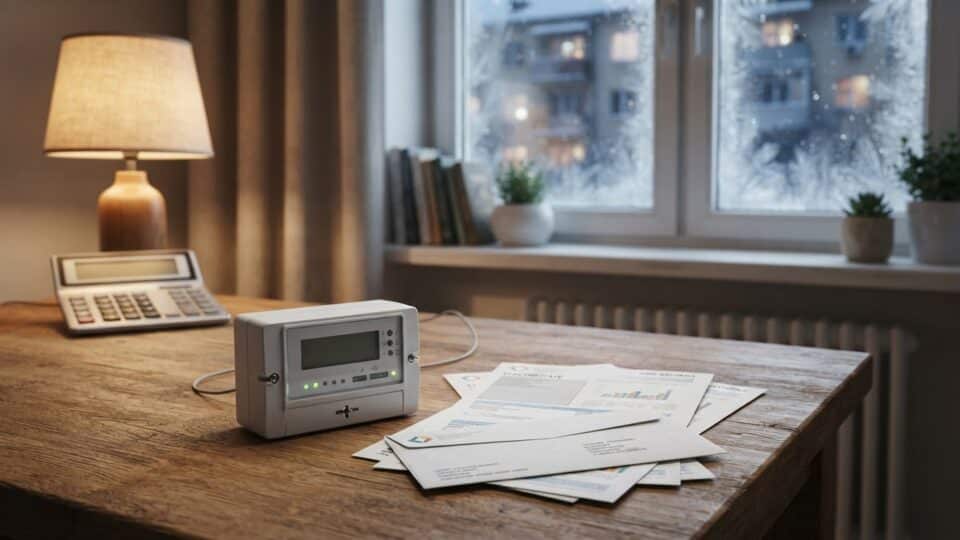
InfoBuz editorial analysis, documented on 29 November 2026. The detailed figures come from official annexes to Hidroelectrica’s November offers, not from an actual bill or a commercial recommendation. The offers expire for acceptance on 30 November; check for updates before entering into a contract. Some secondary comparison tools show slightly different final estimates, so we gave priority to the offer documents. The simulations are illustrative and do not constitute a forecast of 2027 charges. The main image was generated with artificial intelligence.
For homes where heating controls can affect consumption, see our comparison of smart and traditional thermostats.
For context on appliance energy efficiency, see our analysis of market surveillance of energy-consuming appliances.
For context on consumption measurement and grid digitalisation, see our analysis of the role of smart meters in energy security.


Discuția cititorilor
Ai o opinie sau o întrebare despre acest articol? Spune-ne ce crezi.
Fii primul care deschide discuția.
Te rugăm să păstrezi un limbaj civilizat și să discuți la subiect. Comentariile spam sunt filtrate automat.